Meta Muse (2026): What Meta's Personal AI Agent Does, What It Costs and What It Changes for Small Businesses
Meta Muse, announced 8 September 2026, sends emails, books, negotiates and pays on a person's behalf from the Muse app or WhatsApp. The verified facts and prices from Meta's own pages, what the agent can execute today, its US-only limits and the four things a customer's agent will ask your business for.
Last verified: 9 September 2026 · Prem Patel, Nex Automations
Meta Muse (2026): What Meta's Personal AI Agent Does, What It Costs and What It Changes for Small Businesses
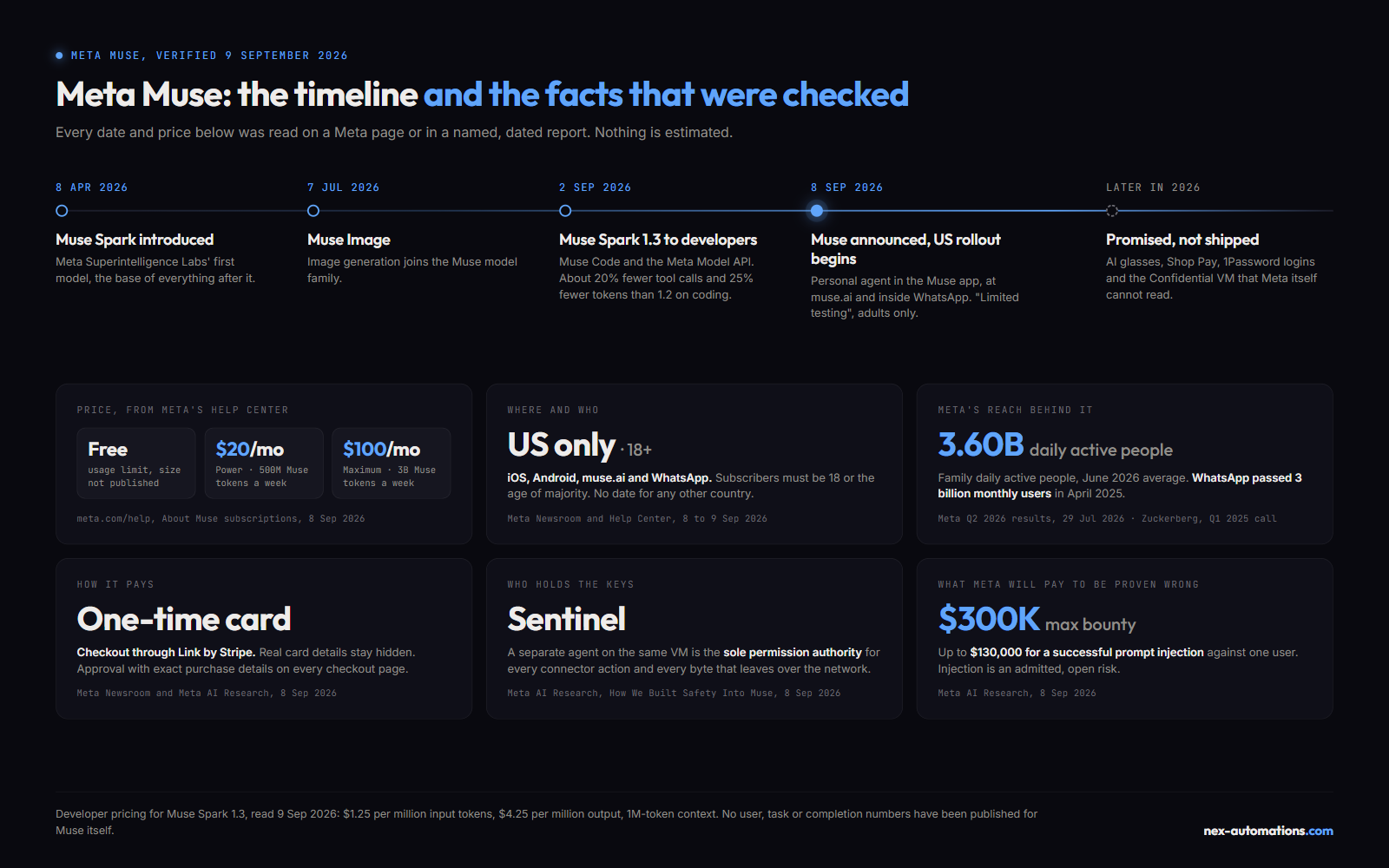
Meta Muse is a personal AI agent that Meta announced on 8 September 2026 and is rolling out to adults in the United States. It sends emails, books travel, fills in forms, negotiates and pays on a person's behalf from a chat in the Muse app or inside WhatsApp, running Meta's Muse Spark 1.3 model on a dedicated cloud virtual machine. It is free with a usage limit, with Power ($20 a month) and Maximum ($100 a month) plans, and every figure on this page was read on a Meta page or in a named, dated report on 9 September 2026.
Why a business should care: Muse lives inside WhatsApp, and when a customer's agent can book, request a quote, check an order and pay a bill on that customer's behalf, the business on the other end needs a system that answers in seconds.
Muse at a glance: the verified facts
| Fact | Value | Date | Source |
|---|---|---|---|
| What it is | A personal AI agent that "doesn't just answer questions, it actually does the work" | 8 Sep 2026 | Meta Newsroom |
| Where it runs | Muse app on iOS and Android, muse.ai on the web, inside WhatsApp. AI glasses "coming soon" | 8 Sep 2026 | Meta Newsroom |
| Availability | United States only, "limited testing" | 9 Sep 2026 | Meta Help Center |
| Age | 18 or the age of majority to subscribe. AP reports the agent is for people 18 and over | 8 Sep 2026 | Meta Help Center, AP |
| Price | Free with a usage limit. Power $20 a month, 500M Muse tokens a week. Maximum $100 a month, 3B Muse tokens a week | 8 Sep 2026 | Meta Help Center |
| Model | Muse Spark 1.3, released 2 September 2026, "Meta's most capable model to date" | 2 Sep 2026 | Meta AI Research, Meta Newsroom |
| Developer price | $1.25 per million input tokens, $4.25 per million output. Contributor tier $0.10 and $0.20 for training rights. 1M-token context | 9 Sep 2026 | Meta for Developers |
| Payments | Link by Stripe with a one-time-use card. Shop Pay and 1Password "coming soon" | 8 Sep 2026 | Meta Newsroom |
| Security model | One Muse Secure VM per person, a separate Sentinel agent approves every network action, Confidential VM "later this year" | 8 Sep 2026 | Meta Newsroom, Meta AI Research |
| Bug bounty | Up to $300,000 per report, up to $130,000 for a successful prompt injection | 8 Sep 2026 | Meta AI Research |
| Meta's reach | 3.60 billion family daily active people, June 2026 average. WhatsApp passed 3 billion monthly users in April 2025 | 29 Jul 2026, 30 Apr 2025 | Meta Q2 2026 results, Zuckerberg on the Q1 2025 earnings call |
What is Meta Muse, and how is an agent different from an assistant?
An assistant answers inside the chat. An agent leaves the chat, uses the services you have connected and comes back when it needs a decision. Meta's first line says it: Muse "doesn't just answer questions, it actually does the work". It "keeps working after people close the app" and returns "when it needs approval, like before it sends an email or makes a purchase".
Three design facts from Meta's 8 September posts define the product:
- One computer per person. Each Muse runs on its own Muse Secure VM, "a dedicated, virtual machine that houses both the agent and a person's data", with its own browser, and Meta says Muse "has no visibility into people's passwords or payment methods".
- A second agent holds the keys. A separate Sentinel agent on the same machine is "the sole permission authority" for connector actions and network traffic. Muse proposes; Sentinel allows, blocks or asks the person, with scoped approvals and a full audit trail.
- The browser is deliberately limited. The sub-agent driving the browser sees an accessibility-tree snapshot, not the raw DOM, and "has no ability to run javascript in the page context". Muse uses a website the way a careful person with a screen reader does, and that decides most of the readiness work below.
We drew the agent-versus-automation line in AI Agent vs Automation. Muse is firmly an agent: it plans, it acts across services and its hardest engineering went into deciding when to stop and ask.
What can Muse actually execute today?
From Meta's announcement, its safety post and the launch interviews with Axios, CNBC, Bloomberg and the Associated Press:
- Messages and bookings. Send an email, book travel, fill in forms, schedule appointments. Meta's examples via Bloomberg are movie tickets, a tennis lesson and a school permission slip.
- Negotiation. Meta's own examples: "selling a car for more" and "lowering a bill".
- Purchases. Checkout through Link by Stripe, which issues a one-time-use card. On any site with a payment method on file, the browser detects the checkout page and asks for approval "with the exact details of the purchase every time".
- The person's Meta life. A recipe reel saved on Instagram becomes a grocery list, and the app shows a feed from connected Facebook and Instagram accounts. The WhatsApp version has the same core conversation but no feed and no ideas tool, Meta AI chief Alexandr Wang told CNBC.
- Long-running goals. A yearlong exercise plan or setting up a new business, per AP. Monitoring home security camera feeds, per CNBC.
- Connectors at launch. Email, calendar, Instagram, Facebook and, in Meta's words, "your car or your home", each with separate read and write permissions.
No Meta page gives a number for users, tasks completed or success rate. The only published performance numbers are for the model, covered below.
Why does Muse matter more than the other agent launches?
Distribution. Meta reported 3.60 billion family daily active people for June 2026, and Zuckerberg said on the Q1 2025 earnings call that WhatsApp had passed 3 billion monthly users. No other agent vendor is one WhatsApp message away from that many people. Ben Thompson's verdict on Stratechery on 9 September: Muse "has the potential to be the exact opposite" of impressive but irrelevant.
The business model. Axios reports no advertising inside Muse. Wang told Axios that "for the vast majority of users, they should be able to do what they need to within the free tier" and that subscriptions "help us cover the compute costs", and told CNBC that Meta is exploring "taking a cut of AI agent-related shopping transactions". If Meta earns when the agent completes a purchase or a booking, its incentive is to steer agents toward businesses the agent can transact with cleanly.
Who pays for the compute. CNBC quotes Zuckerberg on the July 2026 earnings call: "new personal agents that will be the foundation for our next wave of products and revenue lines in the months and years ahead." The honest data says cost is the agent failure mode: Gartner predicted on 25 June 2025 that over 40% of agentic AI projects will be cancelled by the end of 2027, and said on 17 August 2026 that inference cost per agentic workflow will rise more than fivefold through 2028. Muse puts that cost on Meta. The business side is yours, and it is the smaller, better-understood half.
Whether people will pay is open. Forrester polled 455 weekly Meta-app users on 27 to 28 January 2026, before Muse existed: 47% wanted none of eight proposed premium features, 10% valued "AI agent workflow assistance" and about 15% said they would likely subscribe. Unweighted and hypothetical, so a mood reading. TechCrunch's launch piece asks the trust question outright, and CNBC notes the launch comes weeks after Meta agreed to pay nearly $17 billion to settle claims by state attorneys general. The wider payer funnel is in The AI Automation Reality Report 2026.
What changes for a small business when customers have agents?
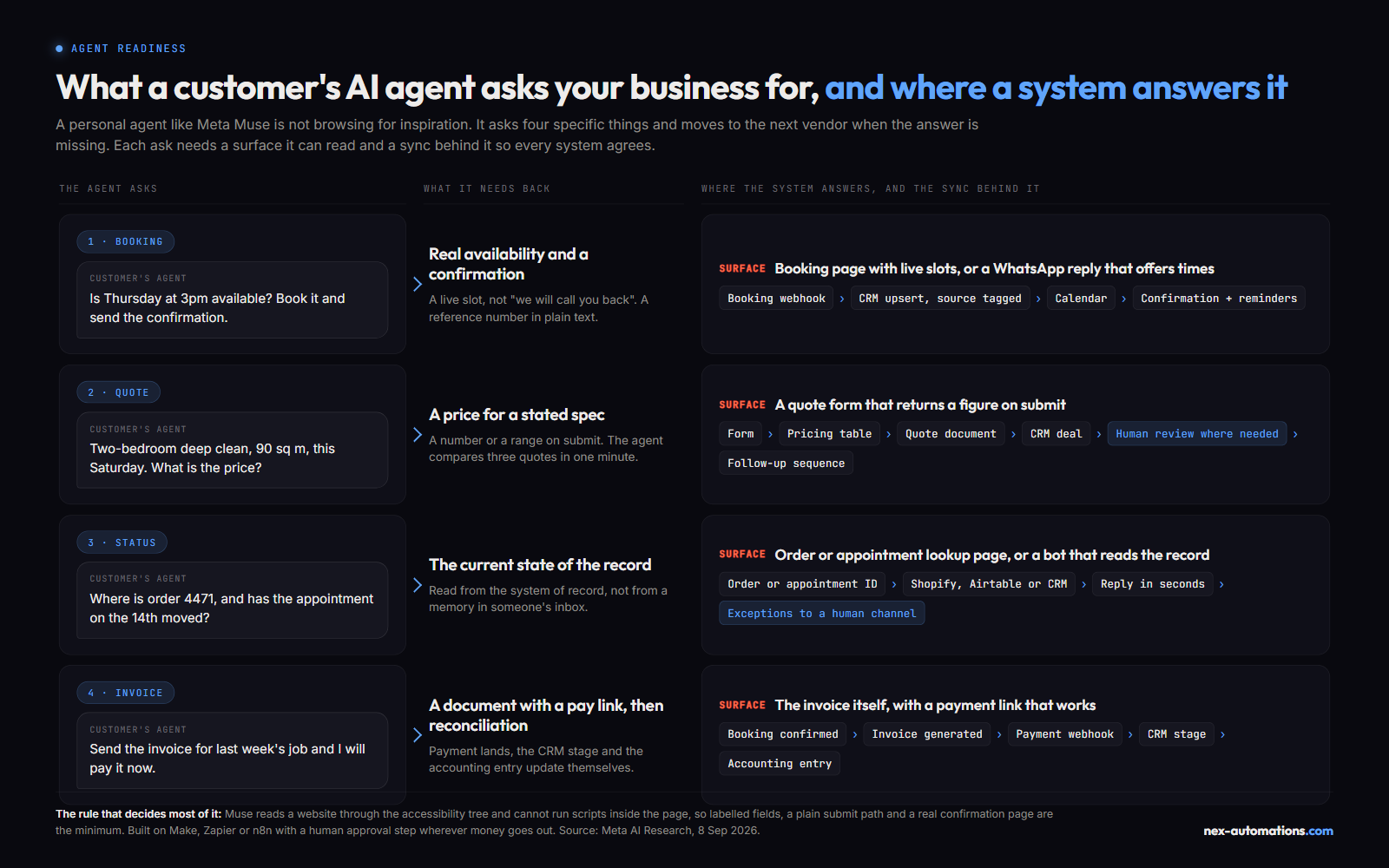
An agent does not browse. It transacts. Strip away the demos and a customer's agent asks a business for four things: a booking, a quote, a status and an invoice. Each is one machine asking another.
Three consequences follow, none of which need Muse to be good yet.
Speed becomes a filter. An agent asks a specific question and, when the answer is missing, tries the next vendor. Yelp's own figure, quoted in our Yelp lead automation guide, is that businesses replying within a day see about four times more requests, and that was humans replying to humans. An agent working a shortlist will not wait a day.
Blocking agents is a choice with a price. Axios notes that the restaurant platform Resy has said it will delete accounts of people using automated agents. A business can take that stance, knowing it is choosing to lose the customers whose agents were sent to book.
Integration is the bottleneck, and it is measured. MuleSoft's 2026 Connectivity Benchmark (1,050 IT leaders, February 2026) found only 27% of enterprise applications connected, and 86% said that without proper integration agents add complexity rather than value. The small-business version: the booking tool, CRM, invoicing app and inbox do not talk to each other, so any answer an agent gets from one is stale in the other three.
How does a business get ready? The four asks, mapped to systems we ship
This is the map we build to on Make, Zapier or n8n, with the shipped example behind each row.
| The agent asks for | What it needs back | The surface | The sync behind it | Shipped example |
|---|---|---|---|---|
| A booking | Real availability and a confirmation | Booking page with live slots, or a WhatsApp reply that offers times | Booking webhook to CRM record with the source tagged, then calendar, confirmation and reminders | Yelp AI lead agent: leads answered in minutes, AI-drafted, human-approved |
| A quote | A price for a stated spec | A form that returns a number or a range on submit | Form to pricing table to quote document to CRM deal to follow-up sequence | Our own fit-check, which captures intent and budget as structured fields |
| A status | The current state of an order or appointment | A lookup page, or a bot that reads the record | ID to the system of record, exceptions to a human channel | TradingView to Telegram alerts: under 2 seconds from event to message |
| An invoice | A document with a working pay link | The invoice itself | Booking confirmed to invoice to payment webhook to CRM stage and accounting entry | Transportation invoice automation: cycle cut from 30 days to 7 |
Three rules fall out of Muse's browser design:
- Forms must work as forms. Muse cannot run scripts in your page. Label every field, keep the submit path plain, return a confirmation page with the reference number in text.
- Answer in seconds, decide by a human where it matters. The Yelp lead desk drafts in seconds and waits for a human tap before anything is sent, so the agent gets a specific answer inside its patience window and nothing goes out unapproved.
- Tune bot filters, do not just tighten them. A customer's agent looks a lot like a bot. Honeypots catch scripts that fill hidden fields, which an accessibility-tree agent never sees, and rate limits should be per session, not per office IP.
Our own site works this way: the chatbot answers through an n8n workflow in seconds, and the fit-check writes to a Notion database with a human reply within 24 hours. Instant, structured, then a person.
If you want that decision made per workflow before anything is built, that is the automation audit: a written map of which asks your business can already answer and a fixed-fee plan to close the gap.
What Muse cannot do yet, and the questions still open
- US only, 18 and over, "limited testing". Meta's Help Center says Muse is not "available in all locations yet". No date for any other country, including India.
- The free allowance is not published. Paid plans raise the weekly token allowance. The free limit is unstated.
- It asks before it acts. Email and purchases need approval by default. Executives told Axios they know that asking too often makes people approve reflexively, so lower-risk, previously authorised tasks proceed. Whether that balance holds is the central unknown.
- Much is "coming soon". AI glasses, Shop Pay, 1Password support and the Muse Confidential VM that would stop Meta itself reading the VM are all promised for later in 2026.
- Training is on unless you turn it off. Users must opt out, and Meta scrubs "critical personally identifying information" first, David Singleton, Meta vice president of engineering, told CNBC.
- Ads are separated, browsing is not invisible. Muse does not share conversations with Meta's ad systems, but when it browses "it will appear as your activity", so a merchant it visits for you can retarget you.
- Prompt injection is an admitted risk. Meta trains against it, tags external content as untrusted and pays up to $130,000 per successful attack. Nobody calls it solved.
- No product metrics. Judge Muse on what it does in your inbox, not on the model's benchmarks.
What is Muse Spark 1.3, and what does it cost developers?
Muse Spark 1.3 is the model under Muse, released to developers on 2 September 2026 through Muse Code and the Meta Model API. Meta says it is trained to "sustain longer-horizon work", ask clarifying questions, confirm "before taking consequential actions" and judge "what constitutes irreversible actions". Against Muse Spark 1.2 in Meta's own comparisons it used about 20% fewer tool calls and 25% fewer tokens on coding.
VentureBeat's 3 September analysis reported Terminal-Bench 2.1 rising from 82.9% to 89.2% in the shipping configuration, and the budget point that matters: per-token prices did not change, yet the measured cost of completing an average task rose, because the model does more per task. VentureBeat also reported the "max reasoning" configuration still in limited preview on 3 September; Meta's release page, read on 9 September, says it is now available.
Developer pricing, read 9 September 2026: $1.25 per million input tokens and $4.25 per million output, a Contributor tier at $0.10 and $0.20 for developers who grant training rights, and a 1M-token context window. Where a model like this sits inside an automation platform is covered in Best iPaaS Platforms for AI Agents in 2026.
Frequently Asked Questions
What is Meta Muse?
Meta Muse is a personal AI agent announced by Meta on 8 September 2026. Unlike a chat assistant it takes actions: it sends emails, books travel, fills in forms, negotiates and makes purchases on a person's behalf, and it keeps working after the app is closed. Each Muse runs on its own Muse Secure VM in Meta's cloud, with a separate Sentinel agent approving anything it sends to the internet, and is reached through the Muse app, muse.ai or WhatsApp.
How much does Meta Muse cost?
Per Meta's Help Center on 8 September 2026, Muse is free with a usage limit, and two subscriptions raise the weekly allowance: Power at $20 a month for 500M Muse tokens a week and Maximum at $100 a month for 3B Muse tokens a week. Meta AI chief Alexandr Wang told Axios that most users should manage on the free tier, whose size is not published.
Is Meta Muse available in India or outside the United States?
No. As of 9 September 2026 Muse is rolling out in the United States only, on iOS, Android and muse.ai, in what Meta's Help Center calls limited testing. No date has been announced for other countries, and subscribers must be 18 or the age of majority.
Can Meta Muse buy things and send messages on my behalf?
Yes, with approval. Muse checks out through Link by Stripe using a one-time-use card number and prompts for approval with the exact purchase details on any checkout page. Sending an email and making a purchase require confirmation by default, and permissions can be scoped to a single task, transaction or period of time.
What is Muse Spark 1.3, and how is it different from Muse?
Muse Spark 1.3 is the model; Muse is the agent built on it. Meta released Muse Spark 1.3 to developers on 2 September 2026 through Muse Code and the Meta Model API, with about 20% fewer tool calls and 25% fewer tokens than version 1.2 on coding tasks. Developer pricing is $1.25 per million input tokens and $4.25 per million output, with a 1M-token context window.
How should a small business prepare for customers who use AI agents?
Make the four things an agent asks for answerable by a machine in seconds: a booking with real availability and a confirmation, a quote that returns a price for a stated spec, an order or appointment status and an invoice with a working pay link. Keep the CRM, calendar, invoicing and inbox in sync on Make, Zapier or n8n with a human approval step wherever money goes out. Keep forms plain and labelled, because Muse reads pages through the accessibility tree and cannot run page scripts.
Sources
All read on 9 September 2026.
- Meta Newsroom, "Introducing Muse: The World's First Personal AI Agent Built for Everyone", 8 September 2026: about.fb.com
- Meta AI Research, "How We Built Safety Into Muse", Tarek Sheasha, 8 September 2026: research.meta.ai
- Meta Help Center, "About Muse subscriptions", updated 8 September 2026: meta.com/help
- Meta AI Research, "Introducing Muse Spark 1.3", 2 September 2026: research.meta.ai
- Meta for Developers, Muse Spark model page with pricing, read 9 September 2026: developer.meta.com
- Meta, "Meta Reports Second Quarter 2026 Results", 29 July 2026, family daily active people 3.60 billion for June 2026: investor.atmeta.com
- TechCrunch, "WhatsApp now has more than 3 billion users a month", Ivan Mehta, 1 May 2025, reporting Zuckerberg on the Q1 2025 earnings call: techcrunch.com
- Axios, "Meta debuts Muse, its long-planned personal AI agent", Ina Fried, 8 September 2026: axios.com
- CNBC, "Meta pushes into personal AI agents as company faces public reckoning over privacy and safety", Jonathan Vanian, 8 September 2026: cnbc.com
- TechCrunch, "Meta debuts its Muse AI agent. Will consumers trust it?", Sarah Perez, 8 September 2026: techcrunch.com
- Bloomberg, "Meta Debuts Muse AI Assistant for Personal Tasks and Organization", Riley Griffin, 8 September 2026: bloomberg.com
- Associated Press via PBS NewsHour, "Meta launches personal AI agent, Muse, to help with everyday tasks", Barbara Ortutay, 8 September 2026: pbs.org
- Stratechery, "OpenAI Does Math, Reward-Hacking, Meta Launches Personal Agent", Ben Thompson, 9 September 2026, subscriber article with the opening line public: stratechery.com
- VentureBeat, "Meta says Muse Spark 1.3 has frontier performance", Carl Franzen, 3 September 2026: venturebeat.com
- Forrester, "Premium Meta? A Small Yes, A Loud No", Mike Proulx, 28 January 2026, n=455, unweighted: forrester.com
- Gartner press releases, 25 June 2025 (over 40% of agentic AI projects cancelled by end of 2027) and 17 August 2026 (inference cost per agentic workflow up more than fivefold through 2028): gartner.com/en/newsroom
- MuleSoft, 2026 Connectivity Benchmark Report, 1,050 IT leaders, February 2026 (27% of applications connected, 86% on integration and agents): mulesoft.com
Related guides
- AI Agent vs Automation: Which Does Your Business Need?
- 12 AI Agent Use Cases That Actually Work in Business (2026)
- Best iPaaS Platforms for AI Agents in 2026
- How Much Does an AI Agent Cost to Build in 2026?
About the author: Prem Patel is the founder of Nex Automations, an automation studio based in Ahmedabad, India. He has built 1,200+ automations for 210+ clients on Make.com, Zapier and n8n, including lead-response agents that answer in minutes with a human approval step. He is a Make.com Level 5 Expert and Make Silver Solution Partner and a Zapier Solution Partner. Corrections to any figure on this page are welcome and will be dated.
Want this built this week?
Tell us the apps and the process. Single automations ship in 3 to 7 days with error handling, alerting and a handover walkthrough.
Nex Automations is an automation studio led by Prem Patel, a Make.com Level 5 Expert, Make Silver Solution Partner and Zapier Solution Partner, based in Ahmedabad and working globally. 1,200+ automations built for 210+ clients across 8+ industries in 12+ countries.
- Have it builtThe fit-check takes two minutes. Prem reads every one and replies within 24 hours.
- Automation systems we buildSixteen system types across lead automation, order operations, AI agents, reporting and payments.
- Book a free consult30 minutes to scope the process you want automated.
More from Nex Automations
- ServicesWhat we build and who it is for.
- Case studiesProduction systems with real numbers.
- Automation libraryGuides, insights and mini builds.
- About Prem PatelCredentials, background and how we work.
- ContactBook a call or reach us on any channel.