If your process follows the same steps every time, you need an automation. If it requires reading, categorising or deciding on messy input, you need an AI agent. And in most real businesses the right answer is a hybrid: automation moves the data, AI judges the exceptions and a human approves the edge cases. That is the short version. The rest of this guide gives you the decision framework I use with clients after 1,200+ builds, so you stop paying agent prices for automation problems.
I'm Prem Patel, Make Level 5 Expert and Zapier Certified. I sell both agents and automations, so I have no reason to push you toward the expensive one.
The one-line test
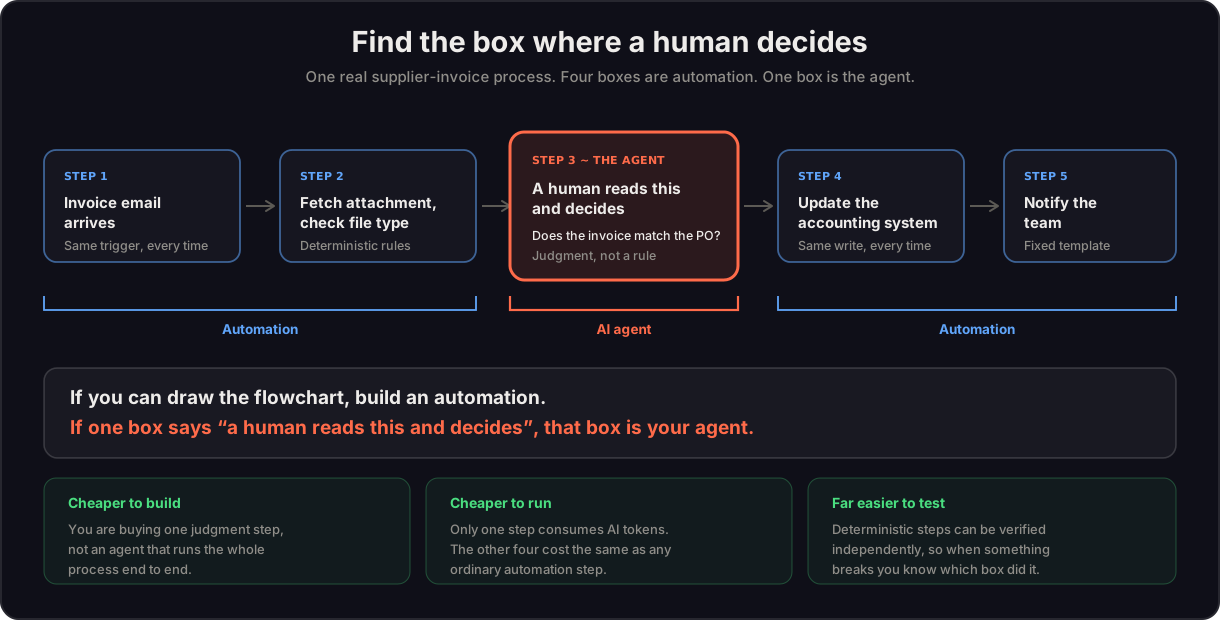
If you can draw the flowchart, build an automation. If one box in the flowchart says "a human reads this and decides", that box is your agent.
That single rule resolves 90% of the confusion. Everything below is detail.
Agent vs automation: the decision table
| Question | Automation | AI agent |
|---|---|---|
| Are the steps identical every time? | Yes | No, they depend on content |
| Is the input structured (forms, IDs, fields)? | Yes | No, it's text, images or documents |
| Can a wrong output be caught cheaply? | Either | Needs validation + human fallback |
| Do you need sub-second speed? | Yes, automation wins | Agents add latency |
| Does the task need reading or judgment? | No | Yes |
| Build cost | $300 to $1,500 | $1,500 to $5,000+ |
| Running cost | Near zero per run | AI tokens per judgment call |
| Testing difficulty | Low, deterministic | Higher, outputs vary |
Cost bands match the AI agent pricing guide and the Make.com automation cost breakdown.
What an automation does better
Automations are deterministic. Same input, same output, every time. That makes them cheaper to build, nearly free to run and easy to test. For anything where speed or reliability is the product, determinism wins.
Real example: my TradingView alert pipeline delivers branded trading alerts to Telegram in under 2 seconds. There is zero AI in the hot path, on purpose. An LLM call would add seconds of latency and a failure mode to a system where late equals worthless.
If your process sounds like "when X happens, do Y then Z", you are describing an automation. Paying for an agent here means paying tokens to rediscover a flowchart you could have drawn yourself.
What an AI agent does better
Agents handle the inputs you cannot predict. Unstructured email. Vendor notes with photos. Invoices where line items shift format. A rules-based system breaks on the first phrasing it has never seen, and the maintenance cost of adding rule after rule quietly exceeds the agent's price.
Real example: the vendor catalog system reads messy Telegram messages with product photos and produces clean Shopify listings. No rule set survives that input. Vision plus a language model handles it every day.
If your process sounds like "someone reads this and figures out what it is", you are describing an agent.
The hybrid: what most businesses actually need
The systems that survive production are rarely pure. The winning pattern after hundreds of these builds:
- Automation moves the data. Triggers, transfers, notifications, records. Deterministic and near free.
- AI judges only where judgment is needed. One step in the flow, not the whole flow. Categorise, extract, validate, draft.
- Humans get the exceptions. Confidence too low, edge case detected, money above a threshold. Route it to a person with context.
My transportation invoice system is exactly this: Make moves invoices through the pipeline, Claude validates line items against trip logs and staff approve only the flagged cases. Processing dropped from 30-plus days to 7. The AI touches maybe a fifth of the volume. That is why it is accurate and cheap to run.
Design the hybrid first. Pure agents and pure automations are both usually a sign the problem was not scoped.
The two expensive mistakes
Buying an agent for an automation problem. You pay 3x the build cost, add latency and take on non-deterministic failure modes for a task a router handles. This is the most common overspend I see in briefs.
Forcing rules onto a judgment problem. The rule set grows every week, someone maintains it forever and customers still hit the gaps. If you have rewritten the same filter logic three times, stop. That is the signal.
How to decide in 10 minutes
Write down one process. Then answer three questions: How many items a month? Are inputs structured or messy? What does one error cost? High volume plus messy input plus tolerable error cost is agent territory. Structured input or zero error tolerance points to automation with human review. Bring those three answers to any builder and you will get an accurate quote instead of a guess.
Not sure which side your process lands on? That is literally what my free 30-minute call is for: we map the process and I tell you which to build, even if the answer is the cheaper one. Book a free consult or check the fit first.
The same process, solved both ways
Take supplier invoices arriving by email. Here is what each answer actually looks like in practice.
Built as a pure automation. You write rules: if the sender is in this list, extract the total from this position in the PDF, match it to a purchase order by reference number, then post it. This works beautifully for the suppliers whose invoice layout never changes, and fails the first time one of them redesigns their template or a reference number is typed with a space in it. Every new supplier is a new rule, so the maintenance burden grows with the business.
Built as a pure agent. You hand the whole process to a model and let it read, decide and post. It handles new layouts on day one without a code change. It also occasionally posts something wrong with complete confidence, and because there are no deterministic checkpoints around it, you find out at month end.
Built the way we actually build it. Deterministic steps do the fetching, the file handling, the posting and the notifying. One agent step reads the document and decides whether it matches the purchase order, with a confidence threshold that routes anything uncertain to a person. New supplier layouts are handled without a code change, and the posting step is still a plain, testable write that either succeeded or did not.
The third option costs less to run than the second, because only one step spends tokens, and less to maintain than the first, because layout changes stop being your problem. That is the whole argument for the hybrid, and it is why the question is rarely agent or automation.
Frequently asked questions
Is an AI agent better than an automation?
Neither is better. They solve different problems. Automations win on speed, cost and reliability for fixed sequences. Agents win on messy input that needs reading or judgment. Most production systems combine both: automation for the flow, AI for the judgment steps, humans for exceptions.
Can I combine an AI agent with an automation?
Yes, and you usually should. The standard pattern is an automation pipeline with one or two AI steps where judgment is needed, plus a human fallback for low-confidence cases. It costs less to run than a full agent and fails more safely.
What is cheaper: an AI agent or an automation?
Automation, in both build and running cost. A serious automation runs $300 to $1,500 to build with near-zero per-run cost. A single-purpose agent runs $1,500 to $5,000 plus AI tokens per judgment call. Only pay agent prices when the input genuinely needs judgment.
How do I know if my process needs an agent?
Try to draw it as a flowchart. If every branch is a clear condition, build an automation. If any box requires reading, interpreting or deciding on unpredictable content, that box needs an agent. The 12 production use cases guide shows where agents consistently earn their cost.