 Make.com
 OpenAI
 Telegram
 Airtable
 Shopify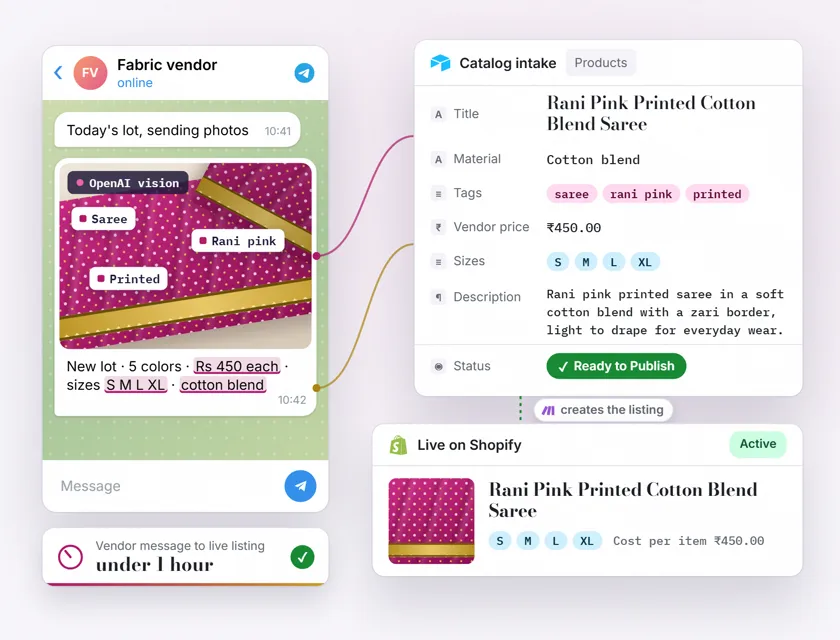
The Situation
A fashion e-commerce brand based in Surat, India sells products to customers in the UK and USA. Their supply chain runs through local vendors who send product images, sizes and prices via Telegram. The team was spending 10+ hours per week manually copying this information into spreadsheets, writing product descriptions, formatting tags and listing items on Shopify one by one.
The bottleneck was not sourcing. It was data entry. Every new product required a team member to look at a Telegram message, extract the details, write a title and description, assign tags, format sizes and upload images to Shopify. At 20-30 products per day, this process consumed the majority of one person's workday.
"Prem's approach didn't just save time, it leveled up my entire product catalog effortlessly." Archana, Founder
The 3 Problems
- Vendor data arrived unstructured. Images, prices and sizes came as Telegram messages with no consistent format. One vendor sends a photo with text overlay. Another sends a voice note. Another sends a spreadsheet screenshot.
- Product descriptions were inconsistent. Each team member wrote titles and descriptions differently. SEO quality varied. Tags were frequently missing or wrong.
- Manual listing consumed the entire workday. At 20-30 products per day, one full-time person was doing nothing but data entry into Shopify.
What Was Built
An AI-powered product intake pipeline that transforms unstructured vendor messages into structured, SEO-optimized Shopify listings with zero manual data entry.
How it flows:
- Vendor sends product image + details on Telegram
- Make.com Telegram bot captures the message
- An OpenAI vision model analyzes the image: extracts product type, color, pattern, material
- The same model processes the text: extracts sizes, prices, SKU patterns
- AI generates an SEO-optimized product title and description
- Structured data is stored in Airtable with all fields mapped
- When marked "Ready to Publish," Make.com creates the Shopify product listing automatically
Tools used:
- Make.com - orchestration and Telegram integration
- OpenAI vision model - image analysis and product data extraction
- Airtable - structured product database and review workflow
- Shopify - product listing creation via API
- Telegram - vendor communication channel
The AI Layer: How the Vision Model Works Here
The vision step is one Make.com module, so it moves to whichever OpenAI model is current as older models are retired. The extraction prompt and the Airtable field mapping stay the same.
This is not a simple text extraction. The system handles genuinely messy input.
Image analysis: A vendor sends a photo of a saree with a price tag visible. The vision model identifies the product category (saree), the primary color, the fabric pattern (printed, embroidered, plain), estimates the material type and reads any visible text including price tags and measurement labels.
Text extraction: The accompanying Telegram message might say "New lot - 5 colors - Rs 450 each - sizes S M L XL - cotton blend." The model parses this into structured fields: price per unit, available sizes as an array, material type, quantity of variants.
Description generation: Based on the extracted data, the AI writes a product title and description optimized for Shopify SEO. The descriptions are consistent in tone, include relevant keywords and follow the brand's style guide configured in the system prompt.
Error handling: If the image is blurry, the message is unclear or required fields are missing, the system flags the product for human review in Airtable rather than listing it with incomplete data.
The Results
| Metric | Before | After | Change |
|---|---|---|---|
| Manual data entry per product | 15-20 minutes | 0 minutes | Eliminated |
| Weekly hours on cataloging | 10+ hours | < 1 hour (review only) | down 90% |
| Product description quality | Inconsistent | SEO-optimized, consistent | Standardized |
| Listing errors (missing tags, wrong prices) | Frequent | < 1% | Near-zero |
| Time from vendor message to live listing | 1-2 days | Under 1 hour | down 95% |
The Insight
The real value of this system is not speed. It is consistency. When a human writes 30 product descriptions per day, quality degrades by description 15. Titles get shorter. Tags get forgotten. SEO keywords disappear. The AI maintains the same quality standard on product 1 and product 300.
The other insight: Telegram as a data source is underestimated. For markets where vendor relationships run through chat (common in India, Southeast Asia and parts of the Middle East), building a structured pipeline from chat messages is more practical than asking vendors to use a portal they will never adopt.
FAQ
Q: Can AI extract product data from Telegram images? A: Yes. An OpenAI vision model analyzes product images to identify category, color, material, pattern and any visible text including price tags. Combined with the message text, it produces structured product data ready for Shopify listing.
Q: How accurate is AI-generated product data from vendor messages? A: In this system, accuracy exceeds 99% for structured fields (price, sizes, category). The system flags uncertain extractions for human review rather than listing incomplete products.
Q: Can this work with WhatsApp instead of Telegram? A: Yes. The same architecture works with WhatsApp Business API via Make.com. Telegram is used here because the vendor ecosystem operates on Telegram. The AI extraction and Shopify listing logic is channel-agnostic.
Q: How does the AI handle inconsistent vendor message formats? A: The extraction prompt is designed to handle variability. It processes photos with text overlays, standalone images, text-only messages and combinations. When format is genuinely unreadable, the product is flagged for manual review.
If your team is spending hours on product data entry from vendor messages, book a free consult and I will show you exactly how this system works for your specific product type.