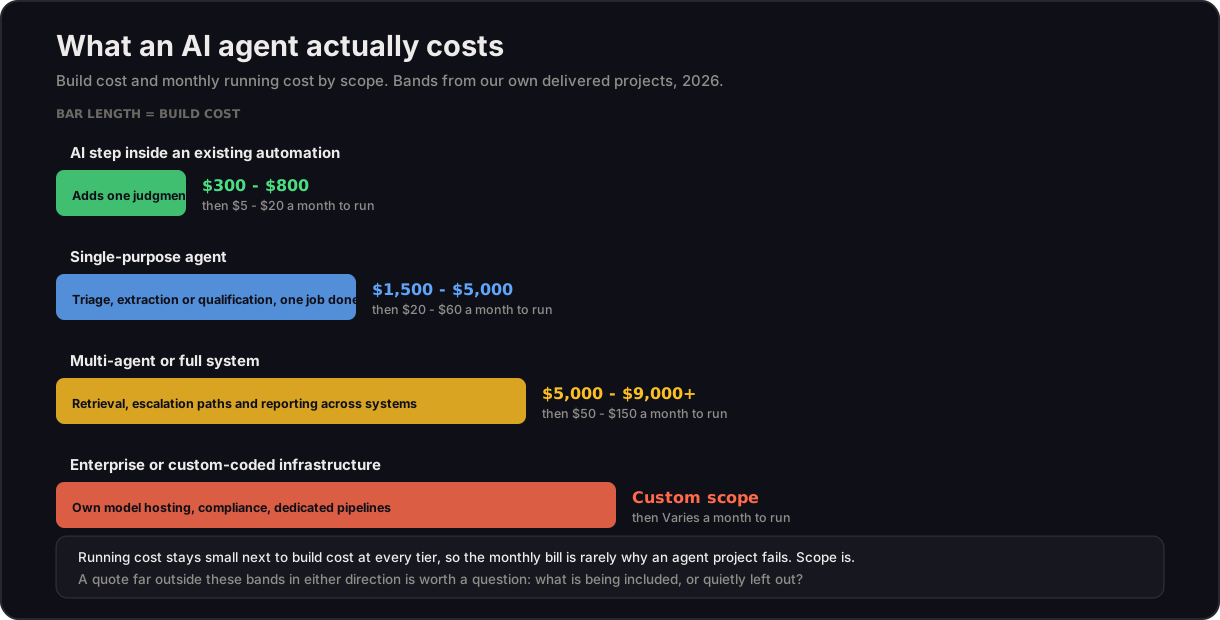
A single-purpose AI agent costs $1,500 to $5,000 to build properly in 2026, a simple AI step inside an existing workflow costs a few hundred dollars, and a full agent system with knowledge retrieval, escalation and reporting starts around $5,000. Running costs are usually tens of dollars a month, not hundreds. Those are the honest numbers after 1,200+ automations for 210+ businesses. The rest of this guide explains what moves you up or down inside those bands.
I'm Prem Patel, Make Level 5 Expert and Zapier Certified. I price and build these systems every week, so this is the same breakdown I give on discovery calls.
TL;DR: AI agent pricing at a glance
| What you're buying | Typical build cost | Monthly running cost |
|---|---|---|
| AI step inside an existing automation | $300 to $800 | $5 to $20 |
| Single-purpose agent (triage, extraction, qualification) | $1,500 to $5,000 | $20 to $60 |
| Multi-agent or full system (RAG, escalation, reporting) | $5,000 to $9,000+ | $50 to $150 |
| Enterprise or custom-coded agent infrastructure | Custom scope | Varies |
These bands line up with the Make.com automation pricing guide I published earlier, because an agent is priced like a serious multi-step automation plus a judgment layer. If a quote is wildly outside these bands in either direction, ask why.
What actually drives the cost up
The number of systems the agent touches. An agent that reads email and writes to one CRM is a week of work. An agent that touches email, CRM, billing, Slack and a knowledge base multiplies the integration and testing surface.
Error handling and validation. This is the real difference between a $500 build and a $3,000 build. Production systems need retry logic, confidence checks, fallback paths and a clean route to a human when the agent is unsure. I covered why validation matters more than extraction in the AI PDF extraction guide.
Edge cases in your data. Clean, consistent inputs are cheap. Vendor messages in three languages with photos, like the product catalog system I built, sit at the top of the band because the messy 10% takes 60% of the build time.
Documentation and handover. Anything I ship comes with docs and a walkthrough so your team owns it. Builders who skip this are cheaper upfront and expensive forever.
What keeps the cost down
Starting with one job. The agents that succeed do one thing with a clear goal. Email triage. Lead qualification. Invoice validation. Scope creep is the number one budget killer, and it usually sneaks in as "while we're at it, can it also...".
Using the platforms you already pay for. Make and n8n both run agents natively now. If your stack already lives there, you skip custom infrastructure entirely. I compared the platforms in Zapier vs Make vs n8n.
Keeping humans on the exceptions. A fully autonomous everything-agent is expensive to build and risky to run. An agent that auto-handles the obvious 80% and routes the rest costs half as much and fails safely.
Build cost vs running cost
Build cost is one-time. Running cost is where people get surprised, in a good way.
A well-designed agent runs on platform credits plus AI tokens. For a triage agent handling 1,000 emails a month, that is typically $20 to $40 total. Costs stay low because the agent only spends tokens on judgment calls. Everything predictable runs as plain automation underneath, which is close to free per execution.
The expensive pattern is the opposite: sending everything through a large model because it was easier to build that way. That is how teams end up with $500 monthly AI bills for work a router and three filters should be doing.
When an AI agent is not worth the money
Skip the agent when a fixed sequence does the job. You do not need judgment to move a form fill into a CRM, send a receipt or post a Slack notification. A plain automation is cheaper to build, cheaper to run and far easier to test. My rule from the 12 agent use cases guide: if you can draw the flowchart, build an automation. If one box needs a human-style decision, that box is your agent.
Also skip it when volume is tiny. An agent that saves 10 minutes a week never pays back its build cost. The math starts working around 30+ judgment calls a day.
How to scope one without wasting a discovery call
Come with three numbers: how many items a month, how many systems involved and what an error costs you. Those three set the band. Whether you build with me or anyone else, a scoped one-pager beats a vague "we want AI" brief and usually cuts the quote, because uncertainty is priced in.
Want a real number for your case? I scope agent builds on a free 30-minute call: use case, platform and a fixed quote. Book a free consult or check the fit first. For fixed-scope builds at listed prices, see the Fiverr gigs.
What a real quote should itemise
A quote that is a single number is not a quote, it is a guess with a price on it. Before you accept one, ask to see these five lines broken out. The exercise is useful even if you never hire anyone, because it forces the scope into the open.
Discovery and scoping. How the current process actually works, where it breaks, and what the agent is allowed to decide on its own. Usually 10 to 20 percent of the total.
Integration work per system. Priced per connected system, not as a lump. Five systems is not one job repeated five times, because each one has its own auth, rate limits and failure modes.
The judgment layer. The prompt design, the confidence thresholds, and the rules for when the agent must stop and ask a human. This is the part that separates a demo from something you can leave running.
Testing against your real data. Not sample data. Your actual messy inputs, including the ones nobody wants to talk about.
Documentation and handover. What happens when it breaks at 6pm and the person who built it is unavailable.
If a builder cannot separate those five, they have not thought about the build yet. And if the judgment layer and the testing line are both missing, the quote is for a prototype, whatever it says on the invoice.
Frequently asked questions
How much does an AI agent cost to build in 2026?
$1,500 to $5,000 for a single-purpose agent built with proper error handling, validation and documentation. Simple AI steps inside an existing workflow run $300 to $800. Full systems with knowledge retrieval, escalation and reporting start around $5,000.
How much does it cost to run an AI agent monthly?
Usually $20 to $60 for a single-purpose agent: platform credits plus AI tokens. Costs stay low when the agent only handles judgment calls and plain automation does the predictable work. Poorly designed agents that route everything through a large model can cost 10x that.
Is it cheaper to build an AI agent myself?
For learning or low-stakes internal tools, yes, Make and n8n make DIY realistic. For anything customer-facing or revenue-touching, the cost of a silent failure usually exceeds the build fee. The honest middle path: build the prototype yourself, then pay for production hardening.
Why do AI agent quotes vary so much between builders?
Because "agent" covers everything from a prompt in a loop to a validated production system. Cheap quotes usually exclude error handling, edge cases, documentation and support. Ask any builder what happens when the agent is wrong. The quality of that answer explains the price.
Do I need an agent or a normal automation?
If the process follows the same steps every time, a normal automation. If it requires reading, categorising or deciding on messy input, an agent layer earns its cost. The 12 use cases guide walks through where each fits.