If you are non-technical and need automation running in fifteen minutes, use Zapier. If you need complex multi-branch workflows at a fraction of the cost, use Make.com. If you are a developer who wants full control and AI agent pipelines without paying per step, use n8n.
For the same workflow, 5,000 runs a month with eight steps each, the list prices on 16 October 2026 are $289 a month on Zapier, $53 on Make.com and €50 on n8n Cloud, on annual billing. Self-hosted n8n runs it for about $12 a month in server cost, before maintenance time.
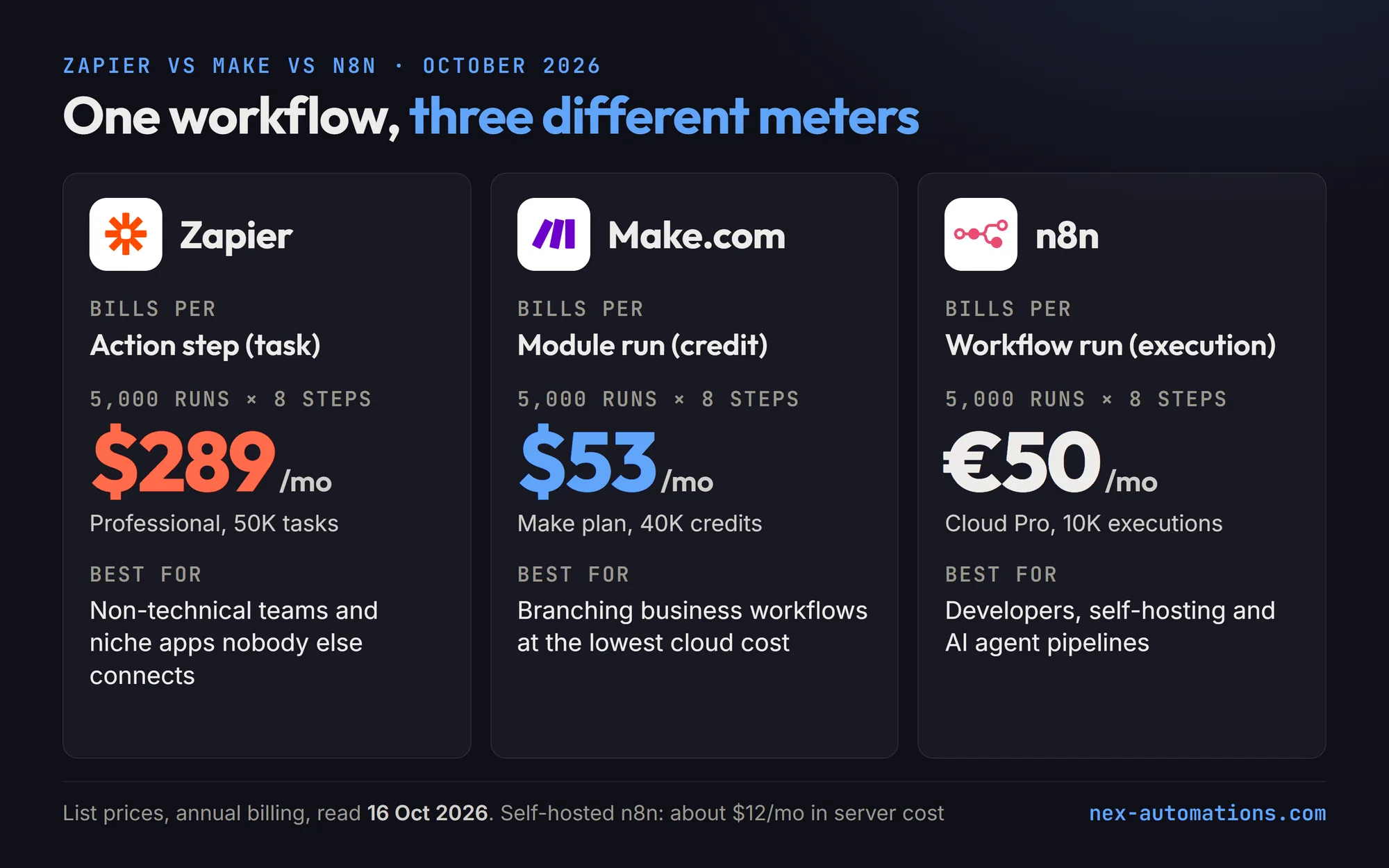
What changed in October 2026: Zapier Agents became AI by Zapier on 6 October: an agent is now an AI step inside a Zap, billed at 1, 3 or 5 tasks a step. Make added scenario version control on 7 October and fallback connections plus prompt caching for its AI Agents on 9 October. n8n published 15 security advisories on 14 October, fixed in 2.43.5. Full dates and sources: automation platform updates for October 2026.
This comparison is written by Prem Patel, founder of Nex Automations, an AI systems studio based in Ahmedabad. He has built 1,200+ automations across 210+ clients on these three platforms. He is a Make.com Level 5 Expert (top 1 percent globally), certified since 2024 and recertified in 2026, and one of roughly 180 Zapier Certified Experts worldwide. Nex Automations is both a Make Silver Partner and a Zapier Silver Solution Partner, and his "Daily Article Producer with an AI editor" won 1st place in Make's Scenario of the Month for September 2026. He runs production n8n on a self-hosted instance for AI-heavy client work.
This is not a feature checklist. Every recommendation comes from real builds: a six-scenario Make invoicing rebuild that cut a transport client's billing cycle from 30 days to 7, a 70 percent speedup on an AI article pipeline built on Make and a sub-two-second stock alert engine for a SEBI-registered trading firm. Prices and features were re-read from each vendor's own pages on 16 October 2026.
Who Should Use Which Platform? The Quick Answer
Most people need a clear answer in 30 seconds. This is the framework that holds across 210+ client engagements.
| You are | Use | Why | Watch out for |
|---|---|---|---|
| Non-technical founder | Zapier | First Zap in 5 to 15 minutes; the largest app directory | Every action step is a billed task |
| Marketing or ops team | Make.com | Routers and error handlers on a visual canvas, 70 to 90 percent below Zapier's price | The first day feels foreign after Zapier |
| Developer or technical team | n8n | Billed per run, not per step; self-hosts; inline code; no AI surcharge | You patch the server: 15 advisories on 14 Oct 2026 |
| Agency building for clients | Make.com, plus n8n for AI | What Nex uses: a canvas clients can follow, low cost per client | Two platforms, two skill sets |
"For 80 percent of the businesses I work with, Make.com is the right choice. I keep n8n in the toolkit for AI agent pipelines and self-hosted compliance work. Zapier wins when a client's stack is already buried in the Zapier ecosystem." Prem Patel, Nex Automations
How Many Apps Does Each Platform Actually Connect To?
Zapier advertises 9,000-plus apps, and its app directory counter read 10,293 on 16 October 2026. Make.com lists 3,500-plus apps on its integrations page, plus an HTTP module for any REST API. n8n lists 2,367 integrations on its integrations page, plus community-published nodes and a Code node for anything else. The headline number is the worst way to choose a platform.
Why Raw App Counts Mislead
Almost every business runs on the same 10 to 20 core apps: HubSpot, Shopify, Slack, Google Workspace, Airtable, Stripe, Notion, ClickUp and one or two CRMs. All three platforms cover these completely.
What changes between platforms is depth per integration. Zapier may list a tool but expose only three triggers and four actions. Make's module set for the same tool often runs 15 to 25 deep. n8n exposes the API behind a typed interface and lets a developer go further with the HTTP Request node.
Where Zapier Wins
Niche vertical tools: industry-specific CRMs, regional accounting software, obscure scheduling apps. Zapier's developer platform has the longest tail. If a client's stack includes a tool nobody outside their industry has heard of, Zapier is the safest bet.
Where Make.com Wins
Depth and HTTP coverage. The Make HTTP module handles OAuth 2.0, custom headers, multipart uploads and binary data better than Zapier's webhook step. Across the 1,200+ automations Nex Automations has shipped, no project has failed because Make lacked a native integration; the HTTP module handles anything with a documented API.
Where n8n Wins
Unlimited custom integrations. The HTTP Request and Code nodes accept arbitrary APIs, arbitrary auth schemes and inline JavaScript or Python. For a developer team integrating an internal microservice that no SaaS vendor will ever support natively, n8n is the sensible choice.
"I have never lost a client project because Make.com lacked an integration. The HTTP module handles every documented API. The same is true for n8n. Zapier wins only when the niche app does not expose a REST API." Prem Patel, Nex Automations
What Does Each Platform Actually Cost? (Real Math, Not Marketing Pages)
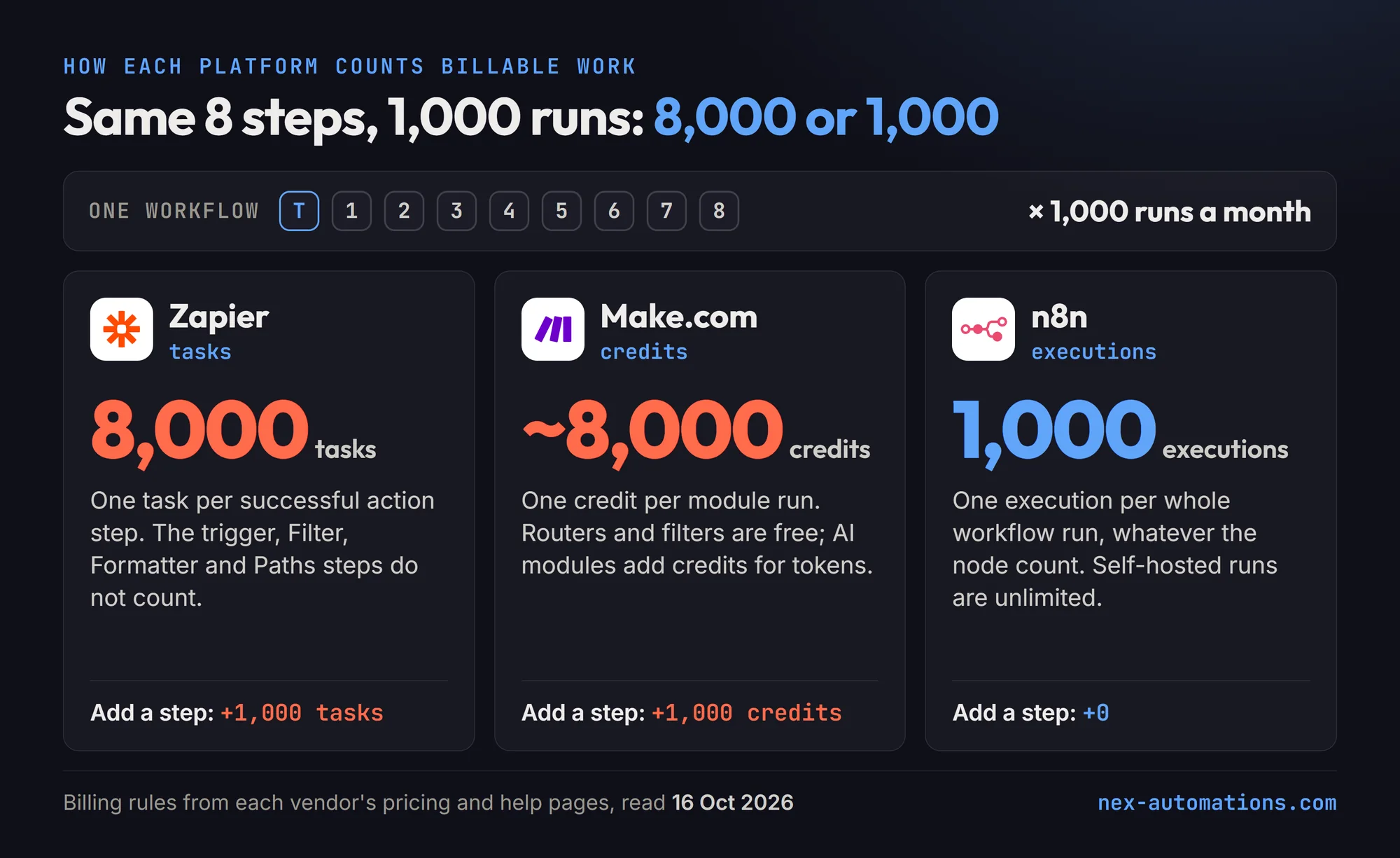
The three platforms meter different things, which is why their bills diverge. Zapier bills every action step as a task, Make bills every module run as a credit and n8n bills each whole workflow run as one execution. A long workflow that runs rarely is cheapest on n8n; a short one that runs often is cheapest on Make.
How Each Platform Counts Work
Zapier counts tasks. One task is one successful action step, so a five-step Zap that runs 1,000 times uses 5,000 tasks. The trigger and the built-in Filter, Formatter and Paths steps do not count. Each Zapier MCP tool call uses two tasks, and an AI by Zapier step uses 1, 3 or 5 tasks depending on the model tier.
Make.com counts credits. Make switched from operations to credits in August 2025 at one to one. A standard module run costs one credit; routers and filters cost nothing; AI modules add credits for the tokens they use; a polling trigger costs a credit on every scheduled check, even when nothing new arrives. Our Make credits explainer has measured readings.
n8n counts executions. One workflow run is one execution, whatever the node count, so a 20-node workflow run 1,000 times uses 1,000 executions. Self-hosted n8n has no meter; you pay for the server.
The Cost Comparison at Four Volumes
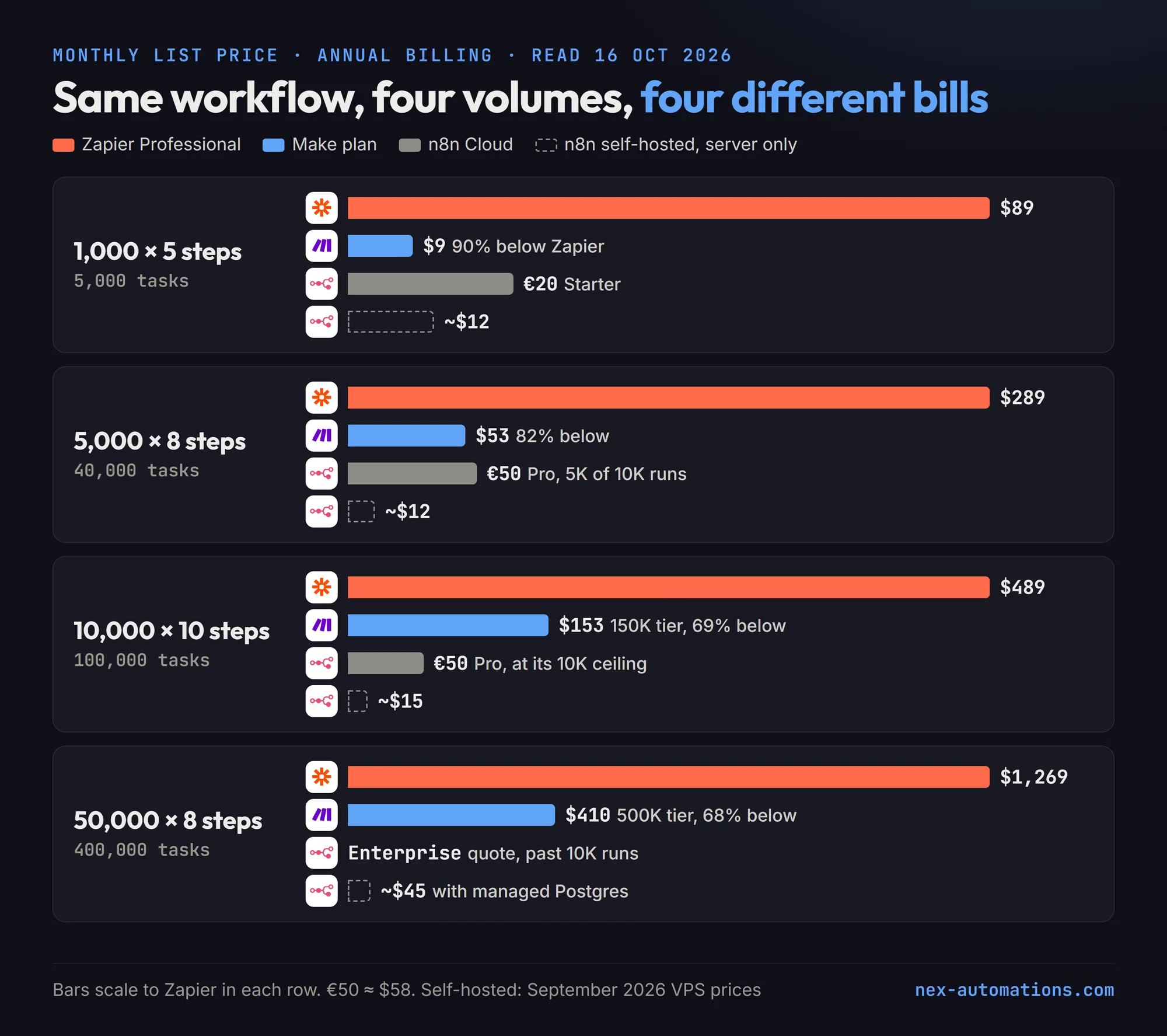
List prices on annual billing, each vendor's default, read from the Zapier, Make and n8n pricing pages on 16 October 2026. Zapier is the Professional plan's task slider, Make is the Make plan's credit slider and n8n Cloud is its published plan ladder in euros. Where a slider has no exact stop, the price is the smallest tier that covers the volume. Self-hosted figures are server cost only.
| Workflow volume | Zapier | Make.com | n8n Cloud | n8n self-hosted |
|---|---|---|---|---|
| 1,000 runs × 5 steps (5K tasks) | $89 (5K tier) | $9 (5K credits) | €20 Starter | ~$12 server |
| 5,000 runs × 8 steps (40K tasks) | $289 (50K tier) | $53 (40K credits) | €50 Pro | ~$12 server |
| 10,000 runs × 10 steps (100K tasks) | $489 (100K tier) | $153 (150K credits) | €50 Pro, at its 10K-run cap | ~$15 server |
| 50,000 runs × 8 steps (400K tasks) | $1,269 (400K tier) | $410 (500K credits) | Enterprise quote | ~$45 with managed Postgres |
At 5,000 runs a month, Make is 82 percent cheaper than Zapier and n8n Cloud about 80 percent cheaper (€50 is about $58), because n8n bills 5,000 executions rather than 40,000 steps. Make's lead narrows to about 70 percent at high volume, $153 against $489 at 100,000 tasks and $410 against $1,269 at 400,000, because its slider jumps from 80,000 to 150,000 credits. n8n Cloud stays at €50 up to 10,000 runs a month; above that, n8n's Business plan (€667 for 40,000 executions) is marked self-hosted only, so a cloud customer needs an Enterprise quote.
Self-hosted n8n is the cheapest on subscription at every volume, about 96 percent below Zapier at 5,000 runs, before the 2 to 5 hours a month of maintenance counted in the hidden-costs section below. Those figures use the September 2026 VPS prices in our n8n self-hosting cost guide: a small VPS at its renewal rate for the first three rows, and a larger VPS plus managed Postgres for the last. On Make, credits bought beyond your plan cost 25 percent more, per Make's extra credits page, so size the tier for a normal month.
"Migrating a marketing client from Zapier to Make.com on the same workflow set saved them 720 dollars a year. The second client we migrated was running closer to 50,000 tasks a month. They saved 11,000 dollars in twelve months." Prem Patel, Nex Automations
Want the numbers for your own workflows rather than ours? The automation platform cost calculator converts one described workflow into Zapier tasks, Make credits and n8n executions and prices each.
The Hidden Costs Most Comparisons Skip
Zapier: per-task counting compounds with multi-step Zaps. Adding two action steps to a five-step Zap raises its task use by 40 percent, and the bill follows once you cross a tier. AI by Zapier steps on the higher model tiers use 3 or 5 tasks each.
Make.com: the credit system confuses new users. AI modules cost variable credits based on tokens, iterators charge for every item they loop over and polling triggers charge for empty checks. Turn on credit overage protection for anything business-critical so a scenario does not stop mid-month.
n8n self-hosted: server maintenance is not free. A small team spends 2 to 5 hours a month on OS updates, backups, SSL renewal and version upgrades. At a $50 an hour cost basis that is $100 to $250 a month of hidden labour. October 2026 made the point: 15 security advisories in one day, all needing an upgrade. Below 10,000 executions a month, n8n Cloud is often the better deal once labour is priced in.
n8n Cloud and self-hosted: AI is not surcharged inside n8n, but the model provider bills you directly. A workflow that calls Claude Sonnet 5.5 or GPT-6.1 Sol a thousand times a day produces a separate Anthropic or OpenAI bill that never appears on n8n's invoice. The AI model landscape for October 2026 has every current model price.
The Pricing Verdict
For growing businesses running 5,000 to 100,000 tasks a month, Make.com is the cheapest cloud platform that handles serious complexity. For developer teams comfortable with infrastructure, self-hosted n8n is unbeatable on raw cost, and n8n Cloud wins for long workflows that run comparatively rarely. Zapier's price is justified when its larger app directory, or a team that will only ever use Zapier, closes a gap the others cannot.
Which Builder Handles Complex Workflows Best?
Make.com handles complex multi-branch workflows better than Zapier or n8n out of the box. n8n wins for developers who want code escape hatches alongside a visual canvas. Zapier is the cleanest builder for linear two-to-five-step Zaps and gets unwieldy past that.
That ranking holds across the 1,200+ automations shipped through Nex Automations.
Zapier's Linear Builder
Zapier is a top-to-bottom step list: trigger at the top, actions stacked below. The model is fast to learn and struggles the moment a workflow needs branching or loops.
The Paths feature handles conditional logic but stacks vertically. By the time a Zap has three or more paths with three or more steps each, it is hard to read. Zapier Canvas helps visualise the bigger picture but does not change the linear execution model.
What Zapier does brilliantly: a two-step Zap from a Typeform submission to a Slack message, built in three minutes and shipped the same hour.
Make.com's Visual Canvas
Make.com's canvas is the genuine differentiator. Scenarios sit on a graph where every module is a circle and every connection a line, and the data flowing between modules is inspectable at every step.
The router is the killer feature. One module fans out into multiple paths, each with its own filter. The aggregator collapses them back, the iterator loops over arrays and an error handler runs a fallback path when a module fails.
Subscenarios (October 2025) let a builder wrap a 20-module pattern as a reusable scenario and call it from any other workflow with typed inputs and outputs, and Make Code runs JavaScript or Python inline. Since 7 October 2026 a redesigned toolbar keeps saved versions of each scenario, which closes one of the last gaps against code-based tools.
The canvas matters most when an automation specialist explains a build to a non-technical client. A six-router scenario can be walked through in five minutes; the same logic in Zapier means switching between tabs.
n8n's Node-Based Canvas with Inline Code
n8n combines a visual graph with developer comfort. The Code node accepts JavaScript or Python, the Merge node handles joins between data sources and sub-workflows give modular design with proper input and output contracts.
The defining n8n feature for engineering teams: workflows can be version-controlled in git on self-hosted instances, so a team can branch, review and merge automation logic like application code.
What n8n loses on is visual clarity. The interface is denser than Make's; a non-technical user needs about 30 minutes of orientation on a first n8n canvas, against about 5 minutes for a Make canvas.
"When a client's workflow has more than three conditional paths, Make.com wins. Zapier's Paths feature works but the visual representation collapses fast. n8n gives the most control but the user has to think like a developer. Most clients do not." Prem Patel, Nex Automations
Which Platform Has the Best AI Features in October 2026?
Zapier wins on AI reach, Make.com wins on AI you can audit inside a workflow and n8n wins on AI depth for developers. The right choice depends on whether the goal is "give my AI access to my apps", "build agents non-technical users can audit" or "build a custom retrieval and agent pipeline".
Zapier's AI Stack
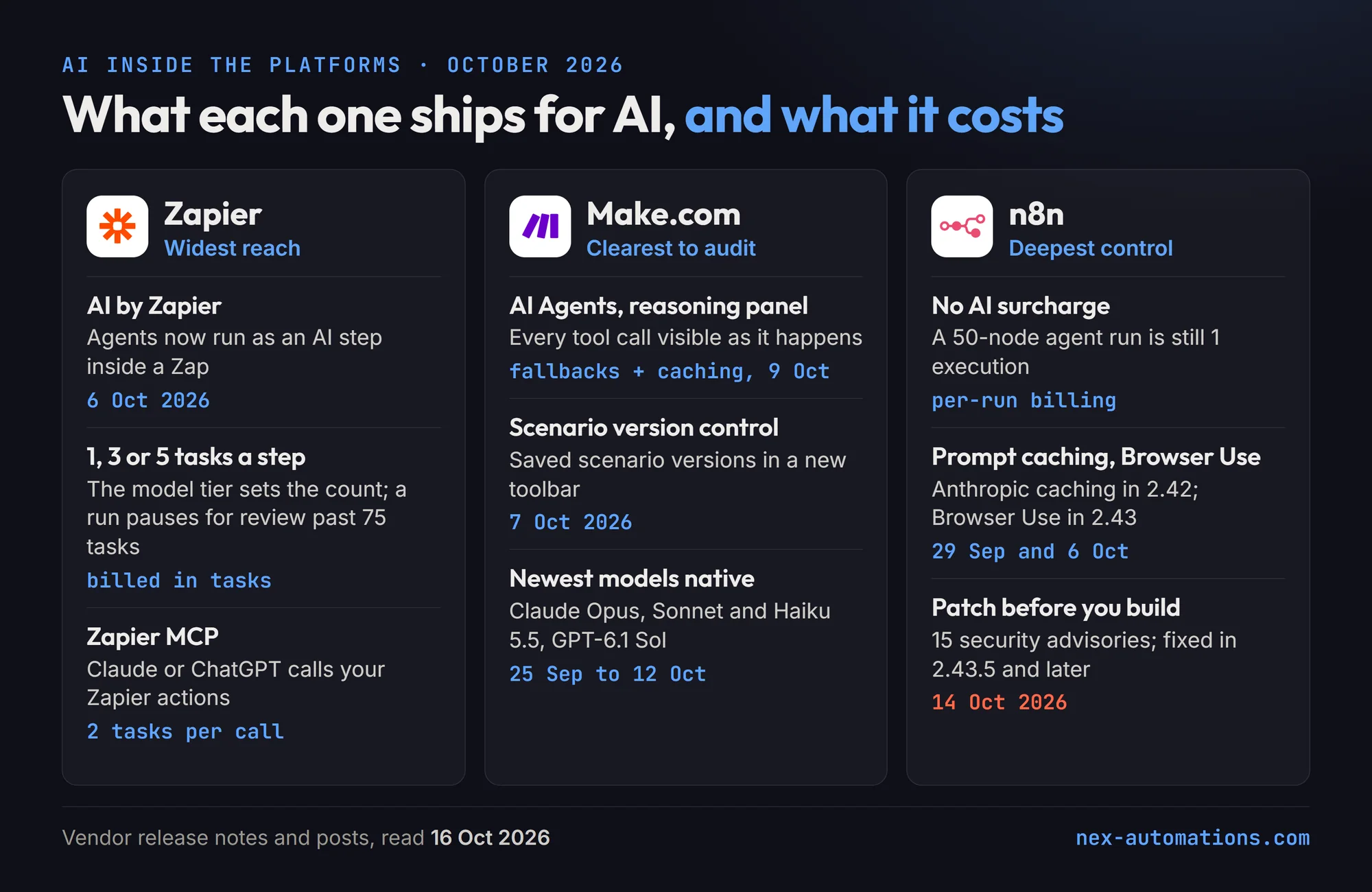
On 6 October 2026 Zapier announced that Zapier Agents is now AI by Zapier. An agent is now an AI step inside a normal Zap, so it inherits Zap triggers, filters, paths and run history. Default models carry no extra charge and higher model tiers multiply the cost, so a step uses 1, 3 or 5 tasks. Usage shows in Zap History, you can set your own per-run cap and a run that crosses 75 tasks pauses for human review.
Copilot, still labelled open beta, builds Zaps, Tables, Interfaces and Canvases from natural language. Zapier MCP lets Claude, ChatGPT or Cursor call 30,000-plus actions across 9,000-plus apps; each tool call uses two tasks from the plan's quota and failed calls do not count. BYOM (bring your own model) routes AI inference through the customer's AWS Bedrock account on Enterprise plans, and AI Guardrails (February 2026) detect 30-plus PII categories, prompt injection attempts and toxicity.
Make.com's AI Stack
Make announced its next generation of AI Agents on 11 February 2026, and the app is still labelled open beta in Make's help centre and on its pricing page. Agents are first-class objects on the scenario canvas, and the reasoning panel shows the agent's chain of tool calls in real time. That visibility solves the black-box problem that blocks AI adoption in regulated teams. On 9 October 2026 Make added fallback connections and prompt caching for AI Agents, so an agent can switch provider when one fails and reuse a cached prompt instead of paying for it again.
Make's AI modules added Claude Opus 5.5 and GPT-6 Sol and Luna on 25 September 2026, Claude Sonnet 5.5 from 2 October, GPT-6.1 Sol from 9 October and Claude Haiku 5.5 on 12 October. Make exposes both an MCP server, which publishes scenarios as tools for Claude or ChatGPT, and an MCP client, which lets a scenario call tools on external MCP servers. MCP Toolboxes add team-scoped permissions and per-tool read-only or read-write controls.
Maia, Make's conversational builder, is in public beta for all paid plans, with a 30-day trial for new free accounts. It configures modules and edits a scenario as you describe it, which narrows Zapier's day-one advantage for beginners.
n8n's AI Stack
n8n ships 70-plus LangChain-based AI nodes. The AI Agent node handles tool calling with vector stores such as Pinecone, Qdrant, Supabase and PGVector, memory backends such as Postgres and Redis and models from OpenAI, Anthropic, Google and local Ollama. n8n 2.42 (29 September 2026) added Anthropic prompt caching and 2.43 (6 October) added a Browser Use tool. On 16 October 2026 the current stable release is 2.43.6 and the beta is 2.44.2, per n8n's GitHub releases.
n8n charges no AI surcharge. AI nodes count as ordinary executions, so a 50-step retrieval pipeline run 1,000 times still costs 1,000 executions. That is the structural advantage for AI-heavy work.
How Do MCP and Chat-Driven Building Work in 2026?
MCP turned a chat session into a workflow trigger and, on n8n, into a workflow builder. Zapier connects a Claude or ChatGPT chat to its library of pre-configured actions. Make publishes scenarios as MCP tools and lets a scenario call external MCP servers. n8n is the only one of the three where an external chat such as Claude can create and edit workflows.
Zapier MCP with Claude and ChatGPT. Setup takes about five minutes: create an MCP server in the Zapier MCP dashboard, pick the actions to expose and paste the server URL into Claude or ChatGPT. Each call uses two Zapier tasks. Patterns that work today: "Read each unassigned Zendesk ticket, classify it and route it to the right team" and "Pull Salesforce pipeline data, calculate a weighted forecast and post the summary to Slack". Tool selection gets unreliable past 30 to 40 active tools in one session, so expose only what the chat needs.
Make MCP server and client. The MCP server (May 2025) publishes any active, on-demand scenario as a callable tool with structured inputs and outputs. The MCP client (July 2025) lets a scenario call an external MCP server such as GitHub or Webflow. Patterns that work: "Run my weekly invoice scenario" and "Trigger the onboarding sequence for this client". Editing a scenario from an external chat through MCP is not supported; inside Make, Maia covers that.
n8n MCP with workflow authoring. Since April 2026 (v2.18.4 and later) a Claude or ChatGPT agent can read, create, update, validate and run n8n workflows through chat. The MCP server generates TypeScript that compiles and type-checks rather than raw JSON, which is why the workflows tend to run first time. Our Claude and Make MCP guide covers the Make side step by step.
The AI Verdict
Zapier's MCP server and AI steps are the most practical AI lever for non-technical users: an assistant that can act across the whole app stack with little setup. Make's reasoning panel is the most under-rated AI feature of 2026, because it lets non-technical operators audit an agent's decisions. n8n gives the most raw power: for custom retrievers, custom memory, custom tool routing and local model fallback, nothing else competes.
"Zapier MCP is the easiest AI win for a non-technical founder. Make's reasoning panel is the most interesting AI feature of 2026. For raw AI agent depth, n8n is still the best engineering platform." Prem Patel, Nex Automations
Can You Self-Host? And Does Data Privacy Matter for Your Use Case?
Only n8n supports self-hosting. Zapier and Make.com are cloud-only, multi-tenant SaaS. For an organisation with strict data residency rules, that single fact closes the conversation.
The Self-Hosting Matrix
Zapier: no self-hosting. SOC 2 Type II and SOC 3. SAML SSO on Team (from $69 a month on annual billing) and Enterprise; SCIM provisioning on Enterprise. BYOM routes AI inference through the customer's AWS account, but the platform itself stays hosted by Zapier.
Make.com: no self-hosting. SOC 2 Type II and ISO 27001 certified. Data is hosted on AWS in US and EU data zones; Make's sub-processor list names Germany and Ireland for EU hosting, and Prague is Make's home base rather than a data centre. Some AI features, including Maia and OpenAI models, are processed in the US even on an EU zone, per Make's AI data zones page. SSO is Enterprise-only.
n8n: full self-hosting via Docker, Kubernetes or npm. SQLite by default, Postgres for production, Redis for queue mode. Air-gapped deployments are supported. External secret stores include HashiCorp Vault, AWS Secrets Manager, Azure Key Vault, GCP Secret Manager and 1Password Connect. n8n Cloud is SOC 2 Type II and hosted in the EU (Frankfurt). The flip side of self-hosting is patching: run 2.43.5 or newer after the advisories of 14 October 2026.
When Self-Hosting Actually Matters
Healthcare, finance and legal teams with strict data residency rules; clinical workflows under HIPAA; European companies with strict third-party processor controls under GDPR; Indian companies under the DPDP Act; and companies whose enterprise clients forbid third-party SaaS processors by contract. It also matters for high-volume operations where cloud pricing turns prohibitive past 50,000 runs a month.
For everyone else, Make.com's cloud is compliant enough for standard business use. Self-hosting should follow a legal or contractual requirement, not a hunch.
"If a client's enterprise contract forbids third-party data processors, n8n is the only option on this list. For everyone else, the cloud platforms are reliable and compliant." Prem Patel, Nex Automations
How Long Does It Take to Build Your First Automation on Each Platform?
Zapier delivers a working two-step Zap in 5 to 15 minutes. Make.com takes 30 to 60 minutes for the first scenario but pulls ahead by day three. n8n takes 1 to 2 hours for a developer comfortable with JSON and APIs; non-technical users typically need 2 to 4 weeks of practice, and most of them should be on Make or Zapier instead.
Zapier
A first Zap takes 5 to 15 minutes, and Copilot drafts multi-step Zaps from a description. The interface is the cleanest of the three for absolute beginners. The trade-off arrives later, when the user needs conditional logic.
Make.com
The first scenario takes 30 to 60 minutes because the canvas is unfamiliar. By day 3 or 4, users build faster in Make than in Zapier because they can see the whole workflow at once. Nex Automations runs Make.com training for agency teams and the pattern is consistent: week one is slower, week two is faster.
n8n
A developer comfortable with JSON, REST APIs and basic JavaScript ships a first n8n workflow in 1 to 2 hours. A non-technical user needs 2 to 4 weeks before n8n feels comfortable, because the interface assumes you know what a webhook, OAuth and a JSON path are.
"I teach Make.com to agency teams once a quarter. Every cohort follows the same curve. Day one feels slower than Zapier. By week two, every team is building twice as fast in Make because the visual canvas exposes the whole workflow at once." Prem Patel, Nex Automations
Building Is Easier Than Ever. So Why Do You Still Need an Expert?
Anyone with a Claude or ChatGPT subscription can now build a working automation in fifteen minutes. The question changed from "can a non-technical person build this" to "can a non-technical person build this reliably, securely and at production scale". Usually the honest answer is no, for structural reasons.
Chat Sessions Forget Yesterday's Work
MCP gives a chat session access to your app stack, but every session starts blank. The agent does not know what was built last Tuesday or why one path was chosen over another. After four or five sessions on the same workflow, the design intent lives only in one person's head. An expert writes it down in a runbook.
Wasted Hours on the Wrong Problem
A common failure in 2026: a founder spends three hours describing a workflow to Claude, Claude builds it in n8n through MCP and it fails because a webhook needs an OAuth approval only a human can complete. Two more hours of debugging in chat follow before anyone notices the agent has been guessing at the credential model. An expert completes the OAuth, validates the trigger and saves the afternoon.
Credential Binding Still Needs a Human
Every platform needs a real person to authenticate each connected app. MCP cannot click through OAuth screens or complete two-factor flows. An expert sets up credentials once, centrally, with service accounts that survive team turnover.
Edge Cases and Error Handling Get Skipped on First Pass
AI agents optimise for the happy path. A workflow that processes 100 invoices a day works in the demo; the first production month surfaces the 4 percent with non-standard formats, the polling trigger that returns duplicates and the API that rate-limits every Friday afternoon. Error handlers, dead-letter queues and retry policies need deliberate design.
Governance Decisions Are Not Delegable
Which Make Toolbox tools are read-only and which read-write. Which n8n workflows are exposed to MCP at all. Which Zapier actions a marketing agent may call and which a finance agent may. These are security decisions: an expert frames the policy and the AI works inside it.
For most teams the right pattern is to build the first 70 percent of a workflow with chat and an MCP-connected platform, then bring in an expert for the 30 percent that decides whether the system lasts one quarter or five years.
After 1,200+ Automations, Here's What I Actually Recommend
Make.com handles 80 percent of business automation needs at the lowest reasonable cost. n8n wins for self-hosted compliance and AI-heavy engineering work. Zapier wins when a client's stack is locked into the Zapier ecosystem or a niche vertical tool only integrates with Zapier.
Choose Zapier If
You are non-technical and need something working today. You depend on a niche tool only Zapier supports. You run under 5,000 tasks a month, so the price gap is small in absolute terms. You want AI steps that can act across your entire app stack with minimal setup.
Choose Make.com If
You need multi-branch workflows with routers, iterators and error handlers. You care about cost: Make's list price is about 70 to 90 percent below Zapier's for the same step count. You want a visual builder that scales with complexity, AI Agents you can audit through the reasoning panel and saved versions of every scenario. You are an agency building for clients.
Full disclosure: the Make.com registration link on this page is an affiliate link. Make.com is the recommended platform here because Nex Automations has shipped most of its 1,200+ automations on it, not because of the affiliate programme.
Choose n8n If
You are a developer or have engineers on staff. You need to self-host for compliance, residency or contractual reasons. You are building AI agent pipelines with custom memory, custom retrievers and local model fallback. Your workflows are long and run comparatively rarely, so per-run billing beats per-step billing. You need inline JavaScript or Python in production.
What Nex Automations Actually Uses
Make.com for about 80 percent of client work. n8n for AI agent pipelines and any project that must be self-hosted. Zapier when a client's existing stack is already deep in Zapier and the migration cost outweighs the recurring saving.
Where Do Zapier, Make and n8n Sit in the iPaaS Market?
The three platforms in this article mostly do not appear in the same analyst reports as Workato, Boomi or MuleSoft. That is the most important framing before comparing them with enterprise iPaaS tools.
Gartner Magic Quadrant for iPaaS (2026)
Gartner published its Magic Quadrant for Integration Platform as a Service on 16 March 2026, assessing 18 vendors. Per Gartner's own report, the Leaders are Boomi, SAP, Salesforce (MuleSoft), Salesforce (Informatica), Workato and Microsoft. Boomi calls it its 12th consecutive time in the Leaders quadrant, SAP its sixth and Workato its eighth, with Workato also furthest in vision for the third year running.
| Quadrant | Vendors in the 2026 Gartner iPaaS Magic Quadrant |
|---|---|
| Leaders | Boomi, SAP, Salesforce (MuleSoft), Salesforce (Informatica), Workato, Microsoft |
| Challengers | AWS, Google, Huawei Cloud, IBM, Oracle |
| Visionaries | Celigo, Jitterbit, SnapLogic, Tray.ai |
| Niche Players | Frends, SEEBURGER, Zapier |
| Honorable Mention | n8n |
| Not mentioned | Make.com |
Zapier is the only one of the three platforms in this article inside the Magic Quadrant, as a Niche Player, a position it already held in 2025. n8n is an Honorable Mention: Gartner says it "saw strong adoption for AI-driven workflows in 2025 but did not meet the revenue and customer number criteria", which require at least $60 million in annual revenue or 3,000 paying customer organisations. Make.com is not mentioned. That gap says more about the inclusion bar than about the products: the Magic Quadrant measures enterprise integration vendors, and Make and n8n compete mainly with SMB and mid-market buyers.
Forbes Cloud 100
On the 2025 Forbes Cloud 100 (published 3 September 2025), Celonis, Make's parent, ranked 12th at a $13 billion valuation, Zapier 48th at $5 billion and Workato 61st at $5.7 billion. Make, n8n, Tray.ai and Pipedream were not on it. Forbes had not published a 2026 list when we checked on 16 October 2026.
Company Background
Zapier was founded in 2011 in Columbia, Missouri, went through Y Combinator in 2012 and has raised only about $1.4 million in outside funding, per Forbes. Sacra estimated its annual recurring revenue at $310 million at the end of 2023; its last priced valuation is $5 billion, from a 2021 secondary sale.
Integromat launched its product in 2016 in Prague and was acquired by Celonis in October 2020 for what Celonis's CEO called "a three-digit amount of over $100 million". It rebranded to Make in February 2022.
n8n was founded in Berlin in 2019. It raised a $12 million Series A in 2021, a €55 million Series B in March 2025 and a $180 million Series C led by Accel in October 2025 at a $2.5 billion valuation. On 12 May 2026 SAP took a strategic stake and agreed to embed n8n in its Joule Studio agent builder; the investment valued n8n at $5.2 billion, roughly double the October 2025 figure. n8n reported 1,400-plus enterprise customers in that announcement.
What Users Say
G2's own Make vs Zapier comparison (updated April 2026) shows Make at 4.6 and Zapier at 4.5 out of 5, and G2's Summer 2026 roundup of top-rated iPaaS tools (20 July 2026) includes Zapier and n8n. Gartner's quadrant is the enterprise validation; G2 and Capterra capture the user voice in the SMB and mid-market segments where Zapier, Make and n8n actually compete.
For the wider field, including Workato, Tray.ai, Pipedream, Celigo, Boomi, MuleSoft, Latenode and Activepieces, see the iPaaS landscape 2026, and for agent features across them, iPaaS for AI agents.
Frequently Asked Questions
Is Make.com really cheaper than Zapier?
Yes, by about 70 to 90 percent at list price. For 5,000 runs a month of an eight-step workflow (40,000 tasks or credits), Zapier Professional costs $289 a month and the Make plan with 40,000 credits costs $53, about 82 percent less, on annual billing read from both pricing pages on 16 October 2026. At 5,000 tasks the gap is $89 against $9; at 100,000 tasks it is $489 against $153, because Make's next credit tier above 80,000 is 150,000.
Which is the cheapest automation platform in October 2026?
Self-hosted n8n, at about $5 to $30 a month in server cost, because it has no usage meter at all; budget 2 to 5 hours a month of maintenance on top. Among cloud plans, Make.com is cheapest for step-heavy workflows and n8n Cloud is cheapest for long workflows that run up to 10,000 times a month, because n8n bills per workflow run rather than per step and its Pro plan covers 10,000 runs for €50. Zapier is the most expensive at every volume we priced.
Can n8n replace Zapier completely?
For developer teams, yes. For non-technical teams, usually no. n8n covers the same workflow patterns as Zapier and adds inline JavaScript or Python, but a non-technical operator typically needs 2 to 4 weeks to become productive in n8n, against 5 to 15 minutes for a first Zap.
Which has the best AI agent features in October 2026?
n8n for developer-built AI pipelines: 70-plus LangChain-based AI nodes and no AI surcharge, so a long agent run is still one execution. Make.com for teams that must audit AI decisions: its AI Agents show every tool call in a reasoning panel and gained fallback connections and prompt caching on 9 October 2026. Zapier for reach: since 6 October 2026 agents run as an AI step inside a Zap (AI by Zapier), billed at 1, 3 or 5 tasks a step depending on the model tier.
What happened to Zapier Agents?
On 6 October 2026 Zapier announced that Zapier Agents is now AI by Zapier: an agent runs as an AI step inside a normal Zap, with Zap triggers, filters, paths and run history. A step uses 1, 3 or 5 tasks depending on the model tier, and a run that crosses 75 tasks pauses for human review.
Can I migrate from Zapier to Make.com easily?
Yes for most workflows. A direct rebuild of a five-step Zap in Make typically takes 30 to 45 minutes. Zapier Paths map to Make routers and Formatter steps map to Make functions or parsing modules. Workflows that rely on a Zapier-only integration need an HTTP module rebuild in Make against that app's API.
Is n8n safe to self-host for production workflows?
Yes, if you keep it patched. n8n published 15 security advisories on 14 October 2026, fixed in 2.43.5 and later on the stable line, so run 2.43.5 or newer (2.43.6 was current stable on 16 October 2026). For production, use Postgres rather than SQLite, queue mode with Redis for high concurrency, an external secret store and regular OS patching.
Which platform do most automation agencies use?
In our experience Make.com is the default agency platform: the visual canvas is easy to walk a client through and the cost per client stays low. Agencies doing AI-heavy or compliance-bound work add n8n alongside it. This is a practitioner view from Nex Automations' own client work, not a market survey.
What is the best automation platform for beginners?
Zapier. A first two-step Zap takes 5 to 15 minutes and Copilot can draft a multi-step Zap from a plain-English prompt. Make.com becomes the better choice once a user understands triggers, arrays and APIs, which for most of the teams we train happens in the second week.
How much does it cost to run n8n on a VPS?
About $5 to $30 a month for the server, depending on volume. A 2 vCPU, 4 GB VPS handles 10,000-plus executions a month for most workflow profiles. High-throughput deployments of 50,000-plus executions a month need queue mode, Redis and a managed Postgres, which adds roughly $15 to $40 a month. Our n8n self-hosting cost guide has current provider prices.
Related guides
- Automation platform updates, October 2026
- The AI model landscape, October 2026
- Automation platform cost calculator
- Make.com credits explained
- n8n pricing, licensing and self-hosting
- What to look for when hiring an automation expert
Want the platform decided and your workflows built? Book a 30-minute call to assess your stack and scope the build. To try Make, start with this link for a Pro month on us.
About the author: Prem Patel is the founder of Nex Automations, an AI systems studio based in Ahmedabad, India. He has built 1,200+ automations across 210+ clients on Make.com, Zapier and n8n. He is a Make.com Level 5 Expert and a Zapier Certified Expert, won 1st place in Make's Scenario of the Month for September 2026, and Nex Automations is both a Make Silver Partner and a Zapier Silver Solution Partner. Prem is also an instructor for the Era of No Code with 1,000+ students.