Zapier, Make and n8n own the SMB and mid-market automation conversation. The deeper iPaaS market is bigger, older and worth understanding before any decision past 50,000 workflow runs per month or any enterprise procurement cycle.
Update, 16 October 2026: two vendor changes since this catalog was last checked. Zapier Agents became AI by Zapier on 6 October 2026, so a Zapier agent is now an AI step inside a Zap, billed in tasks. Make shipped scenario version control (7 October) and fallback connections for Make AI Agents (9 October). The figures below are as checked on their own dates. Dates and sources: automation platform updates for October 2026.
This guide is a quick-scan field reference to eight tools that show up in iPaaS conversations: Workato, Tray.ai, Pipedream, Celigo, Boomi, MuleSoft, Latenode and Activepieces. Each fact pack covers positioning, target buyer, pricing model, key differentiator, weakness and recent funding or M&A status. All numbers verified against live official sources on May 27, 2026.
The companion article Zapier vs Make.com vs n8n in 2026 covers the three platforms that dominate the no-code automation tier. This guide picks up where that one stops.
Last verified 30 August 2026. On that date we re-checked the most volatile claims on this page against vendor sources: Workato's Magic Quadrant standing (Leader and furthest in Vision on the March 2026 iPaaS Magic Quadrant, eighth year, with its AIRO multi-agent assistant GA on 30 July 2026), Tray.ai's analyst position (still a Visionary on the 2026 iPaaS report, and named a Pioneer on Gartner's June 2026 Emerging Market Quadrant for No-Code Agent Builders), Boomi's twelfth Leader placement and Celigo's third Visionary placement on the same 2026 report, and Pipedream's pricing after the Workday acquisition, which is now published again (Free, Basic $29, Advanced $49, Connect $99 a month, with the deal reported closed in Workday's 24 February 2026 earnings release). Funding figures, customer counts and the remaining vendors carry their original dates and were not re-checked in this pass. Where a number matters to a decision you are about to make, confirm it at source. For the AI-agent capabilities of these same vendors, the iPaaS for AI agents catalog is the companion page.
How the iPaaS Market Splits in 2026
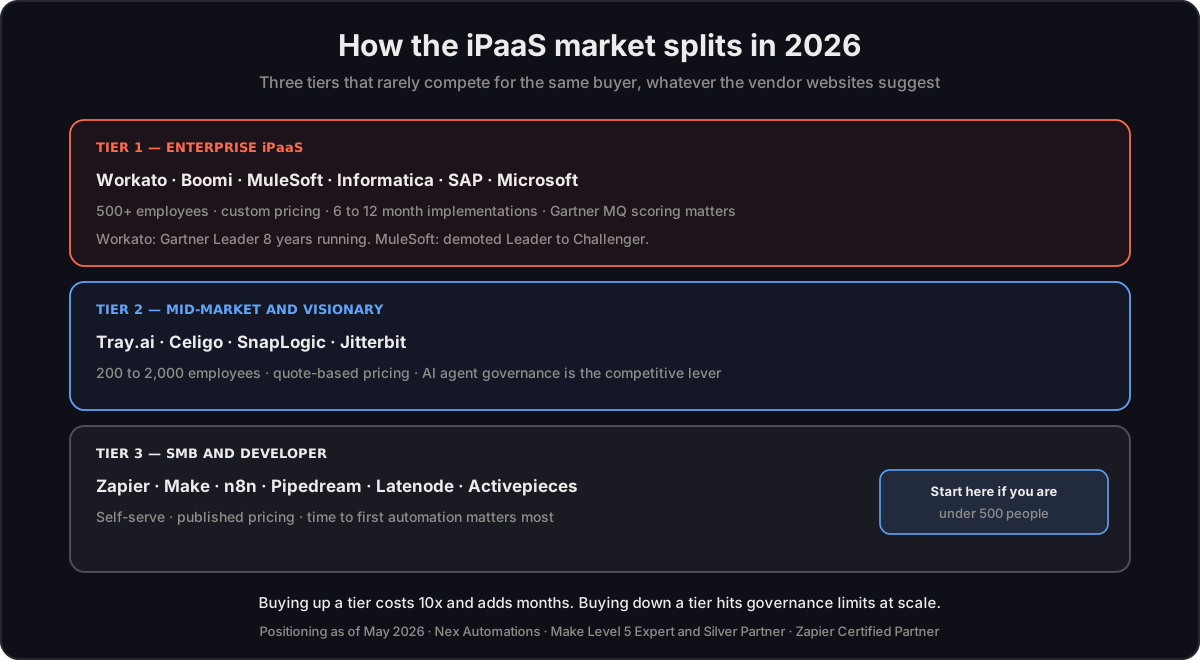
The iPaaS market splits into three clear tiers. The enterprise tier competes in the Gartner Magic Quadrant. The mid-market and visionary tier competes for buyers between 200 and 2,000 employees. The SMB and developer tier competes on price, time-to-first-automation and developer experience.
Tier 1 / Enterprise iPaaS: Workato, Boomi, MuleSoft, Informatica, SAP, Microsoft. 500-plus employees. Custom pricing. 6 to 12 month implementations. Gartner MQ scoring matters.
Tier 2 / Mid-market / Visionary: Tray.ai, Celigo, SnapLogic, Jitterbit. 200 to 2,000 employees. Quote-based pricing. AI agent governance as primary lever.
Tier 3 / SMB / Developer: Zapier, Make, n8n, Pipedream, Latenode, Activepieces. Self-serve. Published pricing. Time-to-first-automation matters most.
The 2025 Gartner iPaaS Magic Quadrant ranks Workato as a Leader for the eighth consecutive year. Boomi and Informatica share the Leaders quadrant. MuleSoft was demoted from Leader to Challenger in 2025. Tray.ai sits in the Visionaries quadrant. Zapier entered as a Niche Player for the first time in 2025. Make and n8n are not in the MQ.
The Eight Tools, At a Glance
The eight tools compared
The full profile for each tool follows. This table is the version to scan first.
| Tool | Primary buyer | Pricing transparency | Cheapest published entry | Standout strength |
|---|---|---|---|---|
| Workato | IT leadership, 500+ employees | None. Quote only | Not published | 8x Gartner MQ Leader, deepest governance toolset |
| Tray.ai | Mid-to-large enterprises running AI agents | None. Two named tiers, no figures | Not published | Agent Gateway governs every LLM tool call with RBAC |
| Pipedream | Developers, startups to Fortune 500 | Published tiers (re-listed after the Workday deal) | Free, then $29/mo (Basic) | Inline Node.js or Python beside no-code steps |
| Celigo | Mid-market on NetSuite, Salesforce, Shopify | None. Three editions, no figures | Not published | Flat-rate per endpoint avoids per-task bill shock |
| Boomi | Large and regulated enterprises | None. Custom quotes | Not published | Hybrid and multi-cloud integration at scale |
| MuleSoft | Global enterprises deep in Salesforce | None. vCore-based, negotiated | Not published | API management depth in the Salesforce ecosystem |
| Latenode | Tech-forward SMBs and white-label embedders | Full published tiers | $5/mo (1,000 executions) | The clearest published pricing on this list |
| Activepieces | Technical teams wanting self-hosted, no lock-in | Full published tiers | $5 per active flow, unlimited runs | MIT-licensed Community Edition, per-flow not per-task |
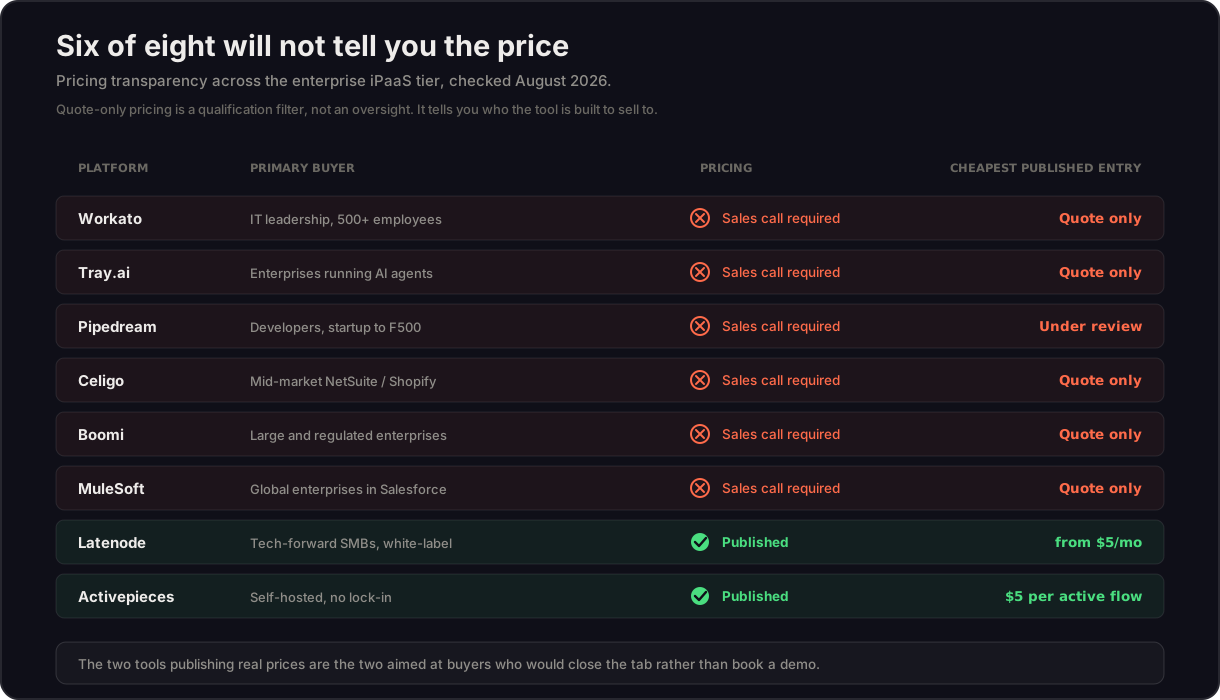
Two things jump out of that column of "Not published". Six of the eight enterprise-tier tools will not quote you a number without a sales call, which is a deliberate filter, not an oversight. And the only two publishing real prices are the two aimed at buyers who would walk away rather than book a demo. If you are evaluating with a budget rather than a mandate, that alone narrows the list.
Workato
Positioning: The self-described number-one Enterprise iPaaS, pivoting to "Enterprise MCP for Agentic AI."
Target buyer: IT leadership at 500-plus employee companies running Salesforce, SAP, ServiceNow or Workday.
Pricing: Custom and quote-only. Zero published rates. The pricing page leads to a demo request.
Differentiator: Eight consecutive years as a Gartner MQ Leader, and three times Furthest in Vision, including the 2026 Magic Quadrant for Integration Platform as a Service. Add the deepest enterprise governance toolset and a recipe-reuse library across 12,000 customers.
Weakness: Pricing opacity blocks any mid-market evaluation without a sales call.
Status: Last raised $110M at $1.7B valuation (Jan 2021, Battery Ventures and Insight Partners). Forbes Cloud 100 ten consecutive years.
Tray.ai
Positioning: Enterprise orchestration for data and AI with 700-plus connectors, an AI agent builder and the Agent Gateway for MCP governance.
Target buyer: Mid-to-large enterprises running active AI agent programs that have outgrown Zapier or Make.
Pricing: Two named tiers (Tray Advantage and Advantage Plus) on a task-volume model. No public dollar figures.
Differentiator: The Agent Gateway governs every LLM tool call with enterprise RBAC and policy enforcement. None of the comparators offer this natively.
Weakness: Still a Visionary rather than a Leader on the Gartner iPaaS Magic Quadrant, including the 2026 report. That gap can slow enterprise procurement against Workato or Boomi, even where the product fits better.
Status: $164M raised across 10 rounds. Last equity round $40M Series C extension (Sep 2022). Acquired Vanti (AI knowledge modeling) Mar 2025. Named a Pioneer in the 2026 Gartner Emerging Market Quadrant for No-Code Agent Builders, with 91 percent of Gartner Peer Insights reviewers recommending it.
Pipedream
Positioning: Developer-first integration and AI agent platform. Now operating as a Workday-owned product.
Target buyer: Developers and technical teams at startups through Fortune 500. Over one million developers and 5,000-plus paying customers at acquisition.
Pricing: Published again as of 30 August 2026: Free, Basic $29 a month, Advanced $49, Connect $99, with MCP servers on every paid plan. Verify before signing a multi-year term while the Workday integration settles.
Differentiator: Inline Node.js or Python next to no-code steps in a single workflow. 10,000-plus typed actions for MCP agents.
Weakness: Workday acquisition creates product-direction uncertainty for non-Workday customers.
Status: Acquired by Workday, announced Nov 19, 2025; Workday reported the deal closed in its 24 February 2026 earnings release. Prior funding $22.4M.
Celigo
Positioning: Intelligent Automation Platform with 1,000-plus prebuilt connectors and the "Ora" natural-language interface. 2025 Gartner Peer Insights Customers' Choice for iPaaS.
Target buyer: Mid-market companies running NetSuite, Salesforce, Shopify, SAP or Microsoft Dynamics. Strong in e-commerce ops.
Pricing: Three editions (Standard, Professional, Enterprise) on a flat-rate per-endpoint-and-flow model. No public dollar figures.
Differentiator: Flat-rate pricing avoids per-task bill-shock. Prebuilt integration logic encodes operational best practices for e-commerce and ERP combos.
Weakness: Sales call required for any quote despite a "transparent" pricing brand promise.
Status: Visionary on Gartner MQ 2025. Last raised $48M Series C Dec 2021. No new round disclosed.
Boomi
Positioning: The Data Activation Company. Twelve-time Gartner MQ iPaaS Leader (2026) with 30,000-plus customers and 310,000-plus users.
Target buyer: Large enterprises and regulated industries (healthcare, financial services, manufacturing) needing hybrid and multi-cloud integration.
Pricing: Tiered editions across Integration, API Management and Data Management tracks. Custom quotes only.
Differentiator: Agentstudio for no-code agent design with ethical guardrails. Boomi Connect governs Claude, Copilot and Gemini across 1,000-plus MCP-enabled enterprise tools.
Weakness: Notorious for long implementation cycles and specialist dependency.
Status: Private after Dell divestiture to Francisco Partners and TPG for $4B in 2021. Intent to acquire Lunar.dev announced May 2026.
MuleSoft
Positioning: Salesforce-owned Anypoint Platform. Increasingly positioned as the connective tissue for Salesforce Agentforce.
Target buyer: Global enterprises with 1,000-plus employees, deep in the Salesforce ecosystem or needing hybrid on-premises and cloud integration.
Pricing: Fully custom and enterprise-negotiated. Structured around vCores, connections, API calls and deployment environment. No public rates.
Differentiator: MuleSoft Agent Fabric orchestrates AI agents across Amazon Bedrock, Google Vertex AI and Salesforce Agentforce from one control plane.
Weakness: Cost. Enterprise contracts routinely run six or seven figures annually. Demoted from Leader to Challenger on the 2025 Gartner MQ.
Status: Acquired by Salesforce for $6.5B in May 2018. Operates as a Salesforce business unit.
Latenode
Positioning: AI-native low-code workflow platform that bills by processing seconds rather than per operation. Bundles 400-plus AI models in every paid plan.
Target buyer: Tech-forward SMBs, SaaS founders embedding integrations into their own product (white-label iPaaS) and individuals priced out of Zapier.
Pricing: Free $0 (300 executions), Mini $5 (1,000), Start $19 (25,000), Team $59 (250,000), Enterprise from $299/mo. The clearest published pricing on this list.
Differentiator: Time-based billing makes high-node workflows dramatically cheaper. GPT-5, Claude, Gemini and Deepseek included at vendor cost.
Weakness: Bootstrapped 19-person team. Enterprise support depth and SLA guarantees lag larger vendors.
Status: Bootstrapped with zero external funding. Founded 2022 in Cyprus and San Francisco.
Activepieces
Positioning: MIT-licensed open-source Zapier alternative with a self-hostable Community Edition and a hosted cloud product.
Target buyer: Technical teams that want self-hosted automation free of vendor lock-in, plus enterprise IT teams wanting per-flow pricing instead of per-task billing.
Pricing: Free for 10 active flows, then $5 per active flow per month with unlimited runs. Community Edition free and MIT-licensed for self-hosting.
Differentiator: Only MIT-licensed self-hosted option on this list with 22,200-plus GitHub stars and 270-plus open-source contributors. Unlimited runs on every plan.
Weakness: Early-stage company with limited disclosed funding. Thin enterprise contract terms versus Workato, Boomi or Celigo.
Status: Founded 2022. Y Combinator Summer 2022 batch plus roughly $500K early-stage VC from Accel, Foodics, Jawaker and Propeller.
How to Decide Which Tool to Evaluate
The pattern repeats across most clients. The right starter platform is rarely the enterprise tool the procurement team prefers.
Start with Zapier, Make or n8n. Pick by the four-persona framework in the companion comparison article. For 80 percent of automation work below 50,000 operations per month, this is the right tier.
Look at Workato or Boomi when procurement requires a Gartner Leader. Both are mature, both are expensive and both expect a 6 to 12 month implementation timeline. Budget accordingly.
Look at MuleSoft when Salesforce is the system of record. The Anypoint Platform is the path of least resistance inside Salesforce-heavy enterprises. Outside the Salesforce ecosystem the cost is hard to justify.
Look at Celigo for NetSuite or Shopify-heavy stacks. The prebuilt business logic for e-commerce and ERP combos is the differentiator.
Look at Tray.ai when AI agent governance is the primary requirement. The Agent Gateway is a real moat for enterprises building agent fleets.
Look at Pipedream for developer-first teams that need MCP-native integration. Watch the Workday product direction closely through 2026.
Look at Latenode when time-based billing changes the math. A workflow with 20 to 50 nodes per execution often costs less on Latenode than on Make or Zapier at equivalent volume.
Look at Activepieces when self-hosting and an open-source license are non-negotiable. This is the only true OSS option on this list.
What the Licence Does Not Cover: Implementation
Every table above prices the platform. None of them prices the project, and on this tier of tooling the platform is usually the smaller number. Workato, Boomi and MuleSoft all expect a 6 to 12 month implementation and all three sell substantially through certified implementation partners rather than direct self-serve. The mid-market tools (Make, Zapier, n8n) are self-serve to start and then hit the same wall at the point where error handling, retries, data mapping and ownership-after-handoff start to matter.
So the honest sequence is: pick the platform from the tables above, then price the build separately.
What a build actually costs
These are our own 2026 scoping bands, from 1,200+ automations delivered for 210+ clients. They are first-party figures, not a market survey, and they describe implementation only, with the platform licence on top.
| Scope | What it looks like | Band |
|---|---|---|
| Simple | 1 to 3 scenarios, linear flow, 2 or 3 apps, no branching | $200 to $800 |
| Medium | 4 to 8 scenarios, routing logic, multiple integrations, error handling | $800 to $3,000 |
| Complex | 9+ scenarios, custom dashboards, AI steps, multi-team systems | $3,000 to $15,000+ |
A quote materially below these ranges for complex work is not a bargain. It usually means the complexity has not been scoped, and unscoped complexity resurfaces as a broken production system three months later.
Six questions that separate an implementer from a demo builder
Ask these of any partner, agency or freelancer, on any platform on this page:
1. Walk me through how you handle errors in production. If the answer only covers the happy path, they have not run systems on real data. Ask for the specific mechanism: error handlers, retries, alerting, dead-letter handling. 2. What happens when the API changes in month three? You are listening for a maintenance model, not a promise that it will not happen. 3. Show me a system of similar complexity. Anonymised is fine. Module count, routing logic and error paths tell you more than any badge. 4. What do you hand over? Documentation and a walkthrough at minimum. If the system cannot be modified without going back to them, that should be your choice, not a condition they created. 5. When would you tell me not to automate this? A partner who has no such answer is optimising for the invoice. 6. Can I verify your certification independently? Every vendor on this page with a partner programme publishes a directory. Look the name up in it rather than trusting a badge image on a website.
Where we sit, so you can check it
Nex Automations is an automation studio led by Prem Patel, based in Ahmedabad and working globally. Credentials that can be verified in the vendors' own directories rather than taken on trust:
- Make.com Level 5 Expert and Silver Solution Partner, listed at make.com/en/partners-directory/nexautomations - Zapier Solution Partner, listed at zapier.com/partnerdirectory/partner/nex-automations - 1,200+ automations for 210+ clients across 8+ industries in 12+ countries
We build on Make, Zapier and n8n, and we say plainly when a process should not be automated at all. If you want the platform decision made per workflow on your real volume and logic before anyone writes a scenario, that is what the automation audit is.
Frequently Asked Questions
Which iPaaS tool is the most expensive in 2026?
MuleSoft, by a wide margin. Enterprise contracts routinely run from low six figures to seven figures annually. Vendor-locked pricing tied to Salesforce procurement compounds the cost.
Which iPaaS tool is the cheapest in 2026?
Activepieces and self-hosted n8n. Activepieces Community Edition is free and MIT-licensed. Self-hosted n8n runs on a 5 to 30 dollar per month VPS for most workloads. Latenode is the cheapest paid-cloud option for high-node workflows.
Is Workato worth evaluating against Zapier?
Only at 500-plus employees with a real procurement budget. Workato's enterprise governance and recipe library justify the cost above that threshold. Below it, Zapier or Make wins on time-to-first-automation and total cost.
What happened to Pipedream after Workday acquired it?
The acquisition closed on January 31, 2026. Pipedream continues as a Workday-owned product. Pricing tiers and feature roadmap are under review. Non-Workday customers should monitor product-direction announcements through the rest of 2026 before signing multi-year contracts.
Why is MuleSoft no longer a Gartner Leader?
The 2025 Gartner iPaaS MQ moved MuleSoft from Leaders to Challengers. The analyst note cited slower innovation velocity relative to Workato, Informatica and SAP. Cost and complexity continue to be the dominant buyer-side concerns.
Where do Zapier, Make and n8n actually sit?
Zapier is a Niche Player on the 2025 Gartner iPaaS MQ. Make and n8n are not in the MQ. All three are G2 Leaders in the SMB and mid-market iPaaS tier. The companion Zapier vs Make.com vs n8n article covers the trade-offs in depth.
What does implementation cost on top of the platform licence?
Usually more than the licence, on this tier. Workato, Boomi and MuleSoft all expect a 6 to 12 month implementation and sell substantially through certified implementation partners. The mid-market tools start self-serve and reach the same point once error handling, retries, data mapping and ownership-after-handoff matter. Our own 2026 scoping bands, from 1,200+ automations delivered for 210+ clients: $200 to $800 for 1 to 3 linear scenarios, $800 to $3,000 for 4 to 8 scenarios with routing and error handling, and $3,000 to $15,000+ for 9 or more scenarios with dashboards, AI steps or multi-team systems. Those are first-party figures for implementation only, not a market survey.
How do I verify an iPaaS implementation partner is actually certified?
Look the name up in the vendor's own directory rather than trusting a badge image on a website. Make publishes a Solutions Partner directory and Zapier publishes a partner directory, both searchable by name. Then test the depth: ask how they handle errors in production, what happens when an API changes in month three, and what documentation they hand over. A partner who only describes the happy path has not run systems on real data.
Related guides
- Zapier vs Make.com vs n8n: Which Should You Use in 2026?
- Best iPaaS platforms for AI agents in 2026: eleven compared
- What is Make.com? Complete Guide for 2026
Need help selecting the right platform or scoping a build? Book a free consult: 30 minutes to map your use case to the right tool and architecture.
About the author: Prem Patel is the founder of Nex Automations, an AI systems studio based in Ahmedabad, India. He has built 1,200+ automations across 210+ clients on Make.com, Zapier and n8n. He is a Make.com Level 5 Expert and Make Silver Partner and a Zapier Certified Expert.