 Next.js
 Supabase
 Make.com
 OpenAI
 Stripe
 Vercel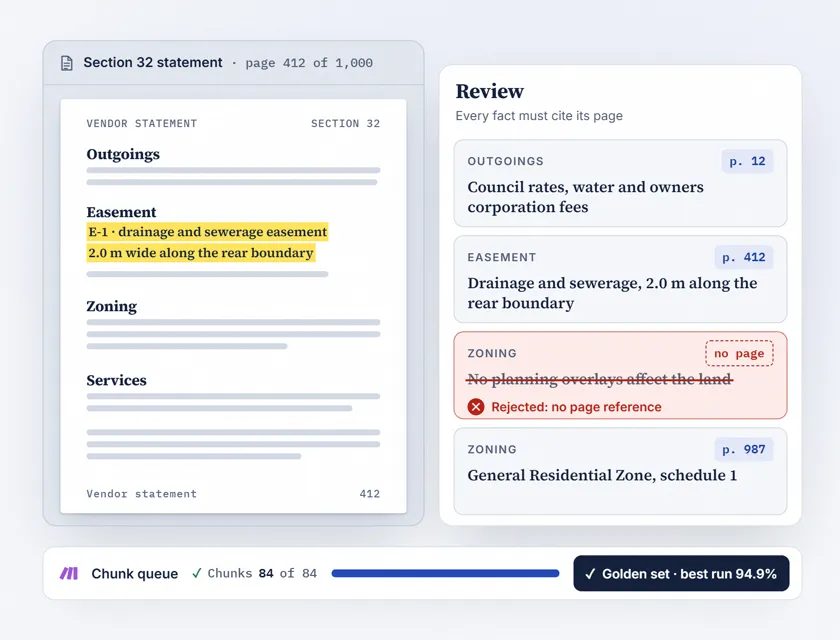
A multi-tenant contract review SaaS for a property-law specialist in Australia: Next.js on Vercel, Supabase for data, Make.com as the entire backend. Every extracted fact carries a page citation, and the best run scored 94.9% on a source-verified golden test set. This is what "AI you can sign off on" looks like in a regulated document workflow: the accuracy is measured, versioned and reported, not assumed.
Built by Prem Patel, Make Level 5 Expert and Zapier Certified Professional; Nex Automations is listed in both official partner directories. This is one of the 1,200+ systems we have shipped, and the one that proves a workflow platform can be the backend of a real product.
The situation
Reviewing a Victorian property contract means reading a Contract of Sale and a Section 32 that together run to hundreds of pages, then writing a review that names the clause behind every point. A lawyer cannot sign a summary that has no evidence behind it. Generic AI tools produce confident summaries with no citations, which is exactly the output a law firm cannot use.
The client wanted contract review a lawyer can trust: no citation, no answer.
The 3 problems
- Long documents. A 1,000-page contract cannot go through a model in one call. Naive pipelines truncate silently and the review looks complete while missing half the document.
- Rate limits and retries. Queued model calls hit Retry-After headers and a retried chunk must never write twice.
- Unmeasured accuracy. Without a golden test set nobody can say whether a prompt change made the reviewer better or worse.
What was built
A multi-tenant SaaS. Front end in Next.js on Vercel, auth and data in Supabase with row-level security, files in Supabase storage, billing in Stripe. Make.com is the backend: two webhook scenarios take the upload, chunk the document, run extraction and drafting against the model, assemble the review and deliver it in the app and by email, every fact carrying a page reference.
How it flows
- A firm uploads a contract in the app; the file lands in Supabase storage with a tenant-scoped record
- A Make.com webhook scenario chunks the document and queues each chunk for extraction
- Each chunk is extracted against a versioned prompt with a strict JSON return contract; every fact keeps its page number
- A second scenario assembles the review, drafts the narrative and writes it back to the app
- Delivery in-app or by email, with DOCX and PDF export, run history, re-run per review, a monthly quota per firm and a retention date on every submission
The hard part was not the AI, it was long documents and rate limits. The pipeline chunks, queues and resumes, honours Retry-After headers and uses idempotency keys so a retried chunk never writes twice.
How accuracy is measured
Prompts are versioned in git, separate from the code that runs them, and every version is scored against eight source-verified golden fact sheets built from real contracts. Failures are classified into five categories (wrong fact, missing fact, invented fact, citation error, format error), so a miss is diagnosed, not guessed at. The harness caught a fabricated fact on a real client form and a context-window bug that would have silently truncated 1,000-page contracts, both before production.
Tools used
- Next.js and Vercel for the app and hosting
- Supabase for auth, Postgres with row-level security and storage
- Make.com for ingestion, chunking, queued AI calls with retries, assembly and email
- OpenAI models for extraction and drafting, behind versioned prompts
- Stripe for billing
Results
| Measure | Value |
|---|---|
| Best single run on the golden set | 94.9% |
| Mean out-of-sample accuracy across prompt versions | 70.2% to 79.5% |
| Contract length handled | 100 to 1,000 pages |
| Commits in five weeks | 191 |
| Failures caught by the harness before production | Fabricated fact on a real form; context-window truncation bug |
The product is in test and pre-revenue as of August 2026; no commercial result is claimed.
Honest limits
- Accuracy is measured on eight golden sheets. That is enough to steer prompt changes, not enough to claim a population-level rate; the mean and best figures above are exactly what the harness reports.
- A workflow platform as backend is right for document processing and AI orchestration. It is not the right backend for high-frequency transactional load, and we would say so on a scoping call.
- The model cannot replace the lawyer. Every review is drafted for human sign-off, which is why the page citation on every fact is the product, not a feature.
Related guides
- Automated Invoice and Contract Processing with Make
- AI PDF Extraction with Make and Gemini
- Document AI in 2026: IDP Platforms vs Cloud APIs vs Building Your Own
FAQ
Q: Can Make.com be the backend for a real SaaS product? A: Yes, when the work is document processing, AI orchestration and delivery. In this build Make.com handles ingestion, chunking, queued AI calls with retries, assembly and email, behind a Next.js and Supabase front end with row-level security.
Q: How do you measure whether an AI document reviewer is accurate? A: With a golden test set: real documents with hand-verified fact sheets, scored on every prompt change and broken down by failure type. This project reports a 94.9% best run and a 79.5% mean from that harness.
Q: How do you process a 1,000-page contract with an AI model? A: Chunk it, queue the chunks, resume on failure, honour rate-limit headers and use idempotency keys so a retried chunk never writes twice. Every extracted fact keeps its page number so the assembled review can cite its source.
Q: What does AI contract review cost to build? A: This product took 191 commits over five weeks for a multi-tenant app with billing, export and an evaluation harness. A single-firm pipeline without the SaaS layer is a much smaller build; scope depends on document types and the review format the lawyers sign.
Need document AI your team can sign off on?
If a document workflow needs page-cited answers and measured accuracy, we build the system that produces them.