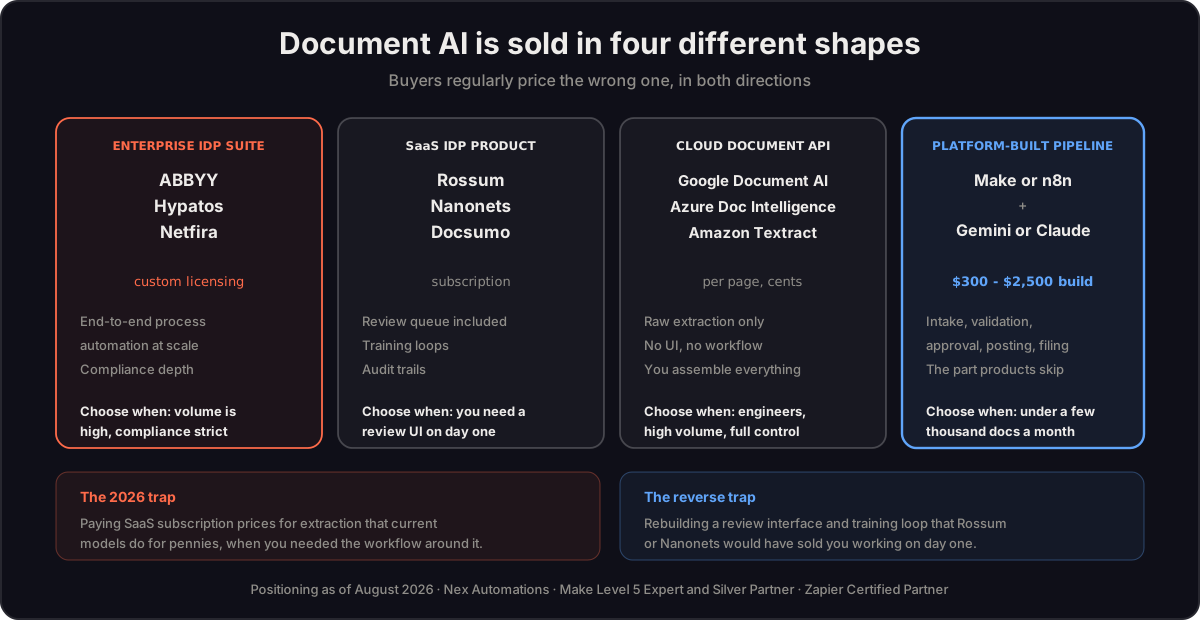
Intelligent document processing (IDP) is sold in four very different shapes, and buyers regularly price the wrong one. Enterprise IDP suites (ABBYY, Hypatos, Netfira) automate document-heavy back-office processes end to end at enterprise volume and enterprise cost. SaaS IDP products (Rossum, Nanonets, Docsumo) give teams an extraction product with a review interface at subscription pricing. Cloud document APIs (Google Document AI, Azure AI Document Intelligence, Amazon Textract) sell raw extraction by the page and expect your developers to build everything around it. And the newest shape, the one most SMBs actually need: a platform-built pipeline, where a workflow tool like Make.com or n8n feeds documents to a multimodal AI model like Gemini or Claude and routes the results, no dedicated IDP product at all. This report positions all four classes and the main vendors in each, with the honest math on when building beats buying.
I am Prem Patel, founder of Nex Automations, an AI systems studio. I hold the Make Level 5 Expert and Zapier Certified Professional certifications, and Nex Automations is listed in both official partner directories, the only India-based company in both as of August 2026. Document workflows are a large share of the 1,200+ systems we have shipped, including an invoice pipeline that cut cycle time 77% for a US logistics client. That build experience is the lens here: this is what we would tell a client comparing these vendors, including when the answer is a product and not us.
The class test: four questions before any vendor demo
- Volume. Under roughly 5,000 documents a month, per-document economics favour APIs and platform-built pipelines. At tens of thousands monthly, product pricing and pre-trained models start earning their keep.
- Variance. Ten known layouts (your own suppliers' invoices) are a solved problem for any class. Thousands of unpredictable layouts push you toward products with training loops and review queues.
- Review needs. If a human must approve extractions in a purpose-built interface with audit trails, SaaS IDP products ship that on day one. If a WhatsApp or Sheets approval step is enough, a pipeline does it cheaper.
- Is extraction the whole job? For most businesses extraction is one step inside a longer workflow: receive, extract, validate, approve, post to accounting, file, notify. Products do the middle step brilliantly and leave you integrating the rest anyway, which is why the workflow layer often matters more than the extraction engine.
The vendors, one fact block each
ABBYY
Hypatos
Netfira
Rossum
Nanonets
Docsumo
Google Document AI, Azure AI Document Intelligence, Amazon Textract
The platform-built pipeline (Make or n8n + Gemini or Claude)
Netfira vs Hypatos, ABBYY, Rossum and Nanonets
Searchers keep pairing Netfira with the extraction vendors, so here is the comparison laid out on the axes that actually decide it. The short version: Netfira is only a like-for-like alternative when the job is trading-partner document exchange; for invoice or form extraction the other four are the real shortlist.
| Netfira | Hypatos | ABBYY | Rossum | Nanonets | |
|---|---|---|---|---|---|
| Class | Enterprise B2B document exchange | Enterprise IDP, finance back office | Enterprise IDP suite | SaaS IDP | SaaS IDP |
| The job it does | Moves orders, confirmations and delivery notes between trading partners without portals or EDI | Touchless processing of invoices, expenses and order documents in shared-service centres | Capture and extraction across document types with pre-trained skills | Email-first intake with a human-in-the-loop review queue | Trainable extraction models with prebuilt document types and workflow hooks |
| Typical buyer | Companies with many suppliers or customers exchanging order documents | Enterprise finance and shared services | Large regulated deployments | Transactional-document teams living in a shared inbox | SMB and mid-market ops teams |
| Pricing model | Custom | Custom | Custom enterprise licensing | Subscription, quote-based tiers | Published entry plans, usage-based |
| Review interface | Partner exchange workflow, not a validation queue | Finance process interface | Vantage platform | Purpose-built validation queue | Product UI with validation |
| Compare it with | EDI projects, supplier portals | ABBYY, Rossum | Hypatos, cloud APIs | Nanonets, Docsumo | Rossum, Docsumo, platform-built pipeline |
| Pick it when | The pain is partner document exchange, not extraction | The problem is finance document operations at enterprise scale | Volume is high, compliance strict, track record outweighs cost | The team needs a review queue with an audit trail | You want a product, not a project, at moderate volume |
Read across the "Compare it with" row and the pairings people search for sort themselves out: Hypatos vs Netfira and Netfira vs Rossum or Nanonets are category-label collisions, while Hypatos vs ABBYY and Rossum vs Nanonets are genuine head-to-heads.
The honest decision table
| Situation | Right class | Why |
|---|---|---|
| SMB, under ~5,000 docs/month, extraction is one step in a workflow | Platform-built pipeline | Cheapest by an order of magnitude and the workflow gets built in the same project |
| Ops team living in a shared inbox, needs a review queue with audit trail | SaaS IDP (Rossum, Nanonets, Docsumo) | The validation UI is the product, and building one is not worth it |
| Enterprise finance shared-services, millions of documents | Enterprise IDP (ABBYY, Hypatos) | Pre-trained depth, compliance, vendor accountability at scale |
| Many B2B trading partners exchanging order documents | Netfira's class | Different problem: partner document exchange, not extraction |
| Engineering team, extraction as infrastructure | Cloud APIs | Commodity per-page pricing, total control, you own the rest |
The trap to avoid in 2026: paying SaaS subscription prices for extraction that current multimodal models do for pennies, when what you actually needed was the workflow around it. The reverse trap is equally real: rebuilding a review interface and training loop that Rossum or Nanonets would have sold you working on day one.
FAQ
Q: What is the difference between Hypatos and Netfira? A: They solve different problems despite sharing a category label. Hypatos automates extraction and processing of finance back-office documents like invoices and expenses at enterprise scale. Netfira automates the exchange of order documents between trading partners, an alternative to supplier portals and EDI projects. Compare Hypatos with ABBYY or Rossum; compare Netfira with EDI and supplier-portal approaches.
Q: Is Netfira an alternative to Rossum or Nanonets? A: Not for extraction. Rossum and Nanonets are SaaS IDP products that read documents and give you a review queue; Netfira automates the exchange of order documents between trading partners. If you are shortlisting Netfira because you need invoices or forms extracted, the real shortlist is Rossum, Nanonets, Docsumo or a platform-built pipeline. If the pain is dozens of suppliers sending orders and confirmations, Netfira's class is the right one and the extraction vendors are not.
Q: What is the cheapest way to extract data from invoices in 2026? A: For volumes under a few thousand documents a month, a workflow platform (Make.com or n8n) sending documents to a multimodal model like Gemini or Claude extracts at fractions of a cent to a few cents per document, with the workflow around it built for $300 to $2,500. Dedicated IDP subscriptions earn their price at higher volumes or when a purpose-built review interface is required.
Q: Do I need IDP software or can Make.com handle document processing? A: If your documents come from a bounded set of layouts and extraction is one step in a longer workflow, a Make.com pipeline with an AI model handles it reliably, including validation and approval steps. Dedicated IDP software earns its subscription when layout variance is extreme, volume is very high or a review-queue interface with audit trails is mandatory.
Q: Are cloud document APIs like Google Document AI better than IDP products? A: They are cheaper per page and more flexible, but they are components, not solutions: no review interface, no workflow, no intake handling. Teams with engineers use them as infrastructure. Teams without engineers are usually better served by a SaaS IDP product or a platform-built pipeline.
Q: What does document automation cost for a small business? A: A platform-built pipeline typically costs $300 to $2,500 to build at SMB scope, plus $0 to $50 monthly in platform fees and single-digit to low-double-digit dollars in model usage. SaaS IDP products start at published entry plans and scale with usage. Enterprise IDP is custom-quoted and generally starts in five figures annually.
Sitting on a pile of invoices, orders or statements that someone retypes by hand? Book a free consult and you will get a straight answer on which class fits your volume, including when a SaaS product beats hiring us.