How to Automate Document and PDF Workflows with Make.com (2026 Guide)
Every business runs on documents and most of it is still manual. Here is how to automate document and PDF workflows with Make.com, and the mistakes that quietly break them.
How to Automate Document and PDF Workflows with Make.com (2026 Guide)
You can automate almost any document or PDF workflow with Make.com by combining four building blocks: a trigger that starts the flow, an AI or parsing step that reads or generates content, a document tool that produces the file and a delivery step that sends or stores it. The most common automations are reading data out of incoming PDFs, generating branded PDFs like invoices and contracts and turning raw data into formatted reports. A well-built document automation removes hours of manual work per week and, more importantly, removes the silent errors that manual document handling creates.
I am Prem Patel, founder of Nex Automations, an AI systems studio. I hold the Make Level 5 Expert certification and we are a listed Make Partner. Across 1,200+ builds for 210+ clients, document and PDF automation is one of the most requested and highest-return categories of work, because every business runs on documents and almost all of it is still done by hand.
This guide covers what document automation actually is, the building blocks, the main workflow types, where AI fits and the mistakes that quietly break document pipelines.
What is document automation?
Document automation is the use of software to create, read, process or route documents without a person doing it manually. Instead of someone copying data into an invoice template or reading a contract to pull out key terms, a workflow does it automatically and consistently.
In Make.com terms, a document automation is a scenario that connects a data source to a document action. The data might come from a form, a CRM, a spreadsheet or another incoming document. The action might be generating a PDF, extracting fields from one or reformatting content into a clean output. Make sits in the middle and moves the data between the tools that each do one part of the job.
The value is not only speed. Manual document work produces errors that nobody notices until they matter: a wrong figure on an invoice, a missing clause in a contract, a number transposed in a report. Automation makes the output consistent every time.
The four building blocks of any document workflow
Almost every document automation, however complex, is built from the same four parts.
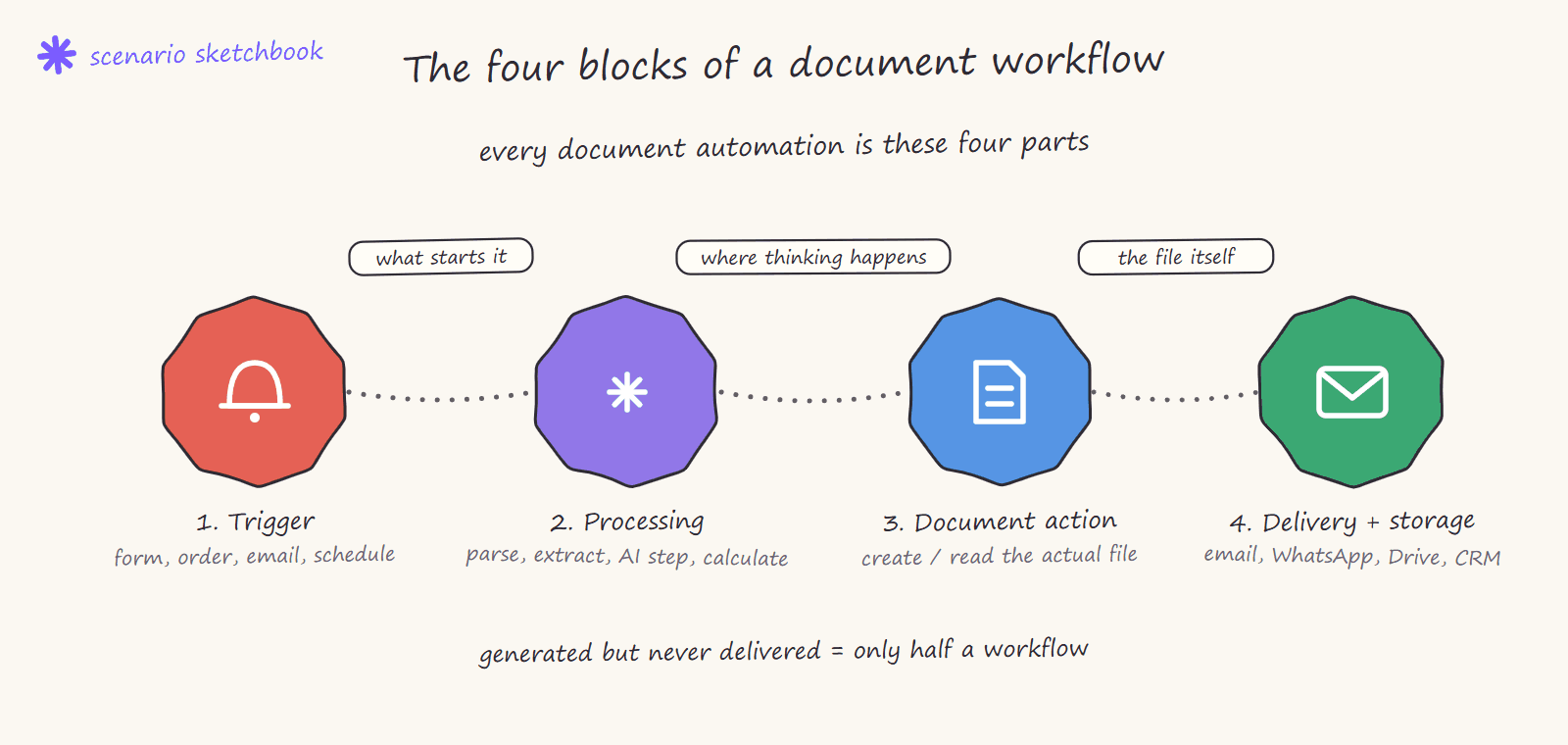
The trigger. What starts the workflow. A new form submission, a paid invoice, a new row in Airtable, an email with an attachment, a scheduled time. This is the event that says a document needs to be made or read.
The processing step. Where the thinking happens. This is parsing an incoming PDF, calling an AI model to extract or generate text, mapping data into the right shape or running calculations. In modern builds this is increasingly an AI step.
The document action. The tool that actually produces or reads the file. Tools like Google Docs, PDF generation services, document parsers and others each handle one type of document job. Make connects to these.
The delivery and storage step. What happens to the finished document. Emailed to a client, sent on WhatsApp, saved to Google Drive, logged in a sheet, attached to a CRM record. A document that is generated but not delivered or stored is only half a workflow.
Understanding these four parts is what lets you look at any manual document task and see how it becomes an automation. Here are all four in one production scenario from our client work: a webhook trigger, iterators and a text aggregator doing the processing, Google Docs creating and reading the document, and a router handing the finished report off for delivery:

The main types of document automation
There are three broad directions document automation runs, and most businesses need all three eventually.
Reading documents (data in). Pulling structured information out of incoming documents: extracting line items from a supplier invoice, key terms from a contract, fields from a scanned form. This is where AI extraction has changed what is possible, because models can now read messy real-world documents that rigid parsers could not. This is covered in depth in the AI PDF extraction guide.
Generating documents (data out). Turning structured data into finished files: invoices from paid orders, contracts from a signed proposal, certificates, branded reports. The data already exists somewhere, the automation assembles it into a professional document. This is covered in the automated invoice and contract guide.
Reformatting and routing. Taking documents that already exist and reshaping or moving them: merging, splitting, converting formats, applying consistent formatting, filing them in the right place. Less glamorous, but it removes a surprising amount of daily friction.
Where AI fits in document automation
AI changed document automation in one specific way: it made unstructured documents machine-readable. Before, automating document reading meant the input had to be perfectly structured, a fixed PDF layout, a clean form. The moment a supplier sent an invoice in a slightly different format, the automation broke.
AI models handle variation. They can read an invoice whether the total is top-right or bottom-left, extract contract terms phrased differently each time and summarise a document into the fields you actually need. Inside Make, an AI step (using models like Gemini, Claude or GPT) sits in the processing slot and does the reading or generating that rigid tools could not.
But AI introduces its own risk, and this is the part most guides skip. AI output is probabilistic, which means it can be confidently wrong. An AI that extracts the wrong invoice total and a human who transposes a digit produce the same problem: a document that looks right and is not. This is why a serious document automation does not just call the AI and trust it. It validates the output, which the extraction guide covers in detail.
The mistakes that quietly break document workflows
Document automations rarely fail loudly. They fail silently, which is worse, because the wrong document goes out before anyone notices. The common failure points across real builds:
- No validation on AI output. The model returns a value, the workflow uses it, nobody checks it was right. The single most common cause of bad automated documents.
- No handling for the document that does not fit. The one invoice in an unexpected format, the contract missing a field. If the workflow has no path for the exception, it either breaks or produces garbage.
- Generated but not verified. The PDF is created but never checked that it actually rendered correctly before being sent.
- Credit-heavy AI steps left unoptimised. Since Make moved to the credit model in August 2025, AI steps cost more than standard modules. A document workflow that calls AI on every field instead of once per document quietly burns budget.
- No record of what was sent. A document goes out with no logged copy, so when a client queries it, there is no record of what they actually received.
How we build document automation at Nex Automations
When we build a document workflow, we start by mapping the four blocks for the specific task, then we design for the exception before the happy path. The question is never just "can we generate this invoice," it is "what happens to the invoice that has a refund, the contract missing a clause, the PDF that fails to render." That is where a document automation either holds up or quietly fails.
We build the validation and error handling in from the start, document the workflow so the team can maintain it and design AI steps to stay credit-efficient. The result is a document pipeline a business can actually trust to run without someone checking every output.

If you want a document or PDF workflow built properly, you can book a call and we will map the highest-value document task in your business first.
FAQ
Q: What document tasks can Make.com automate? A: Make.com can automate generating documents (invoices, contracts, reports, certificates), reading and extracting data from incoming documents and PDFs and reformatting or routing existing files. It connects a trigger, a processing or AI step, a document tool and a delivery step into one workflow.
Q: Can Make.com read data from a PDF? A: Yes. Make can parse structured PDFs directly, and for messy or varied documents it can pass them to an AI model like Gemini or Claude to extract the fields you need. The important part is validating the extracted data before using it, since AI output can be confidently wrong.
Q: Is document automation with Make.com reliable enough for invoices and contracts? A: Yes, when built properly with validation and error handling. The reliability comes from the build quality, not the platform. A workflow that checks its output and handles exceptions is more reliable than manual document handling, which is prone to silent human error.
Q: Do AI document steps cost a lot on Make.com? A: AI steps consume more credits than standard modules since Make moved to the credit model in August 2025. A well-designed workflow calls AI once per document rather than per field, which keeps cost low. Inefficient AI use is a common hidden cost.
Q: What is the difference between document generation and document extraction? A: Generation turns structured data you already have into a finished file, like making an invoice from a paid order. Extraction reads an incoming document and pulls structured data out of it, like reading a supplier invoice. Most businesses need both directions.
Related guides
- AI PDF Extraction with Make and Gemini
- Automated Invoice and Contract Generation with Make.com
- How Much Does Make.com Automation Cost?
- Hire a Make.com Expert: Full Vetting Guide
Want your document workflows built to production standard? Book a free consult: 30 minutes to map the exact flow for your file types and downstream systems. For a fixed-scope build, see the Fiverr's Choice Make.com automation gig. To start building yourself, Make.com's free plan covers basic document routing. Or take 1 month free with 10,000 credits on my partner link.
Want this built this week?
Tell us the apps and the process. Single automations ship in 3 to 7 days with error handling, alerting and a handover walkthrough.
Nex Automations is an automation studio led by Prem Patel, a Make.com Level 5 Expert, Make Silver Solution Partner and Zapier Solution Partner, based in Ahmedabad and working globally. 1,200+ automations built for 210+ clients across 8+ industries in 12+ countries.
- Have it builtThe fit-check takes two minutes. Prem reads every one and replies within 24 hours.
- Automation systems we buildSixteen system types across lead automation, order operations, AI agents, reporting and payments.
- Book a free consult30 minutes to scope the process you want automated.
More from Nex Automations
- ServicesWhat we build and who it is for.
- Case studiesProduction systems with real numbers.
- Automation libraryGuides, insights and mini builds.
- About Prem PatelCredentials, background and how we work.
- ContactBook a call or reach us on any channel.