The changes that matter this month, as of 16 October 2026: n8n published 15 security advisories on 14 October, four rated high on GitHub, so every self-hosted instance below 2.43.5 (or 1.123.85 on the v1 line) should be upgraded now. Zapier folded Agents into an AI step inside the Zap editor on 6 October, which changes how agents are built and billed. Make added version control, signed event subscriptions and fallback connections for its AI Agents. And the AI model lineup turned over: GPT-6.1 Sol, Claude Opus 5.5, Sonnet 5.5, Haiku 5.5 and Gemini 4 Argon replaced most of September's models, with small-model prices halved at OpenAI and cut by 90 percent at Anthropic.
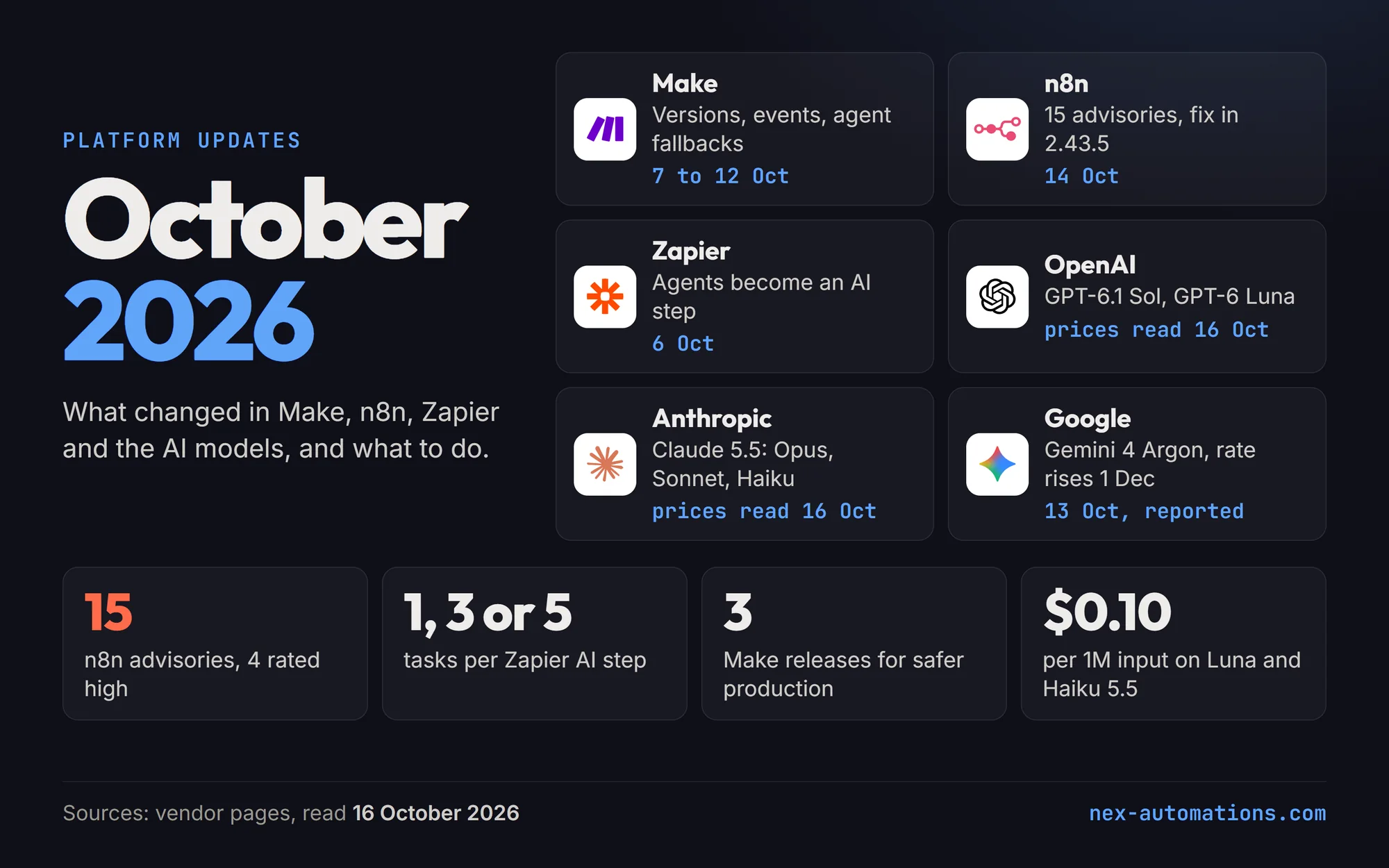
This page is the monthly change log we keep for the platforms our clients run on. Each entry has the date, a link to the source, who it affects and what to do, because a release note tells you what shipped and not whether your scenarios need touching. It is written by Prem Patel, Make Level 5 Expert and Zapier Certified Expert. Every fact below was read from the vendor's own page on 16 October 2026 unless it is marked as reported. The newest month sits on top; earlier months stay below it.
Current versions and prices, as of 16 October 2026
| Platform | Current state | Source |
|---|---|---|
| n8n | Stable 2.43.6 (15 Oct 2026), beta 2.44.2 (15 Oct 2026), v1 line 1.123.85 (14 Oct 2026) | GitHub releases |
| Make | Latest release note 12 Oct 2026; AI modules include Claude Opus 5.5, Sonnet 5.5 and Haiku 5.5, GPT-6.1 Sol and GPT-6 Luna | Make release notes |
| Zapier | Agents run as AI by Zapier steps inside Zaps, billed in tasks, since 6 Oct 2026 | Zapier blog |
| OpenAI | GPT-6 Astra $10 / $50, GPT-6.1 Sol $2 / $10, GPT-6 Luna $0.10 / $0.50 per 1M tokens | OpenAI pricing |
| Anthropic | Claude Fable 5.1 $10 / $50, Opus 5.5 $4 / $20, Sonnet 5.5 $2 / $10, Haiku 5.5 $0.10 / $0.50 (prompts up to 100,000 tokens) | Claude pricing |
| Gemini 4 Argon $2 / $10 to 30 Nov 2026 ($4 / $20 from 1 Dec), Gemini 3.8 Flash $0.75 / $3.75 to 31 Dec 2026, Gemini 3.5 Flash-Lite $0.30 / $2.50 | Gemini pricing |
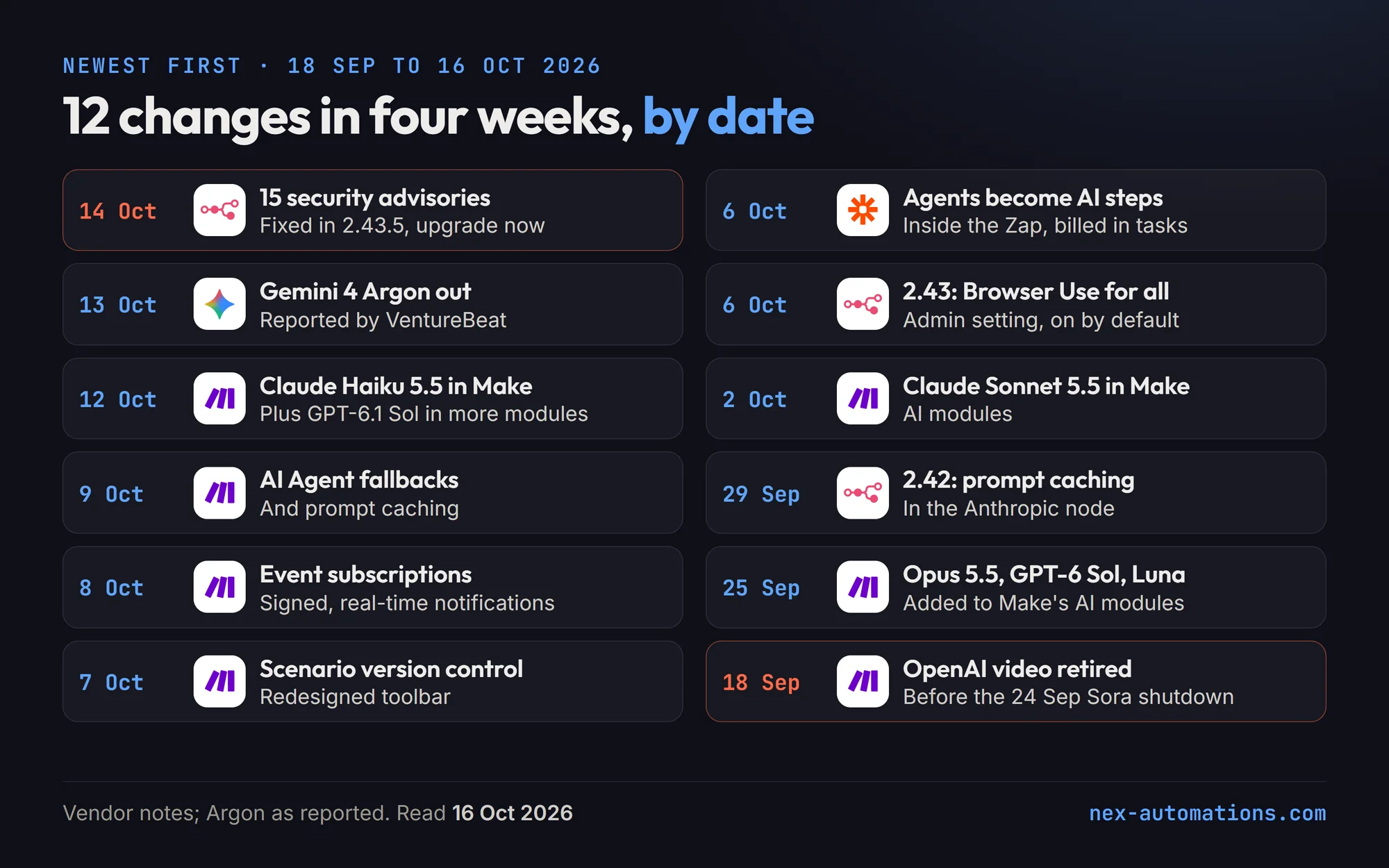
October 2026 at a glance: changes from 18 September to 16 October 2026
| Date | Platform | Change | Who it affects | What to do |
|---|---|---|---|---|
| 14 Oct 2026 | n8n | 15 security advisories (4 high on GitHub); fixed in 2.43.5 (stable), 2.44.1 (beta), 1.123.85 (v1) | Every self-hosted n8n instance | Upgrade this week; Cloud is patched automatically |
| 13 Oct 2026 | Gemini 4 Argon broadly available at $2 / $10 per 1M tokens to 30 Nov, then $4 / $20 (reported by VentureBeat; prices on Google's page) | Anyone picking a frontier model for agents | Test it on your golden set; budget for the December rate | |
| 12 Oct 2026 | Make | Claude Haiku 5.5 and GPT-6.1 Sol in the AI modules; Wealthbox moves to OAuth 2.0; Google Ads API v22 deprecated | Make users on those apps or models | Reconnect Wealthbox; move Google Ads modules off v22 |
| 9 Oct 2026 | Make | Make AI Agents get fallback connections and prompt caching; Claude Sonnet 5.5 and GPT-6.1 Sol; MCP tools for audit logs; SSO login routing | Teams running Make AI Agents | Choose or confirm the fallback connection on every production agent |
| 8 Oct 2026 | Make | Event subscriptions: signed, real-time platform notifications with delivery logs | Anyone monitoring scenarios by polling | Replace polling monitors with a subscription |
| 7 Oct 2026 | Make | Redesigned scenario toolbar and scenario version control | Every Make builder | Save a named version before each production change |
| 6 Oct 2026 | n8n | 2.43: Browser Use released to all users, Supabase OAuth reused for MCP, 12 more features | n8n Assistant users | Decide whether Browser Use stays on (admin setting, on by default) |
| 6 Oct 2026 | Zapier | Zapier Agents is now AI by Zapier: agents run as an AI step inside a Zap, billed in tasks | Every Zapier Agents user | Rebuild agents as AI steps; set a per-run task limit |
| 2 Oct 2026 | Make | Claude Sonnet 5.5 in the AI modules | Make AI module users | Re-run your model choice per step |
| 29 Sep 2026 | n8n | 2.42: Anthropic node gets prompt caching; agents can pay for web search with Gateway credits | n8n workflows calling Claude | Turn caching on for long, repeated system prompts |
| 25 Sep 2026 | Make | Claude Opus 5.5, GPT-6 Sol and Luna (GPT-6 Sol since superseded by GPT-6.1 Sol); MCP tools for webhook queues | Make AI module users | Re-run your model choice per step |
| 18 Sep 2026 | Make | OpenAI video modules retired before the Sora and Videos API shutdown on 24 Sep; legacy OpenAI models deprecated by 28 Sep | Scenarios using OpenAI video or legacy models | Check for failed runs since late September |
Make in October 2026: version control, event subscriptions and safer AI Agents
Make's October releases are mostly about running scenarios safely in production rather than new apps, which is the half of Make that decides whether an automation survives its first bad week. Source for every item: Make's release notes.
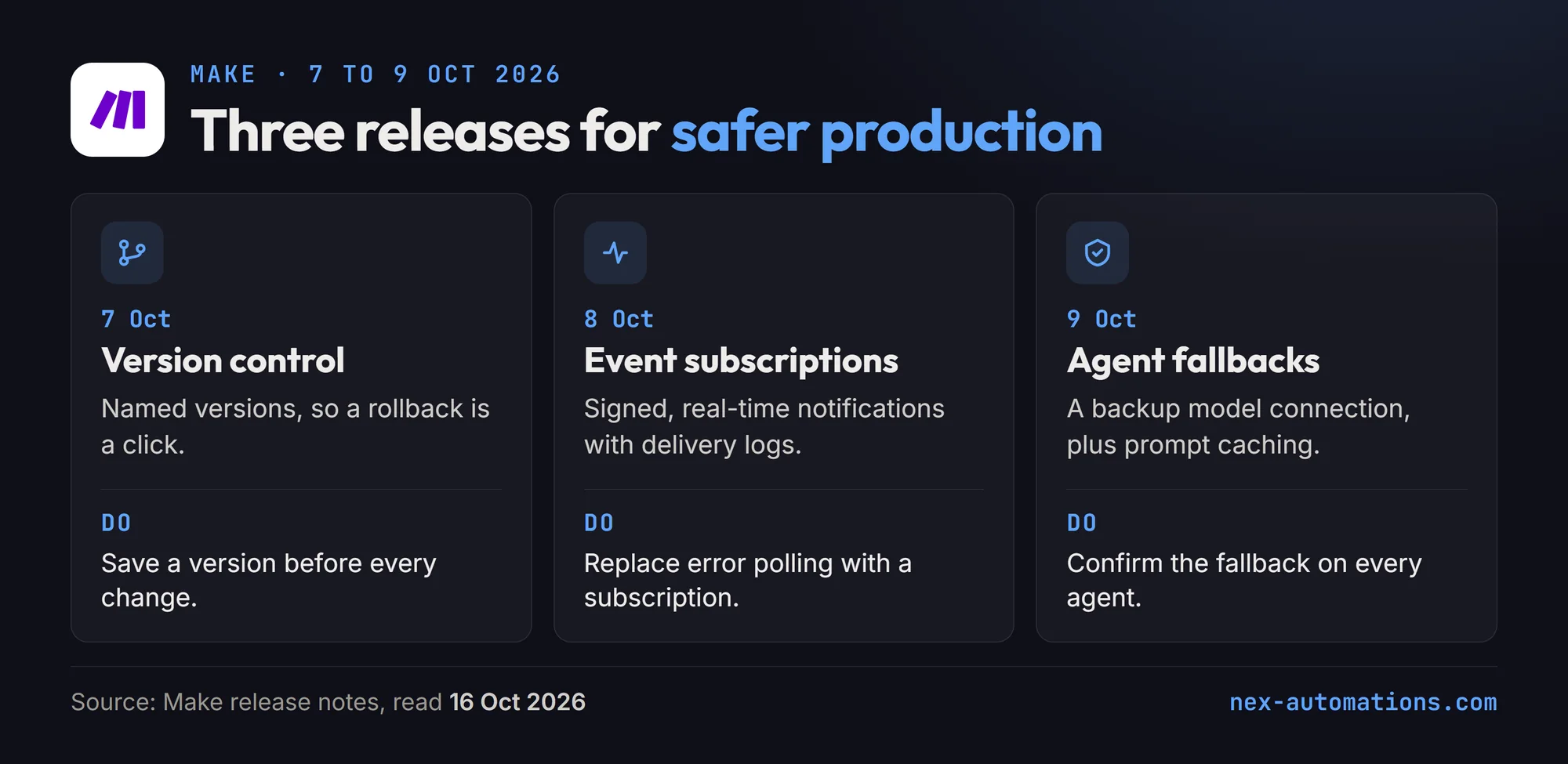
Scenario version control (7 October 2026). The scenario toolbar was redesigned around testing and version control. In practice this ends the "duplicate the scenario before you edit it" habit that leaves accounts full of copies named final-v2. Save a named version before every production change, so a rollback is a click rather than a rebuild. If you hand scenarios to a team or a client, this is now the change record.
Event subscriptions (8 October 2026). You can subscribe to signed, real-time platform notifications, monitor activity and read detailed delivery logs. The use we care about is monitoring: instead of a scheduled scenario that polls for errors, a subscription pushes the event to a webhook you control, signed so you can verify it came from Make. Pair it with the error handling in why Make scenarios fail in production.
Make AI Agents: fallback connections and prompt caching (9 October 2026). A fallback connection lets an agent keep working when its primary model connection fails; Make names its own AI Provider as the default fallback, so choose or confirm the fallback on every production agent rather than assume it. Prompt caching cuts the cost of resending the same long instructions every run. Both close gaps we flagged in the Make AI agents guide. The same release added MCP tools for audit logs (webhook-queue tools arrived on 25 September), so an MCP client such as Claude can now inspect account activity, not just run scenarios; the Claude and Make MCP guide covers the setup.
New models in the AI modules. Make added Claude Opus 5.5 and GPT-6 Sol and Luna on 25 September, Claude Sonnet 5.5 on 2 and 9 October, GPT-6.1 Sol on 9 and 12 October and Claude Haiku 5.5 on 12 October. Gemini 4 Argon was not in the release notes by 16 October; until it is, call it through the HTTP module.
App changes with deadlines. Wealthbox connections move to OAuth 2.0 and Google Ads API v22 is deprecated (both 12 October). OpenAI video modules were retired before OpenAI shut down Sora and the Videos API on 24 September, and legacy OpenAI models were deprecated by 28 September. If a scenario has shown failed runs since late September, check these first. Microsoft Dynamics 365 Business Central connections still set to API v1.0 also fail, per Make's 18 September note.
n8n in October 2026: upgrade first, then look at Browser Use
The security update comes first. n8n's bi-weekly security update of 14 October 2026 lists 15 advisories. GitHub's advisory database rates four of them high:
| Advisory (high severity on GitHub) | CVSS | ID |
|---|---|---|
| Webhook responses without the sandbox policy allow stored cross-site scripting | 8.4 | GHSA-mp7q-23hg-35cf |
| Crafted workflow ID gives access to data tables in other projects | 7.2 | GHSA-wvjj-qg37-pv73 |
| Prototype pollution in workflow history compaction causes denial of service | 7.1 | GHSA-fvv4-gmv9-xqf5 |
| Read/Write Files node glob pattern causes an unbounded event-loop block | 7.1 | GHSA-m7gv-mpg5-7c9v |
n8n's community post also lists GHSA-qmvv-q3c9-wpp7, credential secrets exposed in the execution error data of several nodes, as high; GitHub rates it medium (CVSS 5.3). Either way it is the one to act on beyond the upgrade: check who can read execution data on your instance.
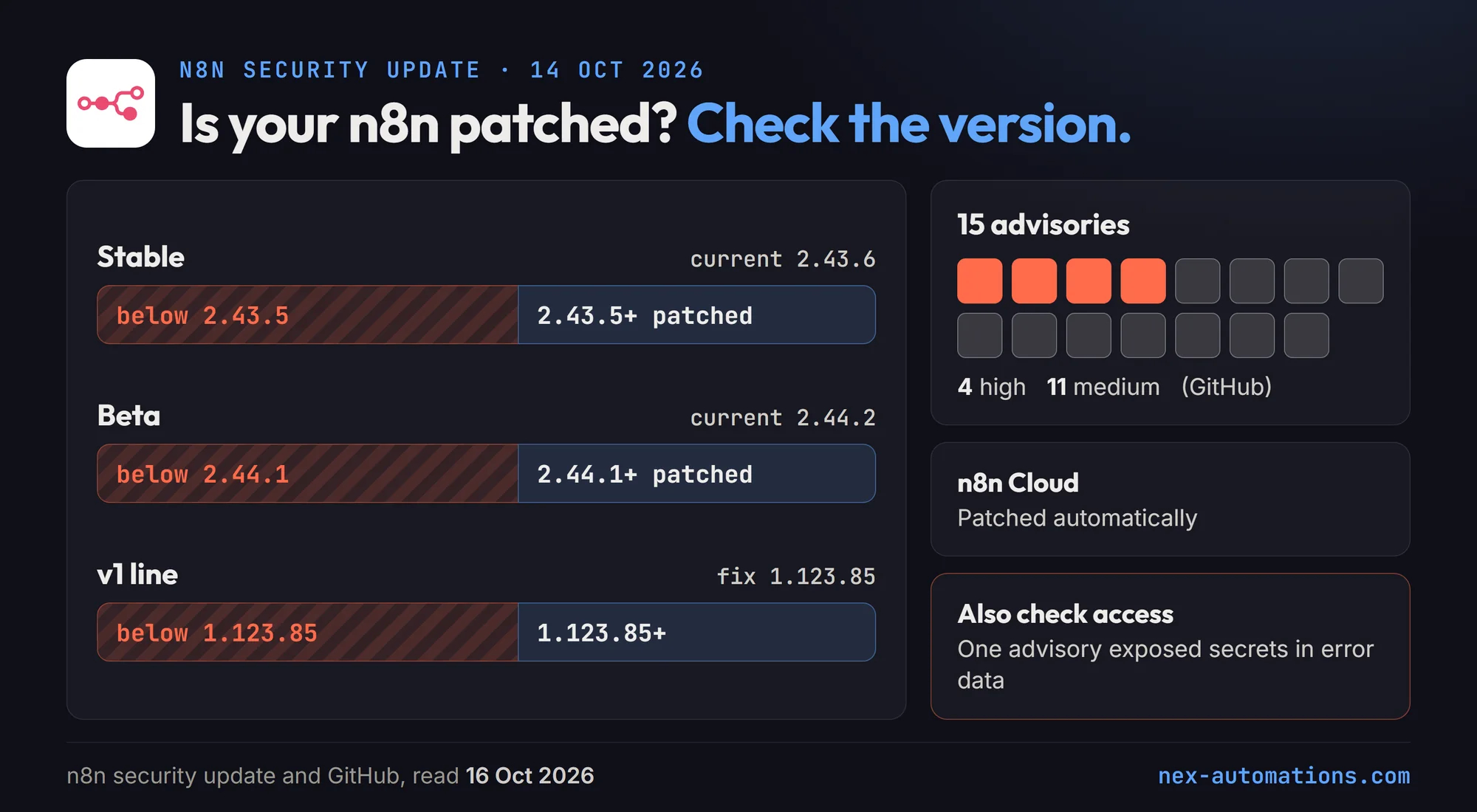
The fixes are in 2.43.5 on the stable line, 2.44.1 on beta and 1.123.85 on v1; GitHub shows 2.43.6 as the current stable release, published 15 October. n8n Cloud is patched automatically. A self-hosted instance below those versions should be upgraded this week. The upgrade itself is covered in our n8n self-hosting cost guide, and the licensing side in n8n pricing, licensing and self-hosting.
n8n 2.43 (6 October 2026). Browser Use, the n8n Assistant feature that drives a connected browser, is now released to all users. An instance admin controls it with N8N_INSTANCE_AI_BROWSER_USE_ENABLED, and it is on by default, so decide deliberately whether a production instance should allow it. The same release lets Supabase OAuth credentials enable the Supabase MCP server in the Assistant and shows Gateway credits promotions on eligible community nodes. Source: n8n release notes.
n8n 2.42 (29 September 2026). The Anthropic node gained prompt caching, and agents can pay for web search with Gateway credits. If an n8n workflow sends Claude the same long system prompt on every run, turn caching on: on Claude Sonnet 5.5 and Opus 5.5 a cache read costs 5 percent of the normal input price.
Zapier in October 2026: Agents became an AI step inside the Zap
Zapier's post "Zapier Agents is now AI by Zapier", published 6 October 2026, moves agent capabilities into a single AI step in the Zap editor. The four parts of an agent (instructions, tools, a trigger and permission to act) now sit inside a normal Zap, so an agent can use Zapier triggers, filters, paths and run history, which the standalone product could not.
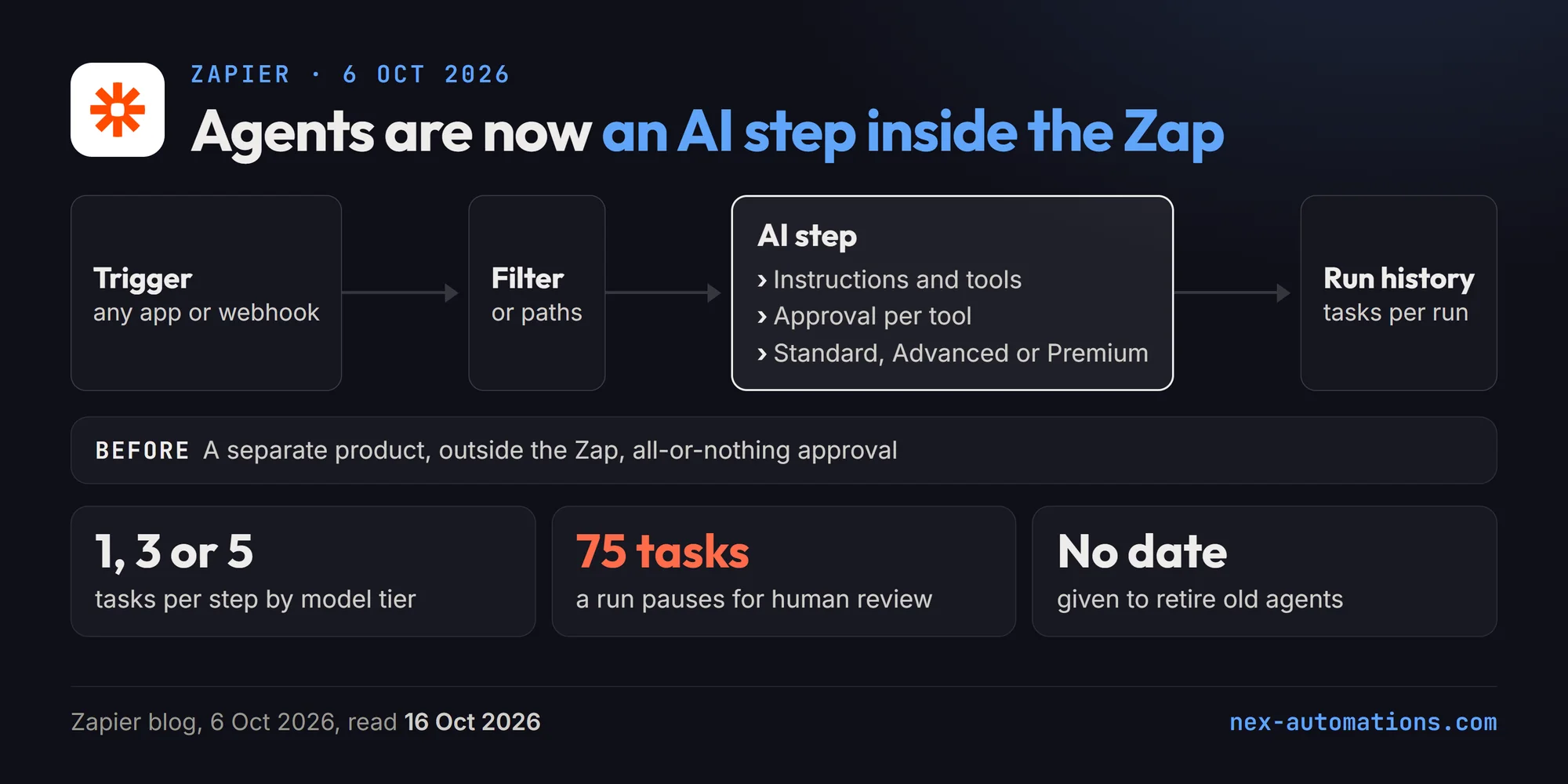
| What changed | Before | Now |
|---|---|---|
| Where an agent lives | A separate Agents product | An AI step inside a Zap |
| Triggers | A few agent triggers | Any app trigger; webhooks replace chat or on-demand agents; sub-Zap triggers let one agent call another |
| Approval | All-or-nothing per agent | Per tool |
| Model choice | Not selectable | Standard, Advanced or Premium tier, or a named model |
| Billing | Activity-based | Tasks: default models are free, other tiers multiply, so a step uses 1, 3 or 5 tasks; usage per run shows in Zap History |
| Runaway protection | None stated | A per-run task limit; a run that crosses 75 tasks pauses for human review |
What to do. Existing agents show a banner linking to a migration guide; rebuild each one as an AI step with the same goal and tools. Zapier gave no shutdown date for the old agents in the post. Set the per-run task limit on every AI step, and put per-tool approval on anything that sends, pays or deletes. Knowledge sources work in the AI step, but HubSpot, Asana, Zendesk, Zoom and Jira were not yet supported. For how this compares with Make and n8n, see Zapier vs Make vs n8n and iPaaS for AI agents.
AI models in October 2026: a new generation and cheaper small models
| Tier | September 2026 | October 2026 (per 1M tokens, input / output) |
|---|---|---|
| Small (labels, routing, scores) | GPT-5.6 Luna $0.20 / $1.20, Claude Haiku 4.5 $1 / $5 | GPT-6 Luna $0.10 / $0.50, Claude Haiku 5.5 $0.10 / $0.50 (prompts up to 100,000 tokens) |
| Mid (extraction, summaries, drafts) | Claude Sonnet 5 $2 / $10, GPT-5.6 Terra $2 / $12 | Claude Sonnet 5.5 $2 / $10, GPT-6.1 Sol $2 / $10, Gemini 3.8 Flash $0.75 / $3.75 to 31 Dec |
| Frontier (agents with tools) | Claude Opus 5 $5 / $25, GPT-5.6 Sol $4 / $20 | Claude Opus 5.5 $4 / $20, Gemini 4 Argon $2 / $10 to 30 Nov ($4 / $20 after) |
| Top of the range | Claude Fable 5.1, GPT-6 Astra $10 / $50 | Unchanged |
Sources: OpenAI, Anthropic and Google API pricing pages, read 16 October 2026. Anthropic's models overview now says: "If you're unsure which model to use, start with Claude Opus 5.5 for most workloads." Cache reads on GPT-6.1 Sol, Claude Opus 5.5, Claude Sonnet 5.5 and Gemini 4 Argon cost 5 percent of the input price, half the usual 10 percent.
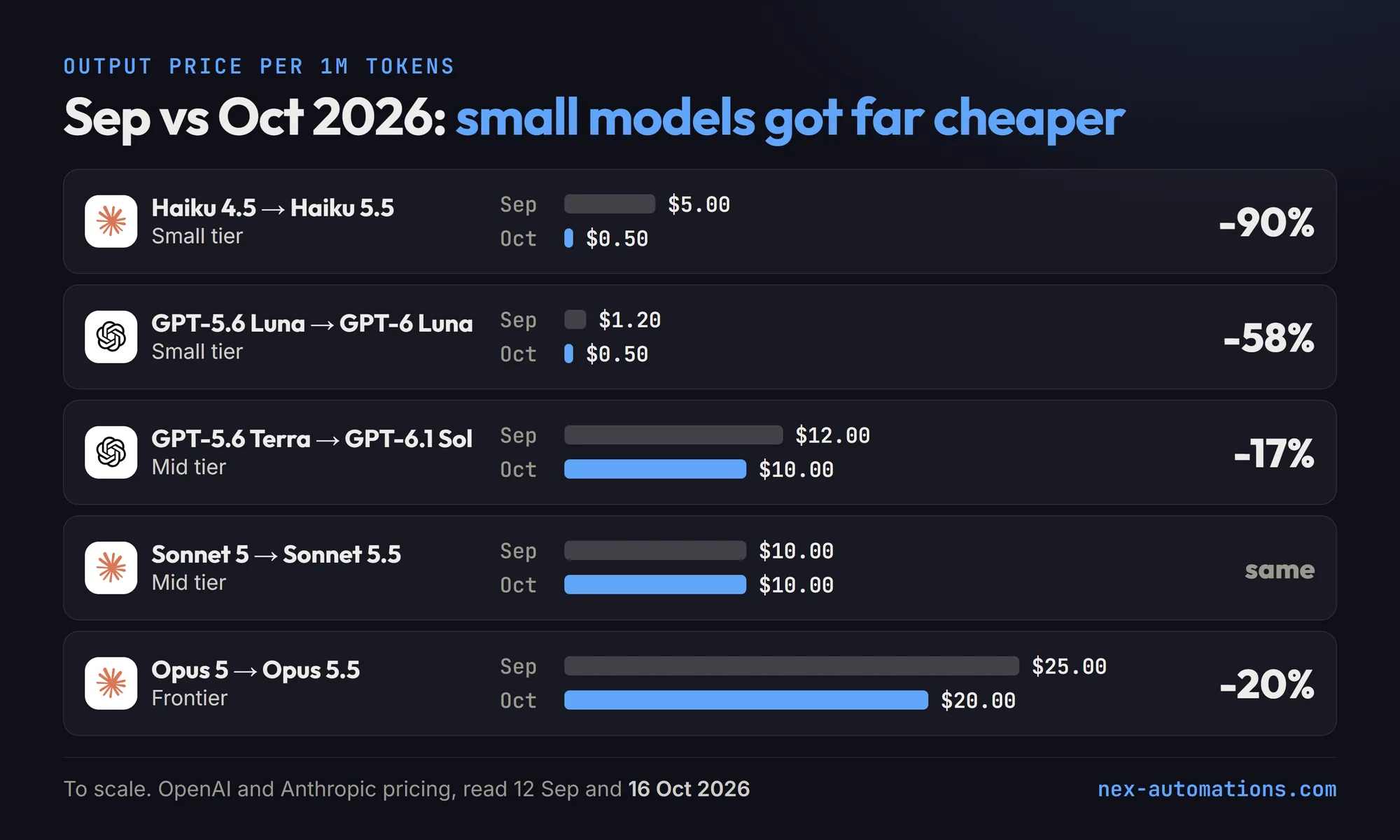
What to do. Do not swap models because a newer one exists. Re-run your golden set on the new small models first, because that is where the saving is: a classification step at 600 input and 20 output tokens costs $0.07 per 1,000 runs on GPT-6 Luna or Claude Haiku 5.5. The full routing, with a cost table per job and model, is in which AI model for which automation workflow, and every model with its API ID, context window and the date it reached Make is in the AI model landscape for October 2026.
AI search in October 2026: what Google says about AI Mode
For anyone publishing content to be found in AI answers: Google's Search Central page on AI features (last updated 10 December 2025, read 16 October 2026) says "There are no additional requirements to appear in AI Overviews or AI Mode, nor other special optimizations necessary," and that "There's also no special schema.org structured data that you need to add." Pages must be indexed and eligible for a snippet. Clicks from AI Overviews and AI Mode are counted in Search Console's Performance report under the Web search type, so there is no separate AI report to wait for. Trade coverage in October also reported more inline source links inside AI Overviews and AI Mode answers; we have not seen Google's own post on that, so treat it as reported, not confirmed.
What this means for a business running automations
- Self-hosted n8n: upgrade to 2.43.5 or later (1.123.85 on v1) this week, then check who can read execution data.
- Zapier Agents: rebuild as AI steps before you rely on them again, with a per-run task limit set.
- Make AI Agents: confirm the fallback connection and turn on prompt caching on every production agent.
- Any AI step: re-test the small tier; at October prices it may halve the bill without a quality loss.
- Monitoring: if you poll for errors on Make, move to an event subscription and save a named version before each change.
If you would rather we check this for you, an automation audit covers exactly this list against your own scenarios, Zaps and workflows, or book a free 30-minute call and bring the account you are worried about.
Frequently asked questions
What changed in Make.com in October 2026?
Make shipped a redesigned scenario toolbar with version control (7 October 2026), event subscriptions for signed real-time platform notifications with delivery logs (8 October), fallback connections and prompt caching for Make AI Agents plus MCP tools for audit logs (9 October) and support for Claude Sonnet 5.5, GPT-6.1 Sol and Claude Haiku 5.5 in its AI modules (2 to 12 October). Source: Make's release notes at help.make.com, read 16 October 2026.
What is the latest n8n version in October 2026?
On 16 October 2026 GitHub shows n8n 2.43.6 as the current stable release (published 15 October 2026), 2.44.2 as the current beta and 1.123.85 on the v1 line. The security fixes of 14 October are in 2.43.5 and later on stable, 2.44.1 and later on beta and 1.123.85 on v1, so any of those is safe to run.
Is it safe to self-host n8n after the October 2026 security advisories?
Yes, once you upgrade. n8n's security update of 14 October 2026 lists 15 advisories; GitHub's advisory database rates four of them high, including stored cross-site scripting through webhook responses (CVSS 8.4), and a fifth on credential secrets exposed in execution error data, which n8n's post lists as high and GitHub rates medium. They are fixed in n8n 2.43.5 on the stable line, 2.44.1 on beta and 1.123.85 on v1. n8n Cloud is patched automatically; self-hosted instances below those versions should upgrade now.
What happened to Zapier Agents?
On 6 October 2026 Zapier folded Agents into AI by Zapier: an agent is now an AI step inside a normal Zap, so it gets Zapier triggers, filters, paths and run history. Approval can be required per tool and a run that crosses 75 tasks pauses for human review. Existing agents show a banner linking to a migration guide; Zapier gave no shutdown date for the old agents in its announcement.
How many tasks does an AI by Zapier step use?
Per Zapier's post of 6 October 2026, an AI step bills as tasks: default models are free, and the Standard, Advanced and Premium model tiers carry multipliers, so a step can use 1, 3 or 5 tasks. Usage per run shows in Zap History, you can set a per-run task limit and a run that crosses 75 tasks pauses for human review.
Which new AI models can I use inside Make.com right now?
Make's release notes add Claude Opus 5.5 (25 September 2026), Claude Sonnet 5.5 (2 and 9 October), GPT-6.1 Sol (9 and 12 October) and Claude Haiku 5.5 (12 October), alongside GPT-6 Sol and Luna from 25 September. Google's Gemini 4 Argon, made broadly available on 13 October per VentureBeat, was not in Make's release notes by 16 October, so call it through the HTTP module until a native module lands.
Do I need to optimise my site separately for Google AI Mode?
Google says no. Its Search Central page on AI features states: "There are no additional requirements to appear in AI Overviews or AI Mode, nor other special optimizations necessary," and that no special schema.org markup is needed. Clicks from AI Overviews and AI Mode are counted in Search Console's Performance report under the Web search type. What helps is what always helped: indexable pages, clear answers, dated facts and sources.