Every figure on this page was checked against n8n's own pricing page and its LICENSE.md on 1 September 2026. Where the number you have seen elsewhere is different, the reason is usually one of two things, and both are explained below.
Security update, 16 October 2026: n8n's security update of 14 October 2026 lists 15 advisories, four rated high on GitHub, fixed in 2.43.5 (stable), 2.44.1 (beta) and 1.123.85 (v1). n8n Cloud is patched automatically; a self-hosted instance below those versions should be upgraded now. The pricing and licence figures below are as checked on 1 September 2026. Details: automation platform updates for October 2026.
This page covers what n8n itself charges and what its licence lets you do. For server sizing and dated Hostinger and DigitalOcean costs, use the companion n8n self-hosting cost guide, which starts where this one ends, at the server.
Two facts decide most n8n decisions, and both are routinely reported wrong:
- n8n is not open source. It ships under the Sustainable Use License, which restricts you to internal business use. GitHub itself reports the licence as
NOASSERTION. - n8n bills per workflow execution, not per step. A fifty-node workflow and a two-node workflow each cost one execution. That single difference is why n8n can be dramatically cheaper than Make or Zapier at the same volume, and why it sometimes is not.
What n8n Costs, From n8n
Prices below are from n8n.io/pricing, read 1 September 2026, on the annual billing toggle.
| Plan | Price | Included executions | Active workflows |
|---|---|---|---|
| Starter | 20€/mo, billed annually | 2,500 workflow executions | Unlimited |
| Pro | 50€/mo, billed annually | 10,000 workflow executions | Unlimited |
| Business | 667€/mo, billed annually | 40,000 workflow executions | Unlimited |
| Enterprise | Contact sales | Custom | Unlimited |
If the numbers you have seen are 24€, 60€ and 800€, you were reading monthly billing. Several widely-shared 2026 pricing round-ups quote the monthly figures while describing them as the standard price. The annual and monthly prices are both real; they are just different products. Check which toggle a comparison used before you budget from it.
Two details that matter more than the headline price:
- Unlimited steps per execution. n8n's own definition: an execution is "a single run of your entire workflow. It doesn't matter how many steps are in the workflow or how much data it processes. It's still a single execution."
- Unlimited active workflows on every paid tier. Older comparisons still describe active-workflow caps on lower plans. That limit is gone.
Trials, as listed on the same page: Starter and Pro trials give access to all Pro features with Starter limits (5 concurrent executions) and no credit card. The Business trial runs 14 days and does require a card.
The Licence Is the Part That Catches People
This is the section most n8n articles skip, and it is the one that changes what you are allowed to do.
n8n's LICENSE.md puts the main codebase under the Sustainable Use License, Version 1.0. The limitation clause, quoted in full:
"You may use or modify the software only for your own internal business purposes or for non-commercial or personal use. You may distribute the software or provide it to others only if you do so free of charge for non-commercial purposes."
Read that twice if you are hiring someone to run n8n for you. Three consequences follow.
n8n is not OSI open source, and calling it that is wrong. GitHub classifies the repository as NOASSERTION rather than any recognised open-source licence. The project is enormously popular, 203,016 stars and 60,484 forks as of 1 September 2026, and it is source-available. Those are not the same thing, and the difference is legally operative.
An agency generally cannot host n8n for you as a commercial service. "Internal business purposes" means your own. A vendor running an n8n instance on your behalf, charging you for it, is not obviously covered by the community licence. The clean patterns are: n8n runs on infrastructure you own and control, or you buy a plan from n8n, or your vendor holds an appropriate licence. If a consultancy offers to "host your n8n for a monthly fee" with no mention of licensing, ask which licence covers it.
Some of the code is not under that licence at all. Files with .ee. in the filename or .ee in the directory name are Enterprise-licensed and require a valid n8n Enterprise License. Branches other than master are explicitly not licensed. If you are forking or vendoring parts of n8n, that boundary is real.
None of this makes n8n a bad choice. It makes it a choice with a shape, and the shape is worth knowing before someone builds your operations on it.
Self-Hosting: Free Software, Real Costs
The community edition is free and has no execution cap. What it has instead is an operating cost that is easy to underestimate.
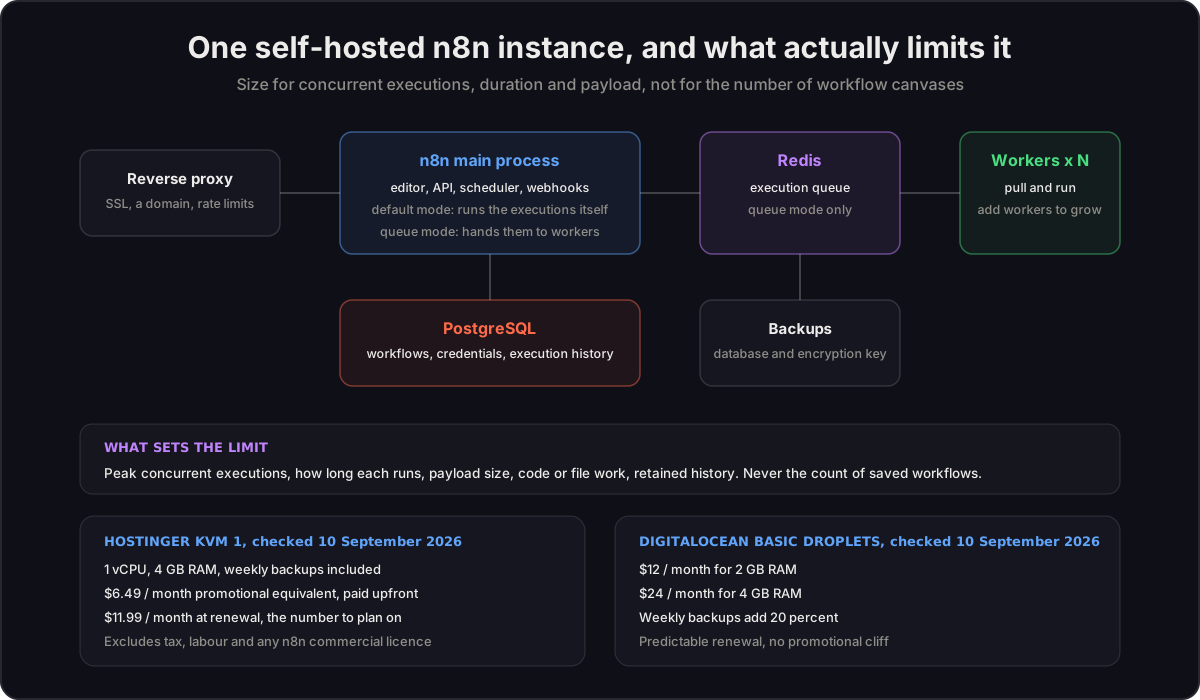
The server itself is the cheap part. What people miss:
- Upgrades. n8n ships frequently. Someone has to test and apply updates, and occasionally fix a breaking node change.
- Backups and restore. Not backups. Restore. An untested backup is a hope.
- Monitoring. A self-hosted instance that dies at 02:00 stays dead until someone notices. A silently failing automation is worse than a manual process, because nobody is watching it fail.
- Queue mode and scaling. Concurrency on a single instance is limited. Real volume means Redis, workers and more moving parts.
- Security. You now own patching, access control and secret storage for a system holding credentials to every tool it touches.
The honest framing: self-hosted n8n trades a subscription for engineering time. If you have someone who already runs infrastructure, that trade is often excellent. If you do not, the cloud plan is usually cheaper than the first outage.
Paid self-hosting works differently. Business and Enterprise plans are available self-hosted, and n8n's pricing page states that a self-hosted paid instance "receive[s] a license key that must ping our license server daily to stay active." Worth knowing if you were planning an air-gapped deployment.
Where the Execution Model Actually Wins
This is the part worth modelling before you migrate anything.
The three major platforms count differently:
- n8n counts one execution per workflow run, regardless of node count.
- Make counts operations, roughly one per module run.
- Zapier counts tasks, roughly one per action step.
So the cost gap is not a percentage. It scales with how many steps your average workflow has.
A three-step workflow run 1,000 times is 1,000 n8n executions and roughly 3,000 Make operations or Zapier tasks. Nothing dramatic. A thirty-step workflow run 1,000 times is still 1,000 n8n executions and roughly 30,000 operations or tasks. That is the same work billed an order of magnitude apart.
The practical rule: n8n's pricing advantage grows with workflow complexity, not with volume alone. Teams running many simple two or three-step automations often find the difference modest. Teams running few, deep, branching workflows over large datasets find it decisive.
Two caveats before you treat that as a migration case:
- Loops and iterations inside a single run still cost compute even when they cost one execution. Cheap billing is not free compute; an under-specified server will simply be slow.
- The migration itself has a cost, and it is usually larger than the first year of savings on small stacks. We wrote up what moving between platforms actually involves in the platform comparison.
When n8n Is the Wrong Answer
Said plainly, because most pages on this topic are written by people selling n8n builds.
- Nobody on the team can operate a server, and you self-host anyway. This is the single most common failure. The build works, then drifts, then breaks quietly.
- Your team needs to maintain the automations themselves and is non-technical. n8n's ceiling is higher than Make's or Zapier's, and so is its floor. If the people who own the process cannot read the workflow, you have bought a dependency.
- You need a specific integration that n8n does not have and you cannot build. n8n's HTTP node covers most gaps, but "we will just use the HTTP node" is an engineering commitment, not a checkbox.
- Compliance requires a vendor relationship. Community-edition self-hosting gives you no support contract and no SLA.
If two or more of those apply, Make or Zapier is usually the better answer even where n8n is cheaper on paper. The cheapest platform is the one that keeps running.
What This Means If You Are Hiring
We build on n8n, Make and Zapier, and we are deliberate about the difference in credentials.
Nex Automations is a Make.com Level 5 Expert and Make Silver Solution Partner, and a Zapier Solution Partner, both independently verifiable in the vendors' own directories. We hold no n8n certification, because n8n's partner programme is not one we are in. What we have on n8n is production work: an n8n content engine that publishes through the Threads API on a schedule with a first-hour reply step, an AI voice and reels pipeline, and a Yelp lead-response agent.
We say that plainly because the questions worth asking a prospective n8n builder are not about badges:
- Where will this run, and who owns that infrastructure? The licence answer above should be part of their answer, unprompted.
- What happens when a node breaks after an upgrade? Listen for a maintenance model, not a reassurance.
- How will I know it failed? If there is no alerting story, there is no production story.
- Can my team modify this without you? Both answers are legitimate. It should be your choice, not a condition they created.
- Would you recommend n8n here at all? Anyone who recommends one platform regardless of the process is selling, not scoping.
If you would rather talk it through first, book the free 30-minute consult and bring one workflow and its monthly volume. If you want that decision made per workflow on your real volume and logic before anyone builds anything, that is exactly what the automation audit is: a written platform decision with the reasons and cost bands, fixed fee, credited against the build.
Frequently Asked Questions
Is n8n open source?
No, not in the OSI sense, and this is widely misreported. The main codebase uses the Sustainable Use License, Version 1.0, which limits you to "your own internal business purposes or for non-commercial or personal use". GitHub classifies the repository as NOASSERTION rather than a recognised open-source licence. n8n is source-available and very widely used, 203,016 stars and 60,484 forks as of 1 September 2026, but source-available and open source are different things. Files containing .ee. in the name are Enterprise-licensed separately.
How much does n8n cost in 2026?
On annual billing, from n8n's own pricing page read 1 September 2026: Starter 20€/mo for 2,500 workflow executions, Pro 50€/mo for 10,000, Business 667€/mo for 40,000, and Enterprise on request. All paid tiers include unlimited active workflows and unlimited steps per execution. If you have seen 24€, 60€ and 800€, those are the monthly-billing prices.
Can an agency host n8n for me?
Not straightforwardly under the community licence. The Sustainable Use License permits use "only for your own internal business purposes", and permits providing the software to others "only if you do so free of charge for non-commercial purposes". The clean arrangements are: the instance runs on infrastructure you own, or you hold an n8n plan, or your vendor holds a licence that covers it. If a vendor offers hosted n8n for a monthly fee, ask which licence covers the arrangement before you sign.
Is n8n cheaper than Make or Zapier?
It depends on how many steps your workflows have, not on how many runs. n8n bills one execution per workflow run regardless of node count; Make bills per operation and Zapier per task, roughly per step. A thirty-step workflow run 1,000 times is 1,000 n8n executions against roughly 30,000 operations or tasks. Deep, branching workflows favour n8n heavily; many small two-step automations barely differ.
Is self-hosted n8n really free?
The software is free with no execution cap. The operating cost is not: upgrades, tested restores, monitoring, queue-mode scaling and security patching all need an owner. Self-hosting trades a subscription for engineering time, which is a good trade if you already run infrastructure and a poor one if you do not. Note also that self-hosted paid plans require a licence key that pings n8n's licence server daily, which matters for air-gapped deployments.
Do I need an n8n certified partner?
There is no equivalent of Make's Level 5 certification that most n8n builders hold, so certification is a weak filter here. Judge on production evidence instead: ask where it will run and under which licence, how failures alert someone, what happens after an upgrade breaks a node, and whether your team can maintain it without the builder.
Related guides
- n8n Self-Hosting Cost: Hostinger vs DigitalOcean (2026)
- Make.com vs Zapier vs n8n: Which Should You Use?
- Automation platform cost calculator: n8n Cloud, self-hosted n8n with server and maintenance cost, Make and Zapier on one screen
- iPaaS Landscape 2026: Eight Enterprise Platforms Compared
- Best iPaaS Platforms for AI Agents in 2026
- How Much Does Make.com Automation Cost?
About the author: Prem Patel is the founder of Nex Automations, an automation studio based in Ahmedabad, India. He has built 1,200+ automations for 210+ clients on Make.com, Zapier and n8n. He is a Make.com Level 5 Expert and Make Silver Solution Partner and a Zapier Solution Partner. Corrections to any figure on this page are welcome and will be dated.