Which Automation Service Do You Actually Need? Audit, Fixed-Scope Build, Custom System or Support (2026)
A 60-second decision table for the four ways to buy automation work, with the published price bands and timelines for each, the safety checklist before you hire anyone, and the one rule that settles it.
Last verified: 10 September 2026 · Prem Patel, Nex Automations
The right automation service depends less on the tool than on how clearly you can describe the problem. If you cannot write the acceptance test yet, buy discovery or an audit. If you can, and the workflow is contained, buy a fixed-scope build. If several processes, teams or real money are involved, buy a custom system. If the automation already exists and matters, buy support. That is the whole decision; the rest of this page is how to apply it and what each option costs.
This is a decision aid from 6+ years and 1,200+ automations of doing this for 210+ clients as a Make.com Level 5 Expert and Zapier Certified Expert, not a quotation. Scope, risk, data sensitivity and integrations set the final price, and every price on this page is a published band from our own service pages, checked 10 September 2026.
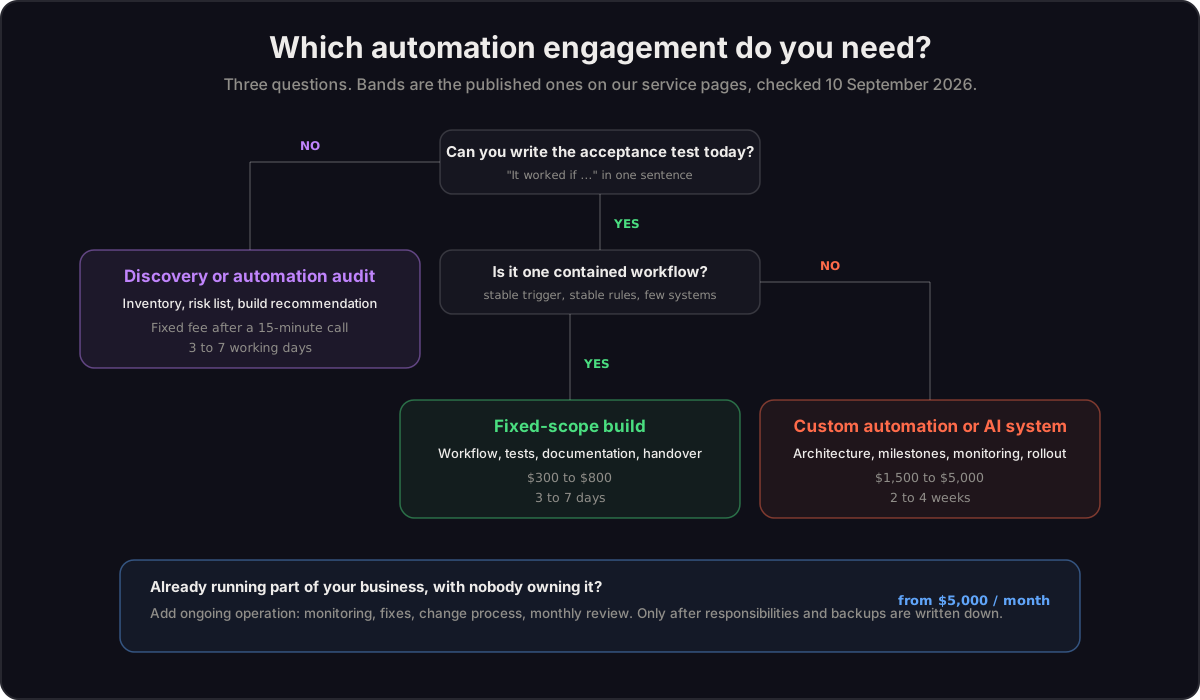
The 60-second decision table
| Engagement | Buy it when | What you get | Published band | Typical timeline |
|---|---|---|---|---|
| Automation audit | You run automations already and something is slow, failing or unowned | Written inventory, risk list, fix-or-retire priority order, build recommendation | Fixed fee, quoted after a 15-minute call | 3 to 7 working days |
| Fixed-scope build | One workflow with a stable trigger, stable rules and a testable result | The working workflow, tests, documentation and handover | $300 to $800 | 3 to 7 days |
| Custom automation or AI system | Several workflows, systems, teams or AI decisions must work together | Architecture, phased implementation, monitoring, rollout | $1,500 to $5,000 | 2 to 4 weeks |
| Ongoing operation | A live system carries revenue, customers or compliance and needs an owner | Monitoring, fixes, change process, monthly review | From $5,000 a month | Ongoing |
If two rows both look right, the higher-risk row is the honest answer. Under-scoping shows up later as disputed scope and a second invoice; over-scoping shows up now as a quote you can decline.
Buy an audit when you cannot see what is broken
An audit is for the business that already automates and has stopped trusting it. The signals are familiar: task or credit bills that climb without new work, duplicate records nobody can explain, silent failures found by a customer, a scenario only the person who left understood.
The deliverable is a written inventory and a priority list, and it is useful even if you hire someone else to act on it. When we audited a monday.com operations account that was supposed to be automated, the inventory found zero live automations; the rebuild that followed delivered 25 across nine boards. The audit came first because nobody knew the true starting point, and building on a false one would have wasted the budget.
Do not buy an audit to explain a documented two-step workflow. That is a fixed-scope build with an extra invoice in front of it.
Buy a fixed-scope build when the finish line is testable
A fixed-scope project works when you can say what starts the workflow, what data is available, what should happen and how you will know it worked. Routing qualified form submissions into a CRM, generating a document from a template, syncing orders between two systems, sending an alert when a threshold is crossed: all of these can be written down before work begins, which is what makes a fixed price safe for both sides.
A safe fixed scope states:
- the applications, triggers, actions and branches included;
- the sample records and test cases you will supply;
- which subscriptions and credentials stay in your name;
- how many review rounds are included and how changes are approved;
- the documentation and handover you receive;
- explicit exclusions, including new integrations and materially different rules.
If those six points cannot be agreed today, you are not ready for a fixed price, and discovery is the cheaper first purchase. The fixed-scope versus custom guide goes through the contract side in detail.
Buy a custom system when failure would hurt
A custom system is the right shape when the work spans several workflows, touches money or customers, needs a custom API, requires AI judgement, or has to keep running when a tool changes. The deliverable is not a canvas with connected boxes. It is a production system: retries, rate-limit handling, idempotency, alerts, audit records, a manual-review path for the cases the machine should not decide alone, and documentation your team can operate.
The transportation invoice system is the shape of this: three tools, a 30-day cycle cut to 7 days, 77% less processing time, and error handling that keeps shipping when one upstream record is bad. That is not a fixed-scope build, and pricing it as one would have produced either a failed project or a quiet second invoice.
Custom work is usually split into milestones so assumptions get checked before the expensive part starts: architecture and a thin production slice first, then integrations and exceptions, then hardening and rollout.
Buy ongoing operation when the system already matters
Support is for the automation that has become infrastructure. If a lead-routing flow going down means sales stops, or a reporting flow feeds a decision every morning, somebody has to own it, and it should be written down who.
The first step is an inventory and a risk assessment. Ongoing operation only makes sense once responsibilities, response times, access, backups, change approval and excluded incidents are all on paper. Without that, a retainer is a monthly fee for hope.
Which buying route
| Route | Fits | Watch for |
|---|---|---|
| Direct, starting with the free consult | Unclear, multi-system or high-risk work | Requires a written proposal before the final cost is known, which is the point |
| Marketplace package (Fiverr, Upwork, Contra) | A small, repeatable, tightly defined deliverable | Poor fit for changing or cross-team scope; the platform fee buys escrow, not quality |
| Milestone contract | Custom systems where staged payment protects both sides | The statement of work still has to be written carefully |
No route is automatically safer. Safety comes from precise scope, client-owned accounts, least-privilege access, written acceptance criteria and a handover plan. We publish the packages and price bands on the Make.com consultant, Zapier consultant and automation audit pages so the direct route starts with the same clarity a marketplace listing gives you.
The safety checklist before you hire anyone
- Keep production accounts, domains, databases and billing under your organisation.
- Prefer delegated access or a separate collaborator account over sharing a master password.
- Provide synthetic or redacted sample data until real data is necessary.
- Record which system is authoritative for every important field.
- Agree test cases, failure behaviour and who can approve production changes.
- Require documentation and credential-revocation steps at handover.
- Confirm any regulatory, retention or data-location requirement before choosing a platform.
Three requests, priced against the table
"Our Typeform leads need to land in HubSpot with the right owner." Trigger, actions and result are all nameable, one workflow, two systems. Row two: a fixed-scope build, $300 to $800, live within the week. If the routing rules turn out to live in three people's heads, that surfaces on day one and the quote changes before any work does.
"Our Make account has 40 scenarios and the bill doubled; nobody knows which ones matter." Nobody can write the acceptance test because nobody knows the current state. Row one: an audit. The inventory is the deliverable, and the fix list that follows is usually a mix of retire, repair and rebuild, each of which is then a fixed-scope item with its own price.
"Invoices arrive by email from 30 carriers in 30 formats and need to reach accounting, the ERP and the customer portal." Several systems, money on the line, exceptions guaranteed, and AI reading documents it has not seen before. Row three: a custom system on milestones, in the $1,500 to $5,000 band, with the manual-review path designed before the automation. That is the shape of the transportation invoice build, and pricing it as a fixed-scope job would have been a mistake for both sides.
What it will actually cost you
There is no permanent price attached to an engagement type, because a single predictable workflow and a multi-team AI operations system should not be priced from the same menu. What we do publish, and hold to, is that every quote is fixed scope before work starts, platform subscriptions are yours and quoted separately, and the bands above are the bands. If you want to price the platform side before you talk to anyone, the Zapier vs Make vs n8n cost calculator does that from your own volume.
The shortest decision rule
If you cannot write the acceptance test, choose discovery. If you can write it and the workflow is contained, choose a fixed-scope build. If several processes or high-impact failures are involved, choose a custom system. If the system already runs your business, choose support.
Still unsure which row you are in? That is exactly what the free 30-minute consult is for. You leave with the row, a rough scope and a price, whether or not you build it with us. See all services for what each engagement includes.
Frequently asked questions
What is the difference between an automation audit and an automation build?
An audit inspects what you already run and tells you what to fix, retire or build, with a written report and a priority order. A build ships a working workflow. Buy the audit when the problem is "we do not know what is broken or where to start"; buy the build when you can already describe the trigger, the actions and the result.
How much does an automation project cost?
A single stable workflow runs $300 to $800 and ships in 3 to 7 days. A multi-workflow system is $1,500 to $5,000 over 2 to 4 weeks. Ongoing operation starts at $5,000 a month. An audit is a fixed fee quoted after a short call. Those are the bands published on our service pages, checked 10 September 2026, and every quote is fixed scope before work starts.
Do I need a discovery call before hiring an automation consultant?
Only when the scope is not yet clear. If you can write the acceptance test for the workflow today, skip discovery and buy a fixed-scope build. If two people on your team describe the process differently, a 30-minute discovery call is the cheapest way to find out what you are actually buying.
Should I hire a freelancer on a marketplace or work directly?
Marketplaces suit a small, tightly defined deliverable where the checkout and escrow are the main value. Direct work suits anything with unknowns, several systems, or production risk, because the statement of work and the milestones do the protecting, not the platform. The marketplace does not decide the quality; the written scope does.
What should I keep control of when I hire someone to build automations?
Your accounts, your billing, your domains and your data. Give delegated access rather than a master password, keep platform subscriptions in your name, provide redacted sample data until real data is needed, and require documentation and a credential-revocation step at handover.
When is ongoing support worth paying for?
When a live automation carries revenue, customer contact or compliance risk and nobody on your team owns it. Support only makes sense after responsibilities, response times, backups and change approval are written down. If the workflow is small and stable, a documented handover is enough.
Related reading
- Fixed-Scope vs Custom Automation Project: How to Choose the Contract
- How to Prepare for an Automation Discovery Call
- How Much Does Business Automation Cost in 2026?
- What to Look for When Hiring an Automation Expert
Want a fixed quote instead of a range?
Describe the process in the fit-check and you get a scoped price and timeline, not an hourly estimate that grows.
Nex Automations is an automation studio led by Prem Patel, a Make.com Level 5 Expert, Make Silver Solution Partner and Zapier Solution Partner, based in Ahmedabad and working globally. 1,200+ automations built for 210+ clients across 8+ industries in 12+ countries.
- Get a fixed quoteThe fit-check takes two minutes. Prem reads every one and replies within 24 hours.
- Automation AuditA scoped price and timeline for your actual process, not an hourly estimate. Fixed fee, credited against the build.
- Book a free consult30 minutes to scope the process you want automated.
More from Nex Automations
- ServicesWhat we build and who it is for.
- Case studiesProduction systems with real numbers.
- Automation libraryGuides, insights and mini builds.
- About Prem PatelCredentials, background and how we work.
- ContactBook a call or reach us on any channel.