 Make.com
 OpenAI
 Shopify
 Google Sheets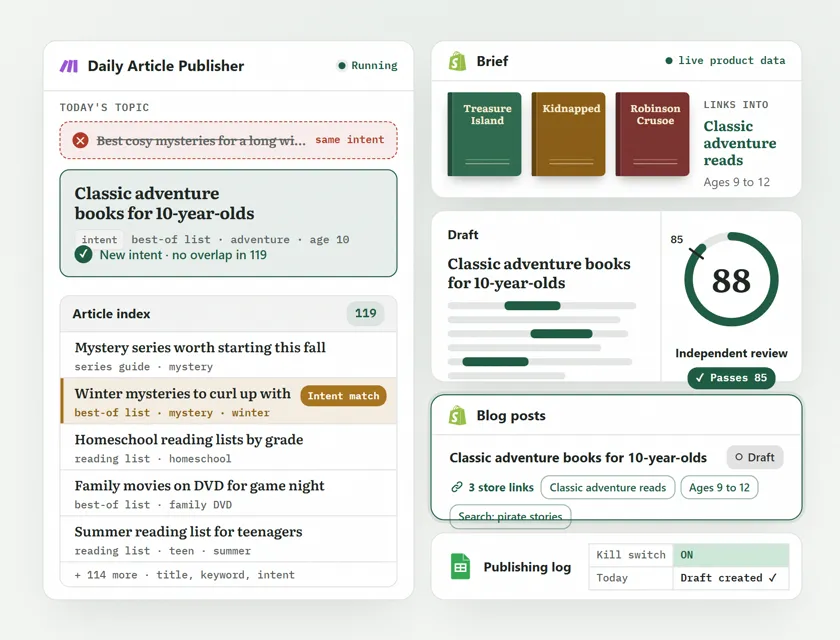
A US used-book retailer with four stores and 14,000 products wanted a new article every day without repeating the 119 it already had. Three connected Make.com scenarios index, plan and publish, checking every new topic against the existing catalogue by intent, not just by title. The system is in production as of August 2026; traffic results will be added once the first quarter is measured.
Built by Prem Patel, Make Level 5 Expert and Zapier Certified Professional; Nex Automations is listed in both official partner directories. This is one of the 1,200+ systems we have shipped, delivered as a paid engagement directly into a live client store.
Award
On 7 October 2026 Make's Community Team announced the first edition of its Scenario of the Month competition, and the daily publisher in this case took 1st place for September 2026. Make shared it as "Daily Article Producer with an AI editor". Their write-up opens on the habit it was built to break: "Most AI content scenarios share one habit: they publish everything they write." On this build: "Its whole job is to say no."
The daily publisher is shared publicly as a free Make blueprint: the setup guide walks through the sheet, the connections and the prompts to change for your own store.
What the announcement picked out:
- Nothing grades its own homework. A planner, a writer and a reviewer are three separate OpenAI steps, each with its own prompt.
- An independent reviewer with a real bar. Eight quality dimensions, a pass mark of 85. A draft that fails once is revised and reviewed again; a draft that fails twice goes to a person with the reviewer's notes, never to the blog.
- Built to run unattended. Every module retries and then alerts the owner, the kill switch is a spreadsheet cell the owner already opens, and every run logs its QA scores and token usage so each article's cost is visible.
Read the announcement in Make's Hall of Fame
The situation
The retailer had published 119 blog articles in a six-week burst. The audit found six pairs that were the same article twice. They wanted daily publishing without that happening again.
Volume without memory is the failure mode of automated content: a system that does not know what the store already published creates duplicates, and duplicates hurt rankings.
Who this is for
- Shopify stores with a big catalogue and a quiet blog. Product pages rarely rank for the searches shoppers actually type, which look like "best cosy mysteries for a long winter", not like your product titles. Articles that answer those searches and link into your collections are how a store earns those rankings, and that is what automated blog posts for Shopify should mean: articles that rank and route readers to inventory, not filler.
- Store owners burned by AI blogging apps. Publish-everything tools grow the blog and the duplicate count, not the traffic.
- Agencies running content for client stores that need daily output with a quality bar they can defend when the client reads the posts.
Two numbers explain the timing (HubSpot State of Marketing 2026, survey of 1,500+ marketers): 56% of marketers say the internet is saturated with AI-generated content, and about 50% of Google searches now show AI Overviews. Both cut the same way. Unedited AI articles are the thing there is too much of, and the pages that search and AI answers reward are the ones with real structure, real facts and real internal links. A quality gate stopped being a nice-to-have and became the difference between publishing content and publishing noise.
The 3 problems
- No memory. Nothing checked a new topic against what was already live.
- Title-level dedupe is not enough. Two articles with different titles can answer the same search intent.
- Content without commerce. Articles that do not link to real inventory do not sell books.
What was built
Three connected Make.com scenarios. This is the real production canvas of the daily publisher, module names visible and client data removed:
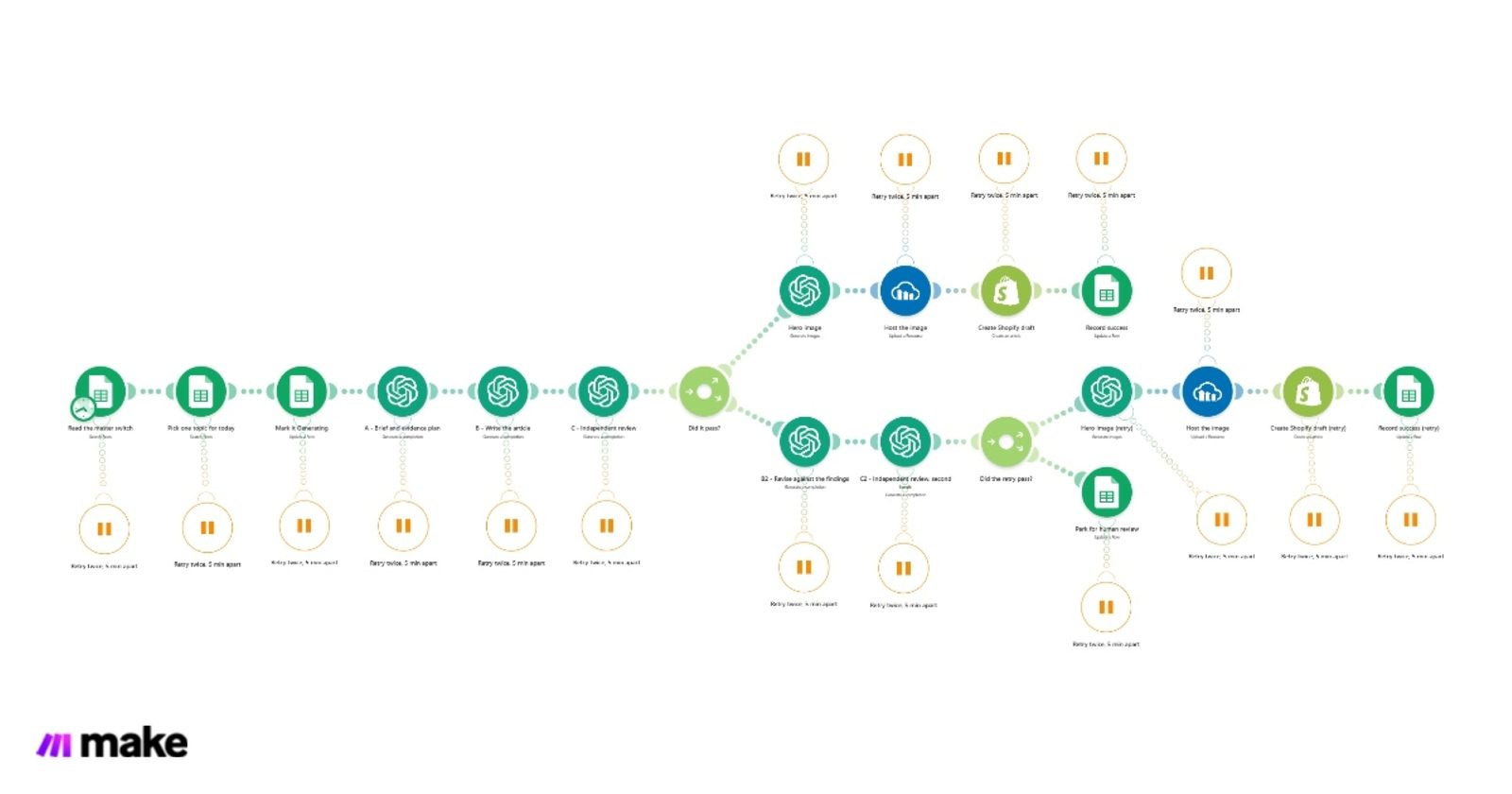
The interesting part is on the right: the review module has its own prompt and grades the writer's work, and the router below it is where a weak draft leaves the publishing path instead of reaching the blog.
How it flows
- Article Index Reader reads all 119 articles into a structured index with title, target keyword and intent label
- Monthly Topic Planner proposes a month of topics, scores each against the index and the store's 45 collections, and rejects overlaps by intent
- Daily Article Publisher writes against a brief with live product data so every article links to real inventory, generates the featured image, runs an independent AI quality gate with its own prompt, creates a Shopify draft via the Admin API, logs to Google Sheets and alerts the owner on failure
Draft-first rollout: the owner approves the first weeks before switching to auto-publish.
Tools used

- Make.com for the three scenarios
- OpenAI for planning, drafting and the independent quality gate
- Shopify Admin API for products, collections and blog drafts
- Google Sheets for the publishing log, the owner's kill switch and alerts
Results
| Measure | Value |
|---|---|
| Scenarios in production | 3 |
| Articles indexed | 119, with 6 duplicate pairs surfaced in the audit |
| Collections checked per topic | 45 |
| Manual equivalent (estimate) | 46 to 60 hours a month |
| Traffic result | To be added after the first measured quarter |
The first production run, measured (September 2026)
Before the daily schedule switched on, the system wrote its first batch of five articles. An independent QA step with a pass mark of 85 decided what happened to each one:
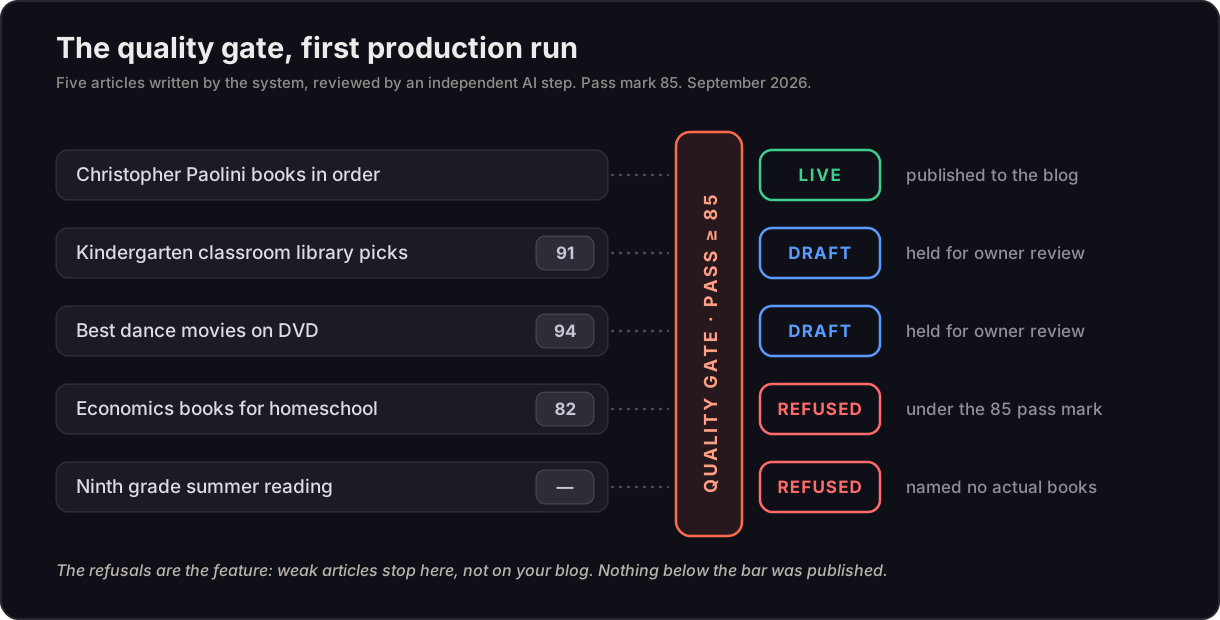
One went live. Two were held as drafts for the owner's review, scored 91 and 94. Two were refused: one scored 82, and one recommended summer reading without naming a single actual book, so the gate blocked it. Nothing below the bar reached the blog.
Measured against the store's 125 existing articles:
| Measure | Existing blog | First-run articles |
|---|---|---|
| Typical length | 526 words | 1,300+ |
| Articles with no shop links | 94% | 0% |
| Carrying the owner's closing line | 28% | 100% |
| Meta description present | patchy | every article |
Every new article carries three tracked links into the store, placed near the beginning, middle and end, pointing at durable collection and search pages rather than products that may sell out.
In plain terms: articles more than doubled in length, every one of them now routes readers toward shop pages, and the two drafts that were not good enough never touched the blog. That last number is the one most automated blogging setups cannot show you, because most of them have no way to say no.
Honest limits
- No traffic claim yet. The system went live in August 2026 and we report measured results, not projected ones.
- The quality gate is a second model with its own prompt, which catches most weak drafts. It is not a substitute for the owner's read during the draft-first weeks, which is why that phase exists.
- Daily publishing is right for a catalogue with thousands of products and dozens of collections. A store with 50 products does not need it, and we would say so.
Related guides
- Shopify Blog Automation as a Service, the packaged version of this build
- Shopify Blog Automation with Make and Airtable
- E-commerce Automation Guide for Agencies and Brands
- AI Article Pipeline with Human Gates
FAQ
Q: Did this automation win an award? A: Yes. The daily publisher, shared as "Daily Article Producer with an AI editor", won 1st place in the first edition of Make's Scenario of the Month (September 2026), announced by Make's Community Team on 7 October 2026. The write-up singled out the independent reviewer that refuses weak drafts.
Q: How do you publish daily SEO content without creating duplicates? A: Index everything already published with intent labels, and check every new topic against that index before writing. This Shopify build rejects overlaps against 119 existing articles and 45 collections.
Q: Can Make.com publish blog posts to Shopify automatically? A: Yes, through the Shopify Admin API. This system drafts, QA-checks, attaches an image and creates the post daily, draft-first until the owner approves auto-publish.
Q: How do you make automated articles link to real products? A: The publisher writes against a brief that includes live product data pulled from the store, so every article references inventory that exists and is in stock at the time of writing.
Q: What stops an AI-written article from being low quality? A: An independent quality gate with its own prompt scores every draft before it becomes a Shopify draft, and the owner reviews drafts during the rollout weeks before auto-publish is switched on.
Q: Do blog articles actually help a Shopify store's products rank? A: Product pages rarely rank for the questions shoppers type into search. Articles that answer those questions and link into collections earn those rankings and then route the reader to inventory. That is why every article this system writes carries three tracked links to durable collection and search pages, and why the first-run measurement tracks linkless articles going from 94% to zero.
Want daily content that knows what you already published?
We build the index first, then the publisher.