Real estate has one automation problem that matters more than all the others combined: response speed. Portal enquiries and website leads arrive at all hours, and the agent who replies first usually gets the viewing. Everything else on this list is real and worth building, but if you only ever automate one thing in a property business, automate the first sixty seconds after a lead lands. This guide covers the eight systems that consistently earn their place in an agency, what each costs, and the parts of the job that should stay human.
I am Prem Patel, founder of Nex Automations, an AI systems studio in Ahmedabad. I hold the Make Level 5 Expert and Zapier Certified Professional credentials, and Nex Automations is listed in both official partner directories, the only India-based company on both as of August 2026. These patterns come from 1,200+ systems built for 210+ businesses, including lead-response and CRM systems for property and services businesses.
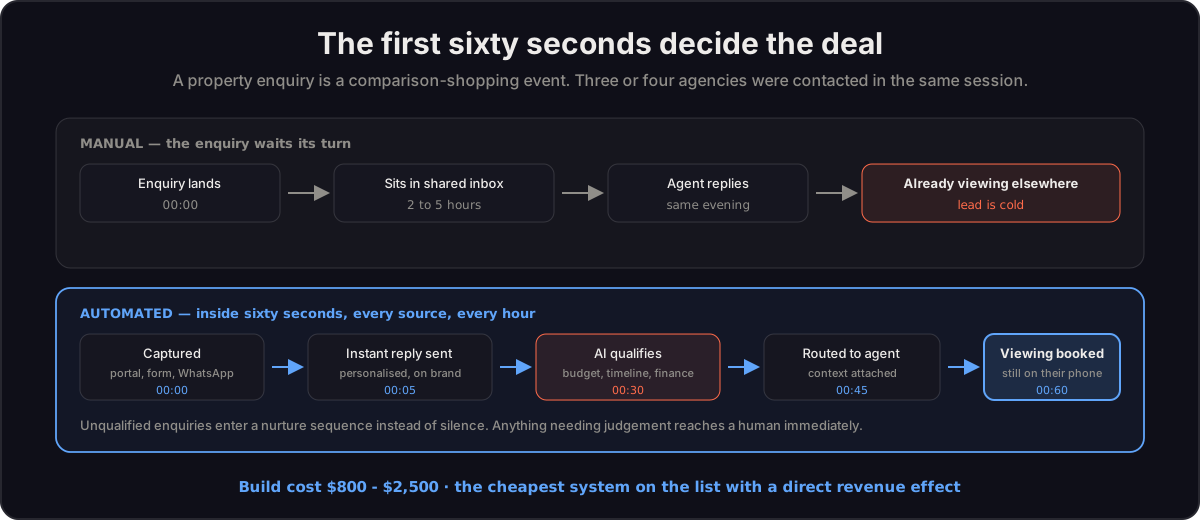
Why speed beats everything else in property
A property enquiry is a comparison-shopping event. The buyer or tenant has usually contacted three or four listings in the same session. The agency that answers while they are still looking at their phone gets the conversation; the one that answers next morning gets a dead lead. Nothing else you automate changes revenue as directly, which is why the first system below is the one to build even if you build nothing else.
The 8 systems, with real build costs
1. Speed-to-lead response and qualification
2. Viewing scheduling and reminders
3. Listing distribution and updates
4. Document and agreement generation
5. Client and document collection for onboarding
6. Past-client and dormant-lead nurture
7. Portal and marketing spend reporting
8. Review and referral requests
What to leave human
| Process | Why |
|---|---|
| Valuation and pricing advice | Judgement plus local knowledge plus liability |
| Negotiation | The whole value of the agent is here |
| Viewings themselves | Relationship building, not a process step |
| Difficult client conversations | An automated message at the wrong moment costs the deal |
A note on tone: property buyers can tell when a message is automated and generic. The systems above work because the automation handles timing, routing and completeness, while the words still sound like the agency. Automating the personality out of a property business is a way to lose it.
Practical sequencing for an agency
Build speed-to-lead first at $800 to $2,500. It is the only system on this list with a direct, measurable revenue effect, and its results argue for the rest of the budget. Then viewing scheduling to convert those faster replies into attended appointments, then nurture to work the database you already own. Those three land around $2,400 to $7,500 in total and cover the full lead lifecycle. Reporting and distribution come after, because they optimise a machine that has to exist first.
Most of this runs on Make or Zapier connected to the CRM the agency already uses, and agencies on GoHighLevel have a shortcut: our GoHighLevel and Make guide covers exactly this stack. For what the whole engagement costs including provider comparison, see the business automation cost guide, and the industry overview has the equivalent for eleven other business types.
FAQ
Q: What can real estate agencies automate? A: Lead response and qualification, viewing scheduling and reminders, listing distribution across portals, document and agreement generation, client document collection, past-client and dormant-lead nurture, marketing spend reporting, and review and referral requests. Valuation, negotiation and viewings stay human.
Q: How much does real estate automation cost? A: Individual systems run $300 to $5,000. The three-system core covering the full lead lifecycle (speed-to-lead, scheduling, nurture) typically totals $2,400 to $7,500 plus $0 to $60 a month in platform fees.
Q: What is the best automation for real estate lead generation? A: Speed-to-lead response. Property enquiries are comparison-shopping events where several agencies are contacted at once, so replying in seconds rather than hours changes which agency gets the viewing. It is also one of the cheapest systems to build at $800 to $2,500.
Q: Can AI qualify real estate leads? A: Yes, reliably, on the structured parts: budget, timeline, location preference, finance status and property type. It should route to a human as soon as the conversation needs judgement, and every automated message should sound like the agency rather than a bot. AI qualifies and routes; agents sell.
Q: What CRM works best for real estate automation? A: The one your agents already use consistently, connected properly, beats a better CRM they ignore. Most property agencies run well on GoHighLevel, HubSpot or a portal-native CRM with Make or Zapier handling the flows between them, portals, calendars and document tools.
Losing enquiries to whoever replies first? Book a free consult and you will get a straight scope and price for a speed-to-lead system, plus an honest read on what else in your pipeline is worth automating.