Most automation advice is generic because most automation vendors are generalists. In practice, every industry has three or four processes that are worth automating first, and a different set that looks automatable but is not. This guide gives each of twelve business types its own answer: the systems that consistently pay for themselves, which one to build first, a real cost band, and the honest note on what to leave alone. If your industry is here and you recognise the first system, you already know what your first project is.
I am Prem Patel, founder of Nex Automations, an AI systems studio in Ahmedabad. I hold the Make Level 5 Expert and Zapier Certified Professional credentials, and Nex Automations is listed in both official partner directories, the only India-based company on both as of August 2026. These patterns come from 1,200+ systems shipped for 210+ businesses across 8+ industries in 12+ countries. Where we have a live case study, I link it.
How to read this
Every block follows the same shape: the processes worth automating, build first, cost band and leave alone. Cost bands are build cost at our rates, and every one of these runs on platforms your business already touches. If you want the full pricing logic including what other provider types charge, see the business automation cost guide.
1. E-commerce and D2C brands
2. Accounting and CA firms
3. Real estate agencies and brokers
4. Logistics and transportation
5. Healthcare clinics and practices
6. Law firms
7. Marketing and creative agencies
8. Manufacturing and distribution
9. Restaurants and hospitality
10. Education, coaching and training businesses
11. Professional services and consultancies
12. Finance, lending and fintech operations
The pattern across all twelve
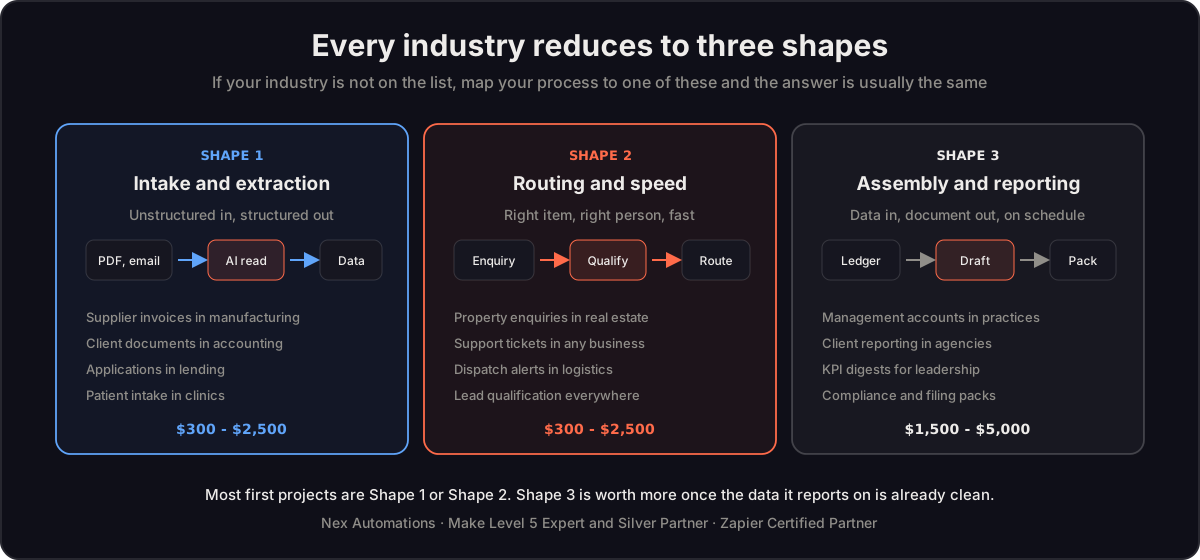
Three shapes repeat regardless of industry:
- Intake and extraction. Something arrives as a document, form, email or message and must become structured data. This is the most common first build and the one AI changed most in the last two years.
- Routing and response speed. Getting the right item to the right person, or to the customer, faster than a human can. Speed is usually worth more than the labour saved.
- Assembly and reporting. Turning existing data into a document, pack or summary on a schedule.
If your industry is not listed, map your process to those three shapes and the answer is usually the same. The 12 AI agent use cases guide covers the function-level version of this with stacks and costs.
What we would tell you not to buy
Three situations where we would rather not take the project, in any industry: the process changes every month, so the automation is obsolete before it is documented; two people in the business do the process differently and nobody has decided which is correct, so we would be encoding confusion; or the volume is genuinely low, where a checklist beats a build. Fixing the process first is cheaper than automating an undecided one, and we say so before quoting.
FAQ
Q: Which industries benefit most from automation? A: Document-heavy and high-volume ones benefit first: accounting, logistics, finance operations, e-commerce and healthcare administration. The common factors are stable rules, repeatable inputs and a clear cost when something is missed. Industries where the core work is judgement or creativity automate the surrounding admin rather than the work itself.
Q: What can be automated in my business? A: Map your processes to three shapes: intake and extraction (documents, forms, messages becoming data), routing and response speed (getting items to the right person or customer fast), and assembly and reporting (turning data into packs and summaries on schedule). Anything matching those with decent volume and stable rules is a candidate.
Q: How much does industry-specific automation cost? A: Most single systems run $300 to $5,000 to build depending on the number of connected systems, with document-heavy pipelines in logistics and finance reaching $2,500 to $8,000. Platform and AI running costs are typically $0 to $150 a month at small and mid-business volume.
Q: What should a business automate first? A: The process with the highest volume, the most stable rules and a painful but not catastrophic failure mode. In practice that is usually intake: email and document handling, or lead response. Start with one system, prove it, then extend. Businesses that try to automate everything at once usually finish nothing.
Q: Do you need industry-specific automation software? A: Rarely. Most industry systems are built from the same general platforms (Make, Zapier, n8n) connected to the tools that industry already uses. Vertical software earns its price when it carries regulatory features or deep domain data models you would otherwise rebuild, which is more common in healthcare, legal and finance than elsewhere.
Not sure which of these describes your business, or your industry is not on the list? Book a free consult and you will get a straight answer on what is worth automating in your operation, what it would cost and what we would tell you to leave manual.