If you are searching for an AI automation agency, you are searching for an outcome, not a company type: someone who will take a manual process off your team's hands and make it run itself, reliably, without you managing the build. Four kinds of provider sell that outcome, and they are genuinely different businesses. Agencies give you a team and a process. Studios give you the senior builder directly. Freelancers give you the lowest price and the highest variance. Enterprise consultancies give you governance and procurement comfort. This guide positions all four honestly, including the cases where the right answer is not us.
I am Prem Patel, founder of Nex Automations, an AI systems studio in Ahmedabad. I hold the Make Level 5 Expert and Zapier Certified Professional credentials, and Nex Automations is listed in both official partner directories, the only India-based company on both as of August 2026. We have shipped 1,200+ automations for 210+ businesses in 12+ countries. So yes, I run one of the four models below and I will tell you plainly which one, and when the other three beat it.
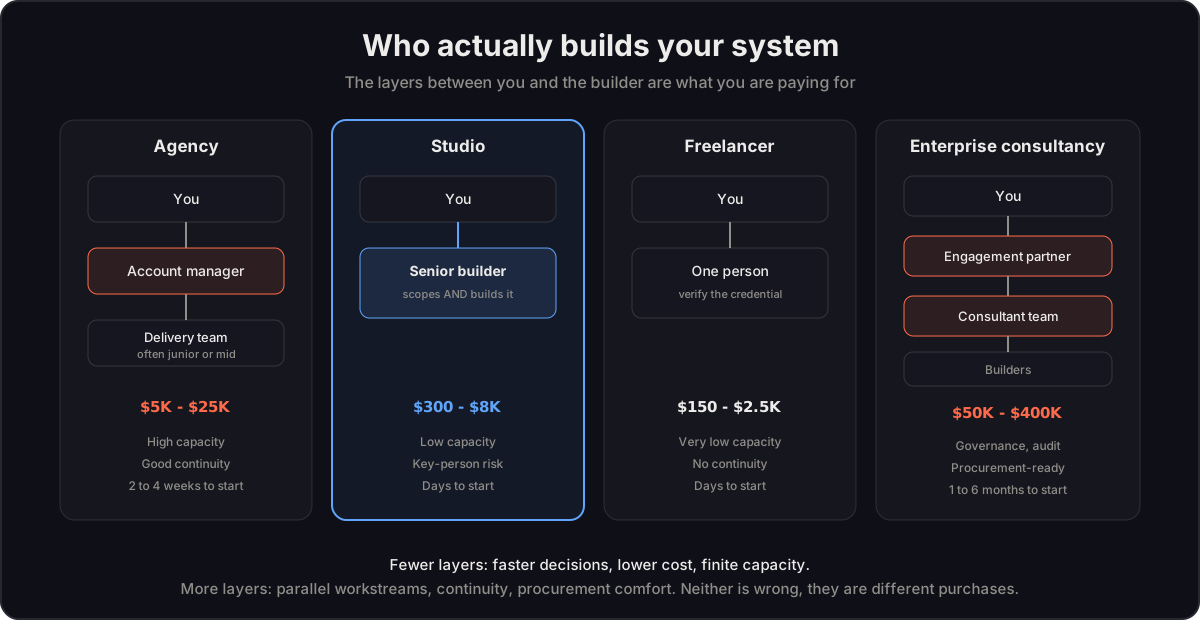
The four models, one fact block each
AI automation agency
AI systems studio (our model)
Freelancer or independent specialist
Enterprise consultancy
The honest comparison table
| Factor | Agency | Studio | Freelancer | Enterprise consultancy |
|---|---|---|---|---|
| Who builds it | Delivery team, often junior | The senior person you spoke to | The person you hired | Consultant team |
| Multi-step build price | $5,000 to $25,000 | $300 to $8,000 | $150 to $2,500 | $50,000 to $400,000 |
| Speed to start | 2 to 4 weeks | Days | Days | 1 to 6 months |
| Parallel capacity | High | Low to medium | Very low | Very high |
| Documentation | Usually | Should be standard, ask | Rarely | Always |
| Continuity if someone leaves | Good | Key-person risk | None | Excellent |
| Verifiable credentials | Sometimes | Check the directories | Check the directories | Not the point |
| Best fit | Several workstreams at once | One or two important systems | Small self-contained jobs | Regulated or legacy-heavy |
What "AI automation agency" usually means in 2026
The label is doing a lot of work and it hides three very different businesses. Knowing which one you are talking to is most of the diligence:
- Genuine implementation firms that build production systems on Make, Zapier, n8n or code, with named clients and verifiable partner status. Whatever they call themselves, these are the ones that ship.
- Reseller or white-label shops that subcontract the build. Not automatically bad, but you should know who is actually writing your scenarios and whether they will be there in six months.
- The AAA course wave: "AI Automation Agency" became a course-selling genre in 2023 to 2025, so a share of the market is people who bought a playbook rather than built systems. Publicly verifiable delivery history is the fastest way to tell them apart.
The tell is not the word on the website. It is whether they can point at an official partner directory listing, a credential level, named case studies with numbers, and reviews you can read.
Six checks that work on any of the four
- Official directory listing. Make and Zapier both publish partner directories with tiers. A listing is granted by the vendor, not self-declared.
- Credential level, linked. "Certified" is a range. Make's expert levels and Zapier's certifications are verifiable.
- Named case studies with numbers. Not "increased efficiency", but a system, a metric and a client type.
- Public reviews you can read on a platform they do not control.
- Documentation and handover in the scope. Ask directly. The answer separates builders from resellers.
- Who exactly builds it. Ask for the name and the credential of the person writing the scenarios, not the agency's collective bio.
We published the full six-check method run on ourselves, every claim linked, precisely so you can run it on us and on everyone quoting against us. If a vendor cannot survive those checks, price is irrelevant.
Studio or agency: the question behind the question
Most businesses searching for an agency actually want three things: it gets built, it keeps working, and they do not have to manage it. All four models can deliver that; they differ in what you pay for and who you talk to.
We operate as an AI systems studio, which is the model many buyers search for as an AI automation agency. The practical difference is the layer: with a studio, the person who understands your process is the person configuring the error handling at 11pm. With an agency, that person exists but you are unlikely to meet them, and you are paying for the coordination that makes their work legible to you. Neither is wrong. If you have six parallel initiatives and a procurement department, the coordination is worth real money. If you have one invoice process bleeding 15 to 20 hours a week, it is overhead.
For what each model charges in detail, we published the full cost breakdown with both pricing axes. For platform choice, the 2026 automation platform landscape covers all nine serious options.
FAQ
Q: What is an AI automation agency? A: A company that designs and builds automated workflows and AI agents for other businesses, typically staffed with an account manager plus a delivery team, and engaged on retainer or per project. In 2026 the label covers genuine implementation firms, white-label resellers and course-taught newcomers, so verification matters more than the label.
Q: What is the difference between an AI automation agency and an AI systems studio? A: Structure and who you talk to. An agency puts an account manager between you and a delivery team, which buys capacity, continuity and process. A studio gives you the senior builder directly, which buys judgement, speed and lower cost, at the price of finite capacity and key-person risk. The technical output can be identical.
Q: How much does an AI automation agency charge? A: For a multi-step build in 2026, Western agencies typically charge $5,000 to $25,000, or $3,000 to $15,000 a month on retainer. Studios charge $300 to $8,000 by scope, certified freelancers $800 to $2,500, and enterprise consultancies $50,000 to $400,000. The middle bands often deliver comparable technical work.
Q: Should I hire an agency or a freelancer for automation? A: Hire a freelancer for a small, self-contained build where you can verify the credential and tolerate rebuilding it later. Hire an agency or a studio when the system is business-critical, needs error handling and documentation, or has to keep working when the builder moves on. The deciding question is what breaks if the automation fails silently for a week.
Q: How do I verify an AI automation agency before hiring? A: Check the official Make and Zapier partner directories for a listing and tier, ask for linked credential proof, request named case studies with real metrics, read reviews on a platform the vendor does not control, confirm documentation and handover are in scope, and ask who specifically will build it.
Q: Are AI automation agencies worth it for small businesses? A: Often not, at agency prices. Small businesses automating one or two processes usually get the same technical result from a certified specialist or a studio at a fraction of the cost. Agency structure earns its price when you are running several workstreams at once or need vendor-grade continuity and procurement paperwork.
Comparing quotes right now? Book a free consult and you will get a straight scope and price, plus an honest read on whether a studio, an agency or a freelancer fits what you are trying to build.