 n8n
n8n Claude
 Notion
 Playwright
 Threads API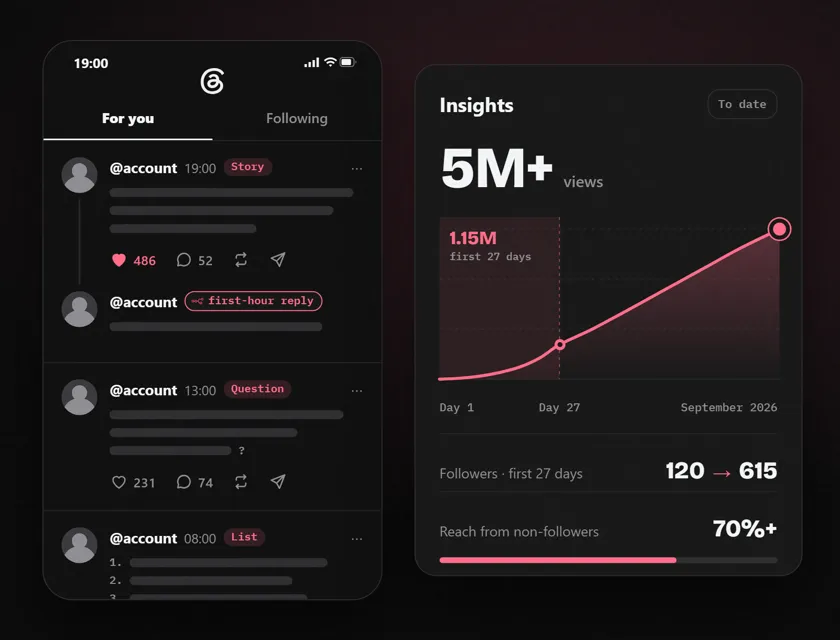
A faceless Threads account went from near zero to 1.15M views in 27 days, 120 followers to 615, and has passed 5M+ views since (September 2026), on a four-tool content engine: Claude writes against a tested format library, Notion holds the calendar and drafts, n8n schedules and publishes through the Threads API and fires the first-hour reply, and a research toolkit finds and ranks the accounts and posts worth learning from. Running cost was close to nothing: Notion free tier, self-hosted n8n, the free Threads API and one Claude subscription.
Built and run by Prem Patel, Make Level 5 Expert and Zapier Certified Professional. It is one of the 1,200+ systems we have shipped and the one we point to when a creator, an agency or a UGC programme asks what "content automation" looks like when it has to survive a real algorithm.
The situation
Threads rewards format and timing, not talent. Most accounts post on instinct, get 300 views on one post and 30,000 on an identical-looking one, and never learn why. We wanted a loop that found what a specific audience responds to and then compounded it without a person babysitting it every day.
The account started with 120 followers and no format library.
The 3 problems
- No data on what works. Advice says "post consistently and add value". It does not say which shape, which hour or why.
- Manual publishing breaks cadence. A person posting by hand misses slots, and missed slots reset the algorithm's trust.
- Discovery by scrolling. Finding the accounts and posts worth studying in a niche took hours and produced no record.
What was built
How it flows
- Discovery. A Node.js and Playwright toolkit searches the niche by keyword, harvests candidate accounts, reads followers, recent views, post count and bio for each, ranks them on an active-plus-influential blend and writes a top-N CSV. A second script logs top posts for a query set with likes, replies, reposts, shares, views, date and URL.
- Format library. Every post is tagged by format. A weekly review promotes the formats that carried reach and kills the dead ones. Twelve posts out of 190 drove roughly 30 percent of all views.
- Drafting. Claude writes against the format library, so output never drifts back to guesswork.
- Calendar. Notion holds the calendar and every draft, the single source of truth.
- Publishing. n8n schedules each post, publishes through the Threads API in the slots that won and fires the first-hour reply automatically.
- Review. Three 10-day blocks, each ending in a hard review: find the format, double down and add structure, then scale and run one new experiment a week beside the winners.
Tools used
- Claude for drafting against the format library
- Notion as calendar and draft store
- n8n (self-hosted) for scheduling, the Threads API and the first-hour reply
- Node.js and Playwright for the discovery and post-research toolkit
- Threads API for publishing
Results
| Measure | Value |
|---|---|
| Views to date, September 2026 | 5M+ |
| Views in the first 27 days | 1.15M |
| Views in the final 7-day window | 490K |
| Followers | 120 to 615 |
| Top single post | 30.2K views |
| Algorithmic reach | 70 percent plus, not from existing followers |
| Posts that carried the account | 12 of 190 drove about 30 percent of views |
| Running cost | Close to nothing: free tiers, self-hosted n8n, one Claude subscription |
Every number comes from one real account across one 27-day sprint, recorded in the full write-up.
Where this goes for UGC and creator programmes
The same engine, pointed at a brand's creators instead of one account, is the automation layer of an influencer or UGC programme: discover creators by keyword and follower threshold, rank them, log what they post and when, track live links and engagement, and report weekly without manual data entry. We have run each of those stages; the creator content automation page sets out the scope and price bands.
Honest limits
- 1.15M views bought around 500 net followers. Reach and following are different games, and the view counter is not the asset. The system is.
- The discovery toolkit reads what a signed-in browser can see. Where an official API exists (Meta Graph, YouTube Data) we use it instead, and for a client programme we would build on the official APIs first.
- The formats that won here are niche specific. The method transfers; the format library has to be rebuilt per audience.
Related guides
- How We Grew a Threads Account to 1.15M Views in 27 Days
- AI Agents for Business: Use Cases
- Zapier vs Make vs n8n in 2026
FAQ
Q: Can this run for a brand's creator or UGC programme rather than one account? A: Yes. The discovery, tracking and reporting stages are the same; the publishing stage becomes reminders and content logging for each creator instead of posting from one account.
Q: Why n8n and not Make.com here? A: Cost and the Threads API. Self-hosted n8n runs the schedule for the price of a small server and the Threads API is free. For a client with existing Make.com or Zapier accounts we build on whichever they already run.
Q: Does the discovery toolkit need an API key? A: No. It drives a signed-in browser over the Chrome DevTools Protocol, because view counts only render for a signed-in session. Where an official API exists we prefer it.
Q: What did it cost to run? A: Close to nothing: Notion on the free tier, self-hosted n8n, the free Threads API and one Claude subscription. The leverage is the design, not the spend.
Running a creator, UGC or content programme by hand?
Discovery, tracking, reminders and reporting are the parts that automate first.