The Situation
Apexal is a crypto investment and research firm based in the UAE with operations in India. Their research team monitored new token listings across CoinMarketCap (CMC) and DexTools to identify early investment opportunities. The process was entirely manual: analysts checked both platforms multiple times per day, copied token details into spreadsheets, looked up social media links and contract addresses, then assessed which tokens warranted deeper analysis.
In crypto, the first 24 to 48 hours after a token lists on a major tracker are critical. By the time a manual process flagged a new listing, the early movers had already acted.
"He suggested syncing social channels we hadn't thought of. The extra value was immediate." Kunal Dave, CEO @ Apexal
The 3 Problems
- Manual monitoring missed new listings. Checking CMC and DexTools 3 to 4 times per day left gaps. Tokens that listed overnight or during off-hours were discovered late.
- Data collection was slow and inconsistent. Each analyst copied data differently. Some captured social links. Some did not. Contract addresses were sometimes wrong because of copy-paste errors.
- No centralized pipeline. Research data lived in individual spreadsheets. There was no shared, structured view of all newly discovered tokens with their metadata, making collaborative analysis impossible.
What Was Built
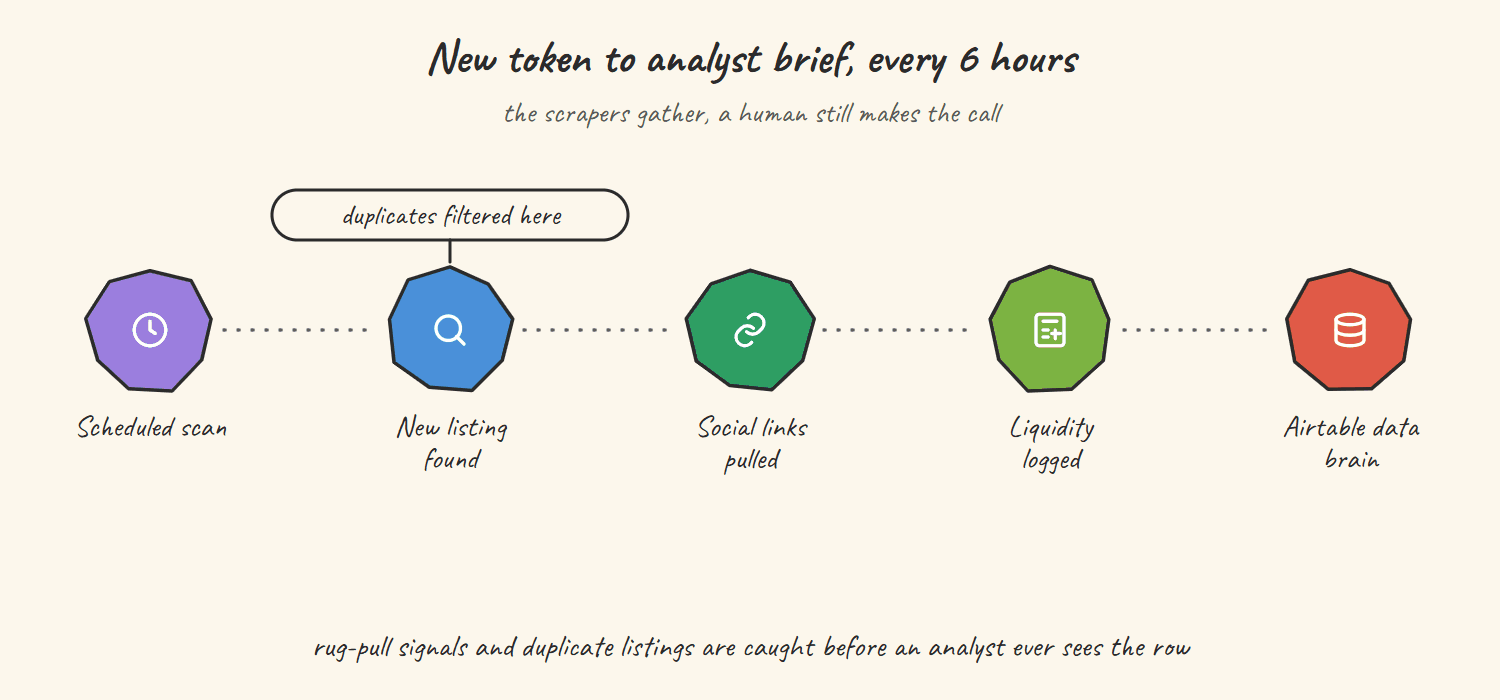
An automated token discovery pipeline that scans CMC and DexTools every 6 hours and delivers structured intelligence to the research team.
How it flows:
- Every 6 hours, Make.com triggers a scan of CoinMarketCap's new listings API and DexTools' pair explorer
- New tokens are identified by comparing against the existing database of known tokens
- For each new token, the system extracts: name, ticker, contract address, chain, market cap, trading volume, liquidity data
- A second pass collects social metadata: Twitter/X handle, Telegram group, Discord server, website URL
- All data is structured and stored in Google Sheets (functioning as the research database)
- A Telegram notification is sent to the research channel with a formatted summary of new discoveries
- Tokens that meet predefined criteria (minimum liquidity, verified contract, active social presence) are flagged for priority review
Tools used:
- Make.com - scheduled triggers, API calls, data transformation, Telegram dispatch
- CoinMarketCap API - new listing detection and market data
- DexTools API - DEX pair discovery and liquidity data
- Google Sheets - structured research database
- Telegram - real-time notification to research team
The Technical Architecture
The interesting engineering problem here is deduplication and enrichment across two data sources that describe the same tokens differently.
Cross-source matching: CMC and DexTools use different identifiers for the same token. CMC uses a slug-based ID. DexTools uses the contract address on a specific chain. The system matches tokens across sources using a combination of contract address (primary) and ticker symbol plus chain (fallback). This prevents duplicate entries while ensuring coverage from both platforms.
Social metadata enrichment: Raw listings on CMC and DexTools often include social links, but they are frequently incomplete or outdated. The system pulls every available link, deduplicates them and flags tokens where key social channels (Twitter, Telegram) are missing. This flag became a signal itself: tokens without social presence are less likely to be legitimate projects.
Threshold-based alerting: Not every new token deserves attention. The system applies configurable filters: minimum liquidity threshold, minimum trading volume in the first 24 hours, verified contract flag and presence of at least 2 social channels. Tokens that pass all thresholds are sent as "Priority" alerts. Others are logged but not alerted on.
Rate limiting: Both CMC and DexTools have API rate limits. The Make.com scenario includes built-in delay modules and request batching to stay within limits. The 6-hour cycle was chosen specifically to balance freshness against API quota consumption.
The Results
| Metric | Before | After | Change |
|---|---|---|---|
| New listing detection | Manual, 3-4x per day | Automated every 6 hours | 24/7 coverage |
| Time from listing to awareness | Hours to days | Under 6 hours | down 80%+ |
| Tokens scanned per cycle | ~50 (manual limit) | 1,000+ | up 20x |
| Data accuracy | Inconsistent (copy-paste) | 98%+ (API-sourced) | Near-perfect |
| Social metadata coverage | Partial | Comprehensive | All available channels captured |
The Insight
The value of this system is not just speed. It is coverage. A human analyst checking CMC manually will look at the first page of new listings and move on. The automated pipeline processes every listing across both platforms, applies the same criteria consistently and never skips a token because it was tired or distracted.
The threshold-based alerting is what made this system actually useful vs just noisy. Without filters, the team would get 50+ alerts per day and ignore all of them. With filters calibrated to their investment criteria, they get 3 to 5 priority alerts per day and each one is worth reviewing.
FAQ
Q: Can Make.com connect to the CoinMarketCap API? A: Yes. Make.com's HTTP module makes authenticated API calls to CMC's endpoint. The system uses CMC's "latest listings" and "cryptocurrency map" endpoints to detect new tokens and pull market data.
Q: How often does the crypto intelligence pipeline update? A: Every 6 hours in this deployment. The cycle time is configurable. Shorter cycles (e.g. every hour) are possible but consume more API quota and increase the risk of hitting rate limits on CMC and DexTools.
Q: Can this system track tokens across multiple blockchains? A: Yes. The pipeline processes tokens on any chain that CMC and DexTools track, including Ethereum, BSC, Solana, Arbitrum and Polygon. Cross-chain matching uses contract addresses as the primary identifier.
Q: How do you filter signal from noise in automated crypto alerts? A: Configurable threshold filters: minimum liquidity, minimum 24-hour trading volume, verified contract flag and presence of at least 2 social channels. Only tokens passing all criteria trigger priority alerts. The rest are logged for reference.
Building a research pipeline or market intelligence system? Book a free consult and I will scope exactly what your data workflow needs.